Strategy
CPA×50 Rule: How Final Expense Agents Use CBO vs ABO to Scale
By Nick Georgalos · 14 min read · Updated 2026-08-28
CPA×50 Rule: How Final Expense Agents Use CBO vs ABO to Scale ! Agent adjusting ad budget on laptop keyboard Use ABO when you need to guarantee equal spend across a test, or when your daily budget is too small to feed multiple ad sets.

Use ABO when you need to guarantee equal spend across a test, or when your daily budget is too small to feed multiple ad sets. Use CBO, which Meta now often calls Advantage campaign budget, once you have a proven ad set and want the delivery system to funnel more money toward it automatically. The standard playbook is simple: test in ABO, then graduate winners into CBO. Platform quirks on TikTok change some of the mechanics, but not the underlying logic.
TL;DR:
- ABO is best for small budgets, structured testing, and when equal exposure for each ad set is necessary to gather unbiased data.
- CBO requires sufficient total budget and conversion volume to effectively leverage algorithmic reallocation and scale proven winners.
- Monitoring early campaign performance is critical with CBO, especially in the first 72 hours, to prevent budget starvation or over-consolidation.
- Using 50 conversions per week per ad set (based on CPA) is a key benchmark to ensure efficient optimization and avoid extended learning phases.
- Managing the transition from ABO testing to CBO scaling benefits from staged moves, limiting ad set counts to 3-5 for better signal and control.
Table of Contents
- CBO vs ABO: What Each One Actually Controls
- What CBO (Advantage Campaign Budget) Does Differently
- CBO vs ABO Comparison: A Quick Reference
- When to Use ABO: A Practical Checklist
- When to Use CBO: A Practical Checklist
- The Test-to-Scale Workflow: How to Graduate Winners
- The CPA × 50 Rule: How Much Budget You Actually Need
- Common Mistakes and How to Fix Them
- Meta vs TikTok: Where the Advice Changes
- A Publisher’s Take: Why Some Agents Skip This Decision Entirely
- Get Your Test-to-Scale Campaign Built the Right Way
- Sources
CBO vs ABO: What Each One Actually Controls
The whole debate boils down to one question: where the budget lives, and who decides how it moves.
ABO (ad set budget optimization) locks the budget at the ad set level. You tell Meta “this ad set gets $30 a day,” and that’s exactly what it spends, regardless of whether a sibling ad set in the same campaign is crushing it or flopping. That rigidity is the entire point. ABO guarantees equal exposure per cell, which is exactly what you want when you’re trying to find out whether Audience A actually outperforms Audience B, or whether a new final expense hook beats your control creative.
Because each ad set reports its own spend independently, ABO also gives you cleaner data for side-by-side comparisons. There’s no algorithm quietly starving one variant to feed another before you’ve collected enough data to draw a real conclusion.
Here’s when ABO earns its keep:
- You’re running a structured creative or audience test and need every cell funded on equal terms.
- Your total daily budget is small enough that a shared pool would collapse into just one or two ad sets getting any spend at all.
- You have a strategic ad set (a retargeting segment, a compliance-required creative variant) that must run regardless of its short-term efficiency numbers.
- You’re rebuilding an account from scratch and want full visibility into which specific combination is working before you commit real money.
Operationally, set every test cell to the same budget and let it run long enough to reach a comparable number of results per cell. If one ad set is capped at $15 a day and another at $40, you’re not testing creative, you’re testing budget size. Pacing under ABO tends to be smoother too, since Meta isn’t reshuffling spend mid-day the way it does under CBO.
What CBO (Advantage Campaign Budget) Does Differently
CBO flips the control structure. Instead of funding each ad set individually, you set one number at the campaign level, and Meta’s delivery system reallocates spend across every ad set inside that campaign in real time. Meta has largely folded this into what it now calls Advantage campaign budget, but the mechanics underneath are unchanged: one pool, algorithmic allocation.
This is where CBO earns its reputation as the scaling tool. Once you know which ad set converts, letting the algorithm chase that signal usually gets you conversions faster than manually nudging budgets around every morning. You also spend less time babysitting the account, since Meta is doing the reallocation work you’d otherwise do by hand.
The trade-offs are real, though:
- New or unproven ad sets can get starved of spend before they ever get a fair shot, since the algorithm favors whatever is already converting.
- CBO needs enough total budget and enough conversion volume to have real signal to work with. Feed it too little and it just guesses.
- You still need to check delivery daily, especially in the first week, because a single dominant ad set can quietly eat 90% of the budget while a genuinely promising variant gets nothing.
CBO isn’t “set it and forget it.” It’s “set it and watch it closely for the first few days,” then check in less often once the pattern stabilizes.
CBO vs ABO Comparison: A Quick Reference
| Factor | ABO | CBO (Advantage campaign budget) |
|---|---|---|
| Best for | Structured testing, low budgets, forced spend | Scaling proven winners, efficiency at volume |
| Who controls allocation | You, manually per ad set | Meta’s delivery algorithm, campaign-wide |
| Test quality | High, equal exposure guaranteed | Low, winners get favored early |
| Scaling efficiency | Lower, requires manual reallocation | Higher, automatic reallocation to top performers |
| Reporting clarity | Clean, per-ad-set data | Muddier, spend shifts mid-flight |
| Management overhead | Higher, daily manual checks | Lower once stable, but close early monitoring |
| Budget suitability | Works at almost any spend level | Needs enough volume to generate real signal |
The decision usually comes down to one question before you even open Ads Manager: is this campaign’s job to find a winner, or to spend more behind one you already have? Test campaigns belong in ABO. Scaling campaigns belong in CBO.
When to Use ABO: A Practical Checklist
Run through these before you build the campaign:
- Is your daily budget under roughly $100 to $200 total? Below that range, a shared CBO pool tends to collapse spend into one ad set almost immediately, defeating the purpose of testing anything.
- Do you need every variant to get a fair, equal shot? If you’re testing three audiences or three creative angles, ABO is the only mode that funds all three the same way from day one.
- Is there a strategic ad set you must keep alive regardless of performance? A compliance-mandated disclaimer creative, or a retargeting segment with a small but valuable audience, often needs protection from an algorithm that would otherwise cut it off.
- Are you restarting an account with no historical data? Starting cold in ABO gives you a clean read on what actually works before you hand control to an automated system.
Size each test cell so it can realistically reach enough conversions to mean something. An ad set with too small a daily budget relative to a high cost per lead will not generate usable data within a reasonable window. If the math doesn’t work, either raise the budget for that specific test or cut the number of cells you’re running simultaneously.
Pro Tip: Check ABO test campaigns every 48 to 72 hours, not every few hours. Checking too often tempts you to make manual budget moves before the data has had time to stabilize, which quietly turns your clean test into a guess.
When to Use CBO: A Practical Checklist
CBO makes sense once you can check most of these boxes:
- You already have at least one ad set with a proven, repeatable conversion pattern from an ABO test.
- You’re consolidating down to somewhere around 3 to 5 ad sets rather than spreading budget across a dozen variants.
- Your total budget comfortably clears the conversion threshold for the ad sets involved (more on the exact math below).
- You’d rather let the algorithm handle daily reallocation than log in every morning to shift dollars between ad sets by hand.
Structuring a CBO campaign well means keeping the ad set count tight. Meta’s system needs room to concentrate signal, and excessive ad-set fragmentation is one of the most common structural mistakes advertisers make when they move from testing to scaling. Group your best-performing audiences and creatives together, then let the campaign run without constant manual interference.
Pro Tip: When you first launch a CBO campaign built from ABO winners, watch the delivery breakdown for the first 72 hours specifically. If one ad set immediately grabs a large majority of spend, pause and check whether that’s a genuinely stronger performer or just an early-signal fluke, before it starves the rest of the campaign.
The Test-to-Scale Workflow: How to Graduate Winners
The operating rhythm that most efficient advertisers settle into isn’t ABO or CBO exclusively. Practitioners commonly run both systems concurrently: a smaller ABO budget dedicated to ongoing testing, feeding proven winners into a larger CBO campaign built for scale.
- Build ABO test cells with equal budgets. Isolate one variable per test, whether that’s audience, creative, or offer angle.
- Let each cell collect enough conversions to be meaningful. Don’t call a winner off five or ten leads; give it time to reach a sample size you’d trust with real money.
- Evaluate against a metric you set before the test started, not one you pick after seeing which ad set happens to be winning.
- Duplicate the winning ad set into a CBO campaign using its post ID, rather than rebuilding it from scratch. Duplicating via post ID preserves attribution and avoids resetting the learning phase.
Watch for audience overlap between your test and scale campaigns; if the same people see both, you’re muddying the very signal you’re trying to read.
The CPA × 50 Rule: How Much Budget You Actually Need
Meta’s delivery algorithm needs enough conversion events to optimize well, and the widely cited benchmark is roughly 50 optimization events per ad set every seven days. Below that, your ad set is likely stuck in a shaky, extended learning phase instead of running efficiently.
The formula: daily minimum budget per ad set = (CPA × 50) ÷ 7
That single calculation tells you almost everything you need to know before you build a single ad set.
A final expense agent with a $50 cost per lead needs roughly $357 a day per ad set to hit that 50-event benchmark, which is exactly why cramming five ad sets into a $200 daily budget almost always backfires. Run the CPL calculator against your own numbers before deciding how many test cells you can actually afford to fund.

This threshold isn’t a hard rule; a few conversions below 50 won’t sink a campaign. But CPA, ad set count, and campaign objective all move the number, and ignoring the math is the single fastest way to burn a testing budget without learning anything.
Common Mistakes and How to Fix Them
Most CBO and ABO problems trace back to one of three symptoms.
Starved ad sets. One ad set eats nearly all the budget within hours of launch. Fix it by checking delivery in the first 24 hours and either pausing the dominant ad set briefly to let others catch up, or moving underperformers back into ABO for a fair test.

Premature championing. You call a winner off a handful of early conversions, scale it into CBO, and it fizzles a week later. This happens because Meta’s learning phase concentrates conversions in early winners quickly, which can look like a clear signal before it actually is one. Wait for a real sample before you graduate anything.
Fragmentation. Too many ad sets, whether in ABO or CBO, spreads thin data across cells that never individually reach significance. Consolidate to 3 to 5 ad sets per campaign wherever the audience size allows it.
- Check delivery breakdown daily for the first 72 hours of any new campaign.
- Compare actual spend distribution against what you expected before launch.
- Hold out a small validation audience when possible to confirm a winner before fully scaling it.
Pro Tip: Stage your rollouts. Move one winning ad set into CBO at a time instead of graduating three at once, so a bad call is easy to isolate and reverse.
Meta vs TikTok: Where the Advice Changes
The core logic behind CBO and ABO holds on both platforms, but the details don’t transfer perfectly.
On Meta, the Advantage campaign budget rename covers the same CBO mechanic described throughout this article, and Advantage+ shopping campaigns sometimes remove the ABO/CBO choice entirely because they’re built to run on account-level automation by default. If you’re running Advantage+, the decision this article covers is often already made for you.
TikTok’s campaign-level budget allocation behaves similarly in principle, but the platform’s signal and creative dynamics differ enough that you should validate the 50-event heuristic with your own tests rather than assume it transfers one-to-one.
- Treat Meta and TikTok as separate learning environments, especially for new accounts.
- Expect TikTok creative to need refreshing faster, which affects how long any given test cell stays valid.
- Assume budget-level parity between platforms only after you’ve run at least one direct comparison inside your own account.
A Publisher’s Take: Why Some Agents Skip This Decision Entirely
Running the CBO vs ABO decision well takes discipline: equal test budgets, patience past the point where early data looks tempting, and the willingness to check delivery daily during the first week of any scale campaign. Most licensed agents don’t have three spare hours a day for that. They have appointments to run and applications to close.
That’s the real argument for a managed approach. Fexads builds custom campaigns for final expense, IUL, and mortgage protection agents with the test-to-scale rhythm baked in from day one, and every lead generated lands directly in the agent’s own ad account. Nothing gets rented out to competing agents.
The agents who benefit most from outsourcing this work aren’t the ones who can’t understand ABO or CBO. They’re the ones who understand it well enough to know that running it properly, every single day, isn’t where their time is best spent. Compliance requirements around final expense creative add another layer most agents don’t want to manage solo, on top of an already time-consuming testing cycle.
Where DIY still makes sense: agents with real ad management experience and enough spare time to check campaigns daily. Where managed service wins: agents who’d rather spend that time closing the leads the campaign generates.
— Nick
Get Your Test-to-Scale Campaign Built the Right Way
Reading about CPA thresholds and budget math is one thing. Building a campaign that actually applies it, correctly, every single day, is another. Fexads runs that exact test-to-scale workflow for final expense, IUL, and mortgage protection agents, structuring ABO tests and graduating proven winners into scaled campaigns without you having to log in and check delivery every morning.
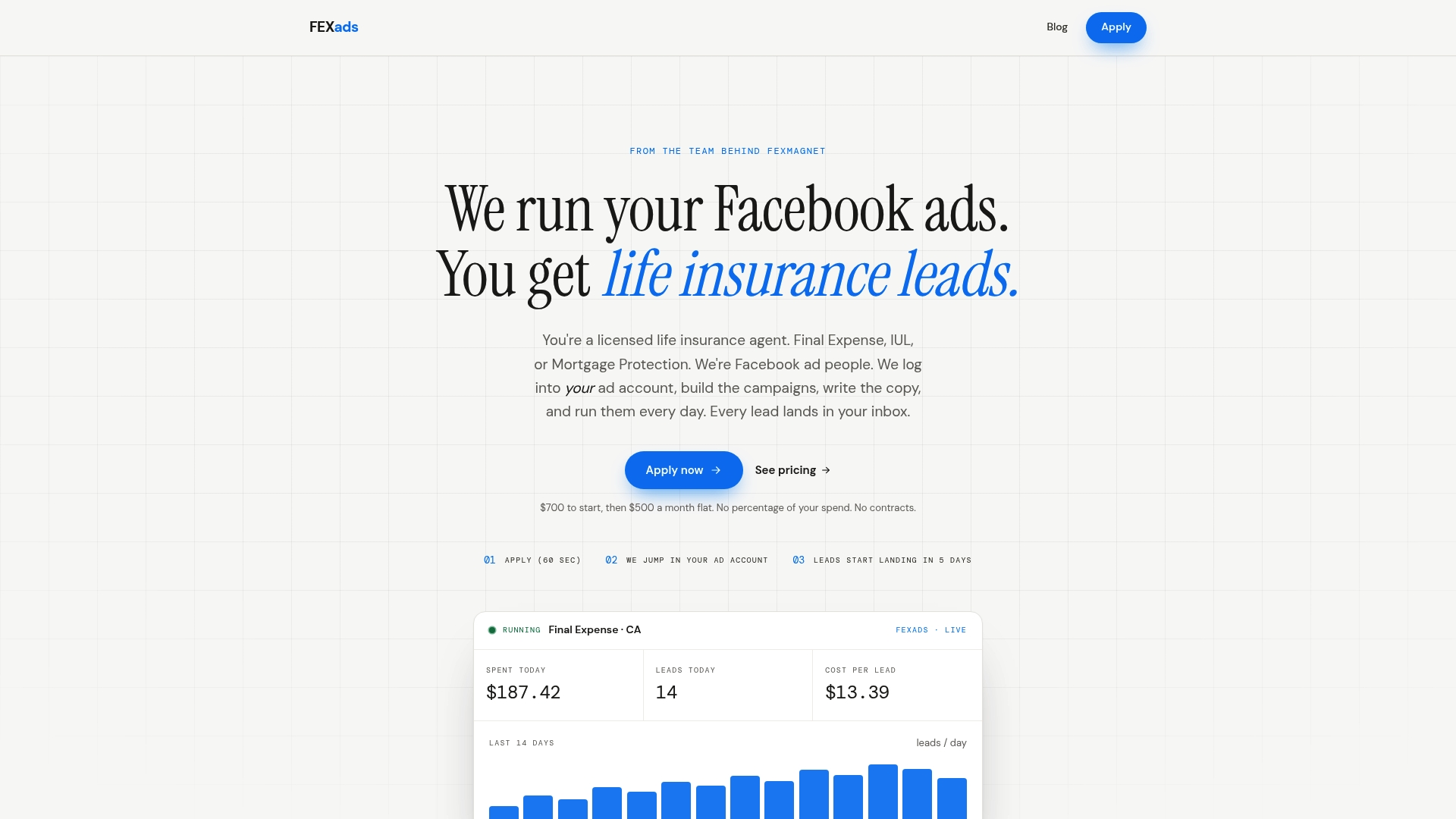
Every lead lands directly in your own ad account, not a shared pool split with other agents buying the same rented list. That means the audience data your campaign builds over time stays yours, and it keeps getting sharper the longer we run it. If you want to see what a custom campaign looks like for your state and your offer, check FE Facebook ads by state and get a setup started.
Sources
- Meta Campaign Budget Optimization (CBO) / Advantage Campaign Budget — Smartly Support
- ABO vs CBO: How to Structure Facebook Ads Campaigns at Every Spend Level — AdAdvisor
Recommended
Want us to run your FE ads?
$200 to launch, custom website included. $500 a month flat, starting at your first sale.
Apply now