Strategy
Make Cost Per Lead Count for Insurance Agents: 2026 Benchmarks & CPA
By Nick Georgalos · 20 min read · Updated 2026-09-26
Make Cost Per Lead Count for Insurance Agents: 2026 Benchmarks & CPA ! Calculating insurance campaign acquisition costs In 2026, insurance cost per lead typically falls into three headline bands: personal auto and home run $20 to $60, life, health, and Medicare often land above $50, and commercial or complex lines climb higher still.

In 2026, insurance cost per lead typically falls into three headline bands: personal auto and home run $20 to $60, life, health, and Medicare often land above $50, and commercial or complex lines climb higher still. None of that matters much on its own. The number that actually predicts profit is what happens after the click, once you convert raw CPL into cost per conversation, cost per quote, and cost per bound policy.
TL;DR:
- Auto and home leads generally cost $20 to $45, but shared auto leads can double your effective contact cost due to multiple agents competing for the same prospect.
- Life, health, and Medicare CPLs range from $50 to over $200, with higher prices linked to intent level and buyer urgency, especially during enrollment periods.
- The most cost-effective leads in terms of CPA are often live transfers, which, despite higher upfront CPL, produce lower costs per bound policy because of near-perfect contact and close rates.
- Optimizing speed-to-lead within five minutes significantly boosts contact rates and overall campaign profitability more than creative or targeting changes.
- Buying directly inside your own ad account improves speed-to-lead and audience learning, resulting in lower cost per bound policy despite similar or slightly higher initial CPLs.
Table of Contents
- Cost Per Lead Benchmarks Insurance Marketers Should Actually Use
- Insurance Lead Cost Analysis by Product Line and Channel
- Why Cost Per Lead Swings So Much Between Campaigns
- Turning Cost Per Lead Into Cost Per Acquisition Insurance Agents Can Bank On
- How to Cut Insurance Lead Acquisition Cost Without Wrecking Quality
- What Regulators Are Watching in Insurance Lead Generation
- What Owning Your Ad Account Changes About Lead Cost
- What Insurance Marketers Get Wrong About Cost Per Lead Benchmarks
- A Different Way to Buy Leads: Own the Account, Own the Data
- Sources
- FAQ
Cost Per Lead Benchmarks Insurance Marketers Should Actually Use
Here’s the quick-reference table most agencies won’t show you, because it forces an uncomfortable conversation about what “cheap” leads really cost once you factor in contact rates and close rates.
| Line / Channel | Typical CPL Range | Notes |
|---|---|---|
| Auto (blended) | $20–$35 | Paid search runs higher; organic and referral pull the average down |
| Home | $25–$45 | Slightly above auto due to longer sales cycle |
| Life / Health / Medicare | $50–$200+ | Wide range driven by intent level and lead type |
| Commercial | $75–$300+ | Highly bespoke, underwriting complexity drives cost |
| Shared P&C lead | ~$15 | Sold to multiple agents simultaneously |
| Exclusive / territory lead | $30–$60 | Single-buyer rights, higher contact rates |
| Live transfer | $30–$60+ | Real-time handoff, best contact rates of any type |
These ranges come from aggregated 2026 carrier and vendor data, and they hold up across most regional markets, with paid search sitting at the expensive end almost everywhere.
Six things worth acting on immediately:
- Auto and home leads cluster tightly because both are high-volume, price-shopped products with thin margins per policy, so vendors compete hard on volume.
- Life, health, and Medicare CPLs vary more because buyer intent varies more. A cold Facebook lead and a Medicare Advantage search lead are not the same asset even at the same price.
- Shared leads look cheap on the invoice and expensive on the P&L once you account for three or four agents chasing the same prospect.
- Live transfers cost more per lead but often produce the lowest cost per bound policy in the whole channel mix, because someone is already on the phone.
- Commercial lines rarely follow any clean benchmark. Underwriting complexity and account size swing CPL by hundreds of dollars from one prospect to the next.
- A “good” CPL for your business depends entirely on your close rate and average commission, not on beating some industry average.
Quick stat check: insurance keywords remain among the priciest in digital advertising. Sample 2026 benchmarks put Google Ads CPC in the $18.50 to $22.00 range with PPC conversion rates near 4.8%. Run the math and a single paid search lead can cost $18.50 divided by 0.048, which lands close to $385 before you’ve even qualified the prospect. That’s why so many agents blend search with cheaper organic and referral traffic rather than running search alone.
Insurance Lead Cost Analysis by Product Line and Channel
Every insurance vertical has its own cost structure, and pretending otherwise is how marketing budgets get wasted. A CPL that’s a bargain for auto would be a red flag for Medicare Advantage, and vice versa.
Auto insurance
Auto sits at the bottom of the CPL scale because it’s a commodity product with fast decision cycles. Blended CPL across channels typically runs $20 to $35. Paid search pushes toward the top of that range, often $35 to $45 per click-to-lead when keyword competition spikes around renewal season. Organic search and referral traffic bring the blended number down, frequently landing in the teens once you strip out paid spend.
The trap here is volume addiction. Auto lead vendors sell high quantities at low unit cost, but shared auto leads get resold to three, four, sometimes five agents. Contact rates suffer, and your effective cost per contacted lead can quietly double.
Home insurance
Home insurance runs slightly above auto, typically in the high twenties to mid-forties range blended. The ticket size is bigger, the underwriting takes longer, and homeowners shop less impulsively than auto buyers switching for a $10 monthly discount. That longer consideration window means a home lead generated today might not convert for weeks, which changes how you should measure channel performance. Judging home campaigns on 7-day conversion windows undercounts real performance.
Life, health, and Medicare
This is where CPL benchmarks get genuinely wide, commonly $50 to $200 or more depending on intent and lead source. A few structural reasons:
- Final expense and IUL leads generated through cold social prospecting sit lower, often around forty dollars because the audience hasn’t actively raised its hand yet.
- Medicare Advantage and Medicare Supplement leads during Annual Enrollment Period routinely exceed $100, sometimes reaching $150+, because every carrier and broker is bidding for the same finite pool of eligible seniors.
- Live transfer leads for life and Medicare products commonly price in the thirty to sixty dollar range per the vendor side, but that figure only tells half the story since transfer quality varies enormously by how the call center screens callers before connecting them.
Aggregated 2026 industry analysis confirms life, health, and Medicare products commonly clear $50 to $60 in blended CPL, with intent-driven channels pushing well past that.
Commercial insurance
Commercial lines rarely fit a tidy range because the product itself is bespoke. A CPL of $75 for a small business general liability quote and $300 for a mid-market workers’ comp account are both normal, just for entirely different buyers. Commercial leads carry the highest CPLs in the industry, and that’s rational: the average commission dwarfs personal lines, so agencies can afford to spend more acquiring each prospect.
Channel-by-channel notes
Paid search delivers high intent but the highest per-click costs in the industry, with insurance CPCs regularly running $18.50 to $22.00 as noted above.
Meta and Facebook campaigns tend to produce lower per-lead costs than search, especially for final expense and mortgage protection, because you’re targeting demographics and interests rather than bidding against every competitor on the same keyword.
Display advertising generates the cheapest CPLs on paper but usually the worst downstream conversion, since click intent is minimal.
Organic search and content cost time rather than ad spend, and once a page ranks, the effective long-term cost per lead often beats every paid channel, particularly when measured against lead-to-quote and quote-to-bind rates rather than raw volume.
Referrals remain the cheapest acquisition channel that actually exists at scale, though volume is capped by how many happy clients you have.
Live transfers and exclusive leads cost more per unit but consistently show better contact and close rates than shared leads, which is the whole reason agents pay the premium in the first place.
Why Cost Per Lead Swings So Much Between Campaigns
Four forces do most of the work.
Competition and auction pressure. Google and Meta both run auction-based pricing, so your CPL rises the moment more advertisers chase the same audience. This is why CPLs spike every year during Medicare’s Annual Enrollment Period and around auto insurance renewal season, when everyone bids at once.
Buyer intent and funnel stage. A prospect who typed “final expense insurance quote near me” into Google is a different animal than someone who paused on a Facebook video for six seconds. Both can become leads. Only one of them is close to buying. Top-of-funnel social leads cost less per unit but need more nurturing before they convert, which shifts cost from your ad budget into your follow-up process.
Underwriting and sales cycle complexity. Products with simple, fast underwriting (final expense, basic auto) tend to show tighter, more predictable CPL bands. Products requiring health questions, financial underwriting, or multi-step applications (IUL, commercial) see wider swings, because the sales cycle stretches and attribution gets murkier the longer it takes to close.
Lead type distribution. This might be the single biggest lever most agencies overlook.
- Auction pressure from competitors bidding the same keywords or audiences
- Buyer intent level, from passive social scrollers to active search shoppers
- Underwriting complexity and how long the sales cycle stretches
- The ratio of shared, exclusive, and live-transfer leads in your mix
- Seasonality, particularly AEP for Medicare and renewal cycles for P&C
Pro Tip: Before comparing your CPL to any industry benchmark, break your own number down by lead type first. A blended CPL that mixes shared and exclusive leads tells you almost nothing useful about whether your spend is working.
Turning Cost Per Lead Into Cost Per Acquisition Insurance Agents Can Bank On
CPL is a vanity metric if you stop there. The number that determines whether a campaign is profitable is cost per acquisition, or cost per bound policy, and the formula connecting the two is straightforward:
CPA = CPL ÷ (contact rate × close rate) + producer labor cost per bound policy
The contact rate and close rate variables do almost all the heavy lifting, and they shift dramatically by lead type.
- Shared leads typically see contact rates of 30% to 50% (agents competing for the same prospect means someone else often reaches them first) and close rates of 5% to 15%.
- Exclusive leads typically see contact rates of 50% to 70% and close rates of 12% to 25%, since you’re the only agent working that prospect.
- Live transfers typically see contact rates above 90%, since the prospect is on the phone at the moment of handoff, with close rates of 20% to 35% depending on script quality and product fit.
Here’s what that looks like in dollars, using the real math vendors rarely walk through:
| Lead Type | CPL | Contact Rate | Close Rate | Effective CPA |
|---|---|---|---|---|
| Shared lead | $15 | 40% | 8% | $469 |
| Exclusive lead | $45 | 60% | 18% | $417 |
| Live transfer | $50 | 92% | 28% | $194 |
That $15 shared lead, the cheapest option on the table, produces the highest CPA once contact and close rates get applied. The $50 live transfer, more than three times the sticker price, ends up cheaper per bound policy by a wide margin. This is the single most counterintuitive fact in insurance lead buying, and it’s why judging vendors on CPL alone routinely leads agencies to the wrong decision.
A useful planning anchor: blended CPA targets for many insurance marketing teams run $98 to $115 depending on channel mix. Work backward from that target using your own contact and close rates to set a maximum acceptable CPL for each lead type before you buy a single lead. The CPL calculator makes this backward math faster if you’d rather not run it by hand every time your product mix changes. For a deeper breakdown of how lead cost varies by product line and what actually closes, the cost analysis by vertical is worth a look before you set next quarter’s budget.

How to Cut Insurance Lead Acquisition Cost Without Wrecking Quality
Lowering CPL is easy. Lowering it without tanking your close rate is the actual skill, and most agents get this backward by optimizing the wrong metric.
On paid search, qualify harder before you spend. Single Keyword Ad Groups (SKAGs) built around high-intent terms like “final expense insurance quote” outperform broad match campaigns because ad relevance and landing page match both improve, which lifts Quality Score and pulls CPC down. Negative keyword lists matter just as much. Every click from someone searching “insurance license requirements” or “insurance jobs” is wasted spend that inflates your CPL for nothing.
On Meta and Facebook, audience layering beats broad targeting almost every time. Stack interest signals, life-stage data, and lookalike audiences built from your actual converted customers rather than your entire lead list. Creative fatigue is real on this platform specifically. A high-performing final expense ad can decay within two to three weeks as the same audience sees it repeatedly, so refresh creative on a schedule rather than waiting for performance to visibly crater. Retargeting sequences that follow up with video testimonials or FAQ content typically convert warm clickers at a fraction of cold prospecting cost. Meta’s Advantage+ campaign tools can help here too, though they work best once you’ve fed the algorithm enough conversion data to optimize against.
On landing pages, shorter forms with progressive profiling beat long intake forms almost universally. Ask for name, phone, and zip code first. Collect health questions or coverage details after the initial contact, once trust is established. Every additional required field before that first micro-commitment measurably drops completion rates, and a lead form ad structure that front-loads the easy questions consistently outperforms a full application upfront.
On measurement, server-side tracking through Meta’s Conversions API (CAPI) has become close to mandatory since iOS privacy changes gutted browser-based pixel accuracy. First-party data, meaning the lead and conversion records you actually own, is the only reliable foundation left for audience optimization. Speed-to-lead matters enormously here too: contacting a lead within five minutes versus thirty minutes can roughly double your contact rate, according to widely cited call-center research, which flows straight through to your effective CPA.
On operations, exclusive lead routing with clear territory rules prevents the internal competition that quietly kills contact rates on shared lead programs. Set a hard SLA for speed-to-lead internally, not just with vendors, and enforce it. An agent who lets leads sit for two hours is paying full CPL for a fraction of the contact rate they could get.
- Build SKAGs and negative keyword lists before scaling search spend
- Refresh Meta creative every two to three weeks to fight audience fatigue
- Shorten lead forms and use progressive profiling for sensitive questions
- Implement CAPI and first-party tracking now, not after the next platform change
- Set and enforce a speed-to-lead SLA, ideally under five minutes
Pro Tip: If you can only fix one thing this quarter, fix speed-to-lead. It costs nothing to implement and it moves contact rate more than almost any creative or targeting change.
What Regulators Are Watching in Insurance Lead Generation
State regulators and the National Association of Insurance Commissioners have been tightening scrutiny on lead generators, and the direction of travel matters for anyone buying leads in bulk. NAIC working groups have advanced model law revisions that increase oversight of lead generators, treating some of their practices similarly to how unfair trade practice rules treat insurers directly. Consent, sourcing transparency, and clear record-keeping are the core themes.
Draft revisions also point toward practical obligations, including expectations around record retention for marketing and performance data, and a requirement to avoid marketing that misleads consumers into the wrong product category. For agents, this shifts the economics of shared versus exclusive leads. A shared lead vendor with murky consent documentation and no clear record of how the lead was sourced becomes a liability, not just a quality problem.
A short compliance checklist worth running against any lead source:
- Confirm the vendor documents clear, specific consent for insurance marketing contact, not a vague blanket opt-in
- Ask how long lead source and consent records are retained, and whether you can access them if a complaint arises
- Verify the lead source doesn’t imply government affiliation or misrepresent the product being marketed
- Check whether the vendor can identify exactly where and how each lead was generated
- Favor sources where you own the ad account and the resulting data, since that ownership simplifies every one of the points above
What Owning Your Ad Account Changes About Lead Cost
Running campaigns inside an agent’s own ad account rather than buying resold leads changes more than just who owns the data. It changes the optimization cycle itself. When ad campaigns are built and managed directly inside a licensed agent’s Facebook ad account, every click, every form fill, and every audience signal feeds back into that same account continuously, rather than disappearing into a vendor’s black box.
The practical difference shows up in speed-to-lead and contact rates first. Leads generated in the agent’s own account can route to that agent’s phone or CRM immediately, with no reselling delay and no competing agents working the same name. Over time, the audience targeting itself improves, because the ad account accumulates real conversion history from that specific agent’s book of business rather than someone else’s average performance. That compounding effect is the core reason exclusive, account-owned leads tend to outperform rented leads on cost per bound policy, even when the sticker-price CPL looks similar or slightly higher.

What Insurance Marketers Get Wrong About Cost Per Lead Benchmarks
Most of the advice floating around treats cost per lead benchmarks for insurance like a single number you’re supposed to hit. That framing is backward, and it’s the reason so many agencies chase cheap leads straight into a bad quarter.
The uncomfortable truth this data supports: a low CPL is often a warning sign, not a win. Shared leads at $15 look great on a dashboard and terrible on a P&L once contact rates collapse under multi-agent competition. The conventional wisdom of “lower your CPL” should really read “lower your cost per bound policy,” which sometimes means paying more per lead, not less.
If you take one thing from this article, make it this: set your maximum acceptable CPL by working backward from a CPA target you can actually afford, not by comparing yourself to an industry average that mixes shared, exclusive, and live-transfer leads into one meaningless blend. Everything else, creative testing, landing page tweaks, keyword lists, matters less than getting that ceiling right first.
— Nick
A Different Way to Buy Leads: Own the Account, Own the Data
Every tactic above assumes you’re buying leads from someone else’s pipeline, whether that’s a shared-lead vendor, a live transfer service, or a lead aggregator reselling the same prospect to your competitors. Fexads takes a different route: we build and manage Facebook ad campaigns directly inside your own ad account, so every lead and every scrap of audience data belongs to you, not to a vendor you’re renting from month to month.
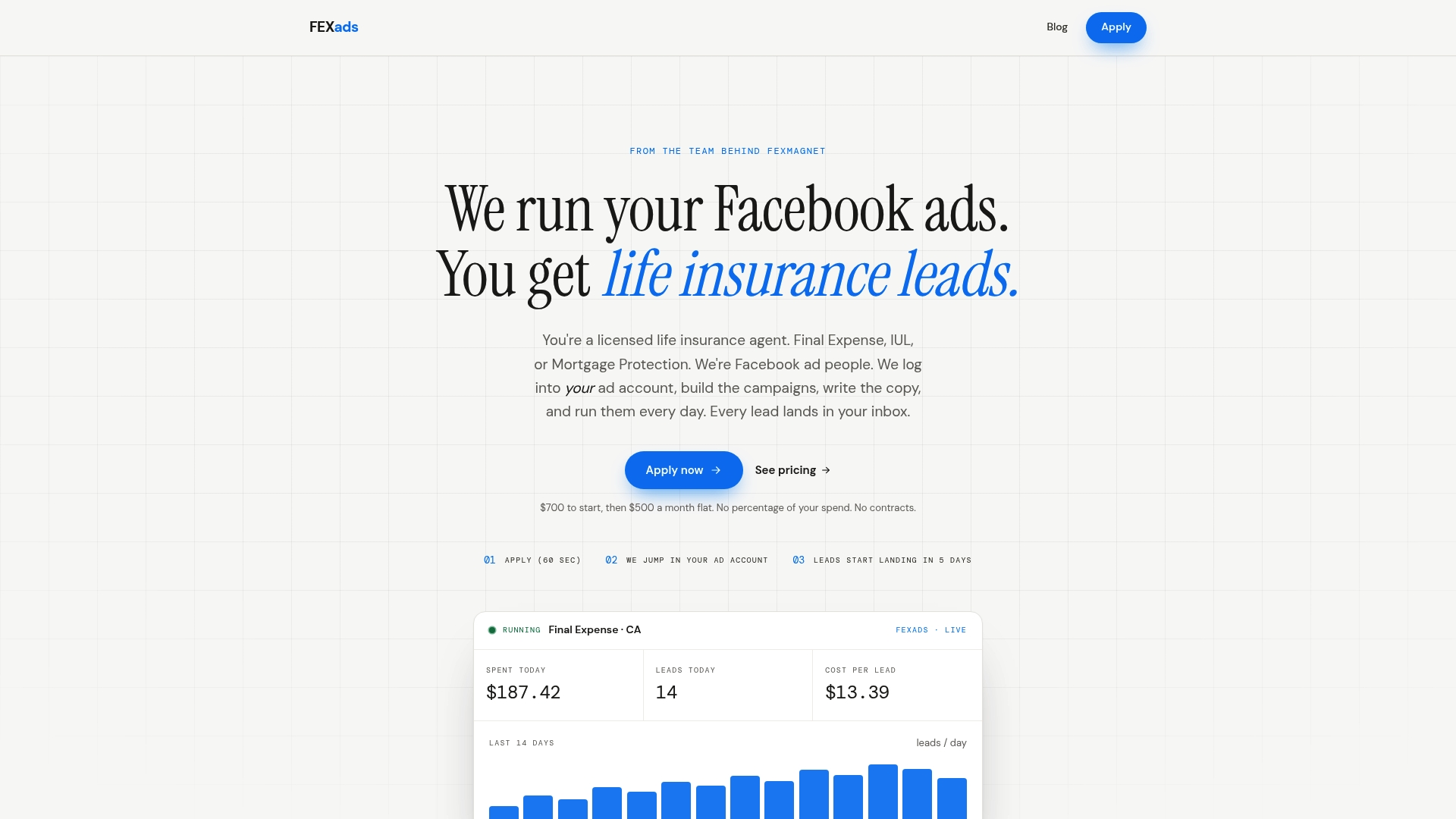
That matters most for licensed agents selling final expense, indexed universal life, or mortgage protection, the exact products where shared-lead CPA math tends to run highest. Campaign setup, including a custom website and compliance-first ad management, runs $700 one time, with ongoing monthly management at $500 billed separately from your ad spend, no long-term contract locking you in. There’s no resold software subscription bundled in either. Check the CPL calculator to see where your numbers land, then see Facebook ad management availability by state to get started.
Sources
The figures in this article draw from a handful of primary sources worth bookmarking if you’re building your own CPL model. QuoteNest’s 2026 carrier benchmark analysis covers line-by-line CPL ranges across P&C and life/health products. Maverick Marketing’s CPA versus CPL breakdown supplies the shared, exclusive, and live-transfer pricing bands and the worked CPA math. CUFinder’s InsurTech marketing benchmarks provided the Google Ads CPC range and blended CPA targets. Regulatory context comes from Venable’s summary of NAIC model law revisions and Lexology’s coverage of the same working group’s record-retention proposals.
This article is general information, not a substitute for advice from a qualified financial advisor. Consult a qualified financial professional about your own circumstances before acting on anything here.
- Cost per Insurance Lead in 2026: Benchmarks & What Carriers Should Know - QuoteNest
- Insurance Lead CPA vs CPL: The Real Math (2026) | Maverick
- InsurTech Industry Marketing Benchmarks 2026
FAQ
What Is a Reasonable Cost Per Lead for Insurance?
A reasonable CPL depends on the line and lead type, not a single universal number. Auto and home typically run $20 to $45, while life, health, and Medicare often land between $50 and $200, and the aggregated 2026 benchmark data backs those ranges. The better question is what CPL keeps your cost per bound policy under your target CPA, which for many teams runs $98 to $115.
How Do I Calculate Cost Per Lead?
Divide total campaign spend by the number of leads generated in that same period: CPL = total spend ÷ number of leads. To make that number meaningful, also calculate cost per bound policy using CPA = CPL ÷ (contact rate × close rate), since a cheap lead with a low contact rate can cost more per sale than a pricier, better-qualified one.
What Do Average Cost Per Lead Benchmarks Look Like by Insurance Line?
Auto and home cluster in the $20 to $45 range blended across channels, while life, health, and Medicare commonly exceed $50 and can climb past $200 for high-intent Medicare Advantage traffic during Annual Enrollment. Commercial lines run highest, often $75 to $300 or more, because underwriting complexity and account size vary so widely.
How Does Cost Per Thousand Impressions (CPM) Relate to Cost Per Lead?
CPM measures what you pay per 1,000 ad impressions, not per lead, so a low CPM doesn’t guarantee a low CPL if the audience doesn’t convert. The two connect through the funnel: CPM affects reach and click volume, click-through rate turns impressions into clicks, and your landing page conversion rate turns clicks into the leads that make up your CPL.
Does Owning My Ad Account Actually Lower My Effective Lead Cost?
It tends to lower cost per bound policy more than it lowers headline CPL, because leads generated inside your own account route to you instantly with no reselling delay, which improves contact rates. Fexads builds campaigns this way, with setup at $700 one time and management at $500 per month, so agents keep both the leads and the audience data that compounds over time.
Recommended
Want us to run your FE ads?
$700 to launch, custom website included. $500 a month flat after that.
Apply now