Strategy
Three Field Form & Exclusive Leads: Final Expense Landing Page for Agents
By Nick Georgalos · 10 min read · Updated 2026-08-31
Three Field Form & Exclusive Leads: Final Expense Landing Page for Agents ! Agent reviewing final expense landing page Use a conversion-focused final expense landing page built around a three-field form and exclusive lead delivery, not a long policy explainer.

Use a conversion-focused final expense landing page built around a three-field form and exclusive lead delivery, not a long policy explainer. Paid traffic converts on speed and clarity, not education, so the page’s only job is to start a conversation. If you’d rather skip the build entirely, FexAds runs this setup inside your own ad account so every lead is exclusively yours.
TL;DR:
- Using an exclusive, in-house ad campaign and fast CRM delivery improves lead quality and follow-up efficiency over shared or rented lead pools.
- The most effective landing pages feature a simple, above-the-fold form with three fields focused on name, age, location, and contact details, with mobile design optimized for target user age and behavior.
- Budgeting for a final expense landing page typically ranges from a low-cost template built for quick launch to a custom-designed page taking up to three days, with ongoing management costing more.
- Picking a provider that owns and delivers leads directly into your CRM, with transparent reporting and a trial or refund option, is crucial to avoid shared lead pitfalls and ensure quality.
- FexAds offers campaign setup and ongoing optimization inside your ad account, ensuring lead exclusivity and audience data ownership, which outperforms generic or shared lead generation approaches.
Table of Contents
- What Does a High-Converting Final Expense Landing Page Look Like?
- What Fields and Copy Actually Convert Final Expense Traffic?
- Does Mobile Design Really Change Conversion Rates?
- Where Do Your Leads Actually Go After Someone Submits the Form?
- What Should You Budget for a Landing Page, and How Fast Can It Go Live?
- How Do You Choose Between a Template, DIY, and a Managed Provider?
- How FexAds Builds and Runs Final Expense Lead Funnels
- The Part Most Agents Get Backward
- Ready to Run Your Own Final Expense Lead Funnel?
- Sources
What Does a High-Converting Final Expense Landing Page Look Like?
Three patterns show up again and again in agent funnels, and each fits a different traffic style. The single-screen short-form template puts a headline, a hero image, and a three-field form above the fold, which keeps cost per lead down because there’s nothing between the click and to submit. A two-step quote flow asks for ZIP code and age first, then phone and email on a second screen, filtering for slightly higher intent at the cost of a few extra clicks. A brochure-plus-callback layout suits agents who prefer talking through coverage by phone rather than chasing a form fill.
Design showcases for final expense landing pages consistently feature an above-the-fold form, one clear call-to-action button, and a line of social proof near the form, not buried at the bottom.
| Template type | Best for | Form depth | Typical CPL trend |
|---|---|---|---|
| Single-screen short form | Cold Facebook traffic | 3 fields | Lowest |
| Two-step quote flow | Warmer, retargeted traffic | 4 to 5 fields | Moderate |
| Brochure + callback | Phone-first agents | Callback request only | Higher, but stronger intent |
Before copying any demo, check that it shows the actual form fields, not a placeholder screenshot. A polished mockup without a working submit button tells you nothing about real conversion.
What Fields and Copy Actually Convert Final Expense Traffic?
Short, well-designed pages that collect name, age, location, and contact info turn paid clicks into calls and quote requests far more reliably than pages asking for policy history or income details.
- Full name. Needed for the agent’s callback script and CRM record, nothing more.
- Phone number. The single most important field. If you can only ask for one thing, ask for this.
- ZIP code. Determines carrier availability and state-specific compliance rules before the agent even calls.
- Age. Final expense pricing is age-banded, so this qualifies the lead before the call starts.
Your headline and button copy should sell the conversation, not the policy. “Get Your Free Quote” or “See What You Qualify For” outperforms anything that reads like a policy brochure. Corebridge Direct’s own final expense product pages keep technical language light for exactly this reason: seniors respond to simplicity, not fine print.
Pro Tip: Put your name, license number, and a small headshot near the form. A real face next to “Licensed Agent” line does more for trust than any stock photo of a happy family.

Does Mobile Design Really Change Conversion Rates?
Most final expense ad traffic arrives on a phone, so the page has to work like one. That means the form sits on the first screen, not after a scroll, and the layout stays single column so there’s nothing to accidentally tap past.
- Keep tap targets large enough for a 70-year-old thumb, not a designer’s mouse cursor.
- Compress every image; aim for a load time under two seconds or you’ll lose the click you paid for.
- Choose photos that read as warm and reassuring without leaning on funeral clichés like caskets or lilies.
- Label every field clearly and show errors inline, right where the mistake happened, not in a banner at the top.
- Use a color contrast that a reader with declining eyesight can actually read.
None of this is exciting work.
Where Do Your Leads Actually Go After Someone Submits the Form?
The decision that matters more than any headline or button color is who owns the lead once it’s captured. Exclusive leads generated inside your own ad account let you keep optimizing that specific audience over time and give you full access to the data. Rented leads sold to three or four agents at once come cheaper per lead but cost you more in wasted callbacks and lower close rates.
Delivery method matters almost as much as ownership:
- Instant email notification to the agent or team inbox.
- Webhook or REST integration pushing straight into a CRM.
- Direct API connection for agencies running their own systems.
- Real-time SMS alert to a telesales desk for fastest follow-up.
- CSV export for agents still working from spreadsheets.
Owning the lead and the underlying audience data lets you keep refining targeting long after the first campaign launches, which is the entire point of running ads instead of buying rented lists. Compliance-wise, keep a one-line consent statement, a link to your privacy policy, and clear opt-in language near the submit button, and make sure your calling process respects Do-Not-Call rules in whatever state the lead’s ZIP code lands in.
What Should You Budget for a Landing Page, and How Fast Can It Go Live?
Pricing and timeline vary a lot depending on how much customization you want.
| Option | Typical cost | Time to live |
|---|---|---|
| Pre-built template | One-time fee or low monthly charge | Same day to hours |
| Custom-designed page | One-time design and development fee, plus hosting | 3 days |
| Managed service with ad campaign | Setup fee plus monthly retainer | 2 to 3 weeks |
A template gets you live fast but offers little room to test messaging variations. A custom build costs more upfront but gives you full control over copy, layout, and A/B testing structure. A managed service folds the landing page into the broader ad campaign, so setup takes longer but the page, targeting, and tracking are built to work together from day one.
How Do You Choose Between a Template, DIY, and a Managed Provider?
Run through this checklist before you commit budget to any option:
- Ask who owns the leads. If the answer is vague or the leads get shared across multiple agents, that’s rented, not exclusive.
- Request a live demo or real screenshots, not a mockup. A vendor who can’t show a working page is hiding something.
- Confirm integration options: does it push to your CRM via webhook, or does it dump leads into a dashboard you have to check manually?
- Ask about reporting cadence. Weekly performance updates beat a monthly PDF nobody reads.
- Find out if there’s a refund policy or trial period if the page underperforms.
- Get a straight answer on expected cost per lead for final expense specifically, not a generic insurance benchmark.
Red flags include no demo available, delivery described only as “you’ll get notified,” and any claim of results with no reference you can check.
How FexAds Builds and Runs Final Expense Lead Funnels
FexAds sets up landing pages and ad campaigns inside the agent’s own ad account, so every lead generated stays exclusive to that agent. A typical engagement includes campaign setup, pixel and tracking installation, state-specific final expense targeting, and ongoing CPL benchmarking against real performance data rather than industry averages pulled from unrelated verticals.
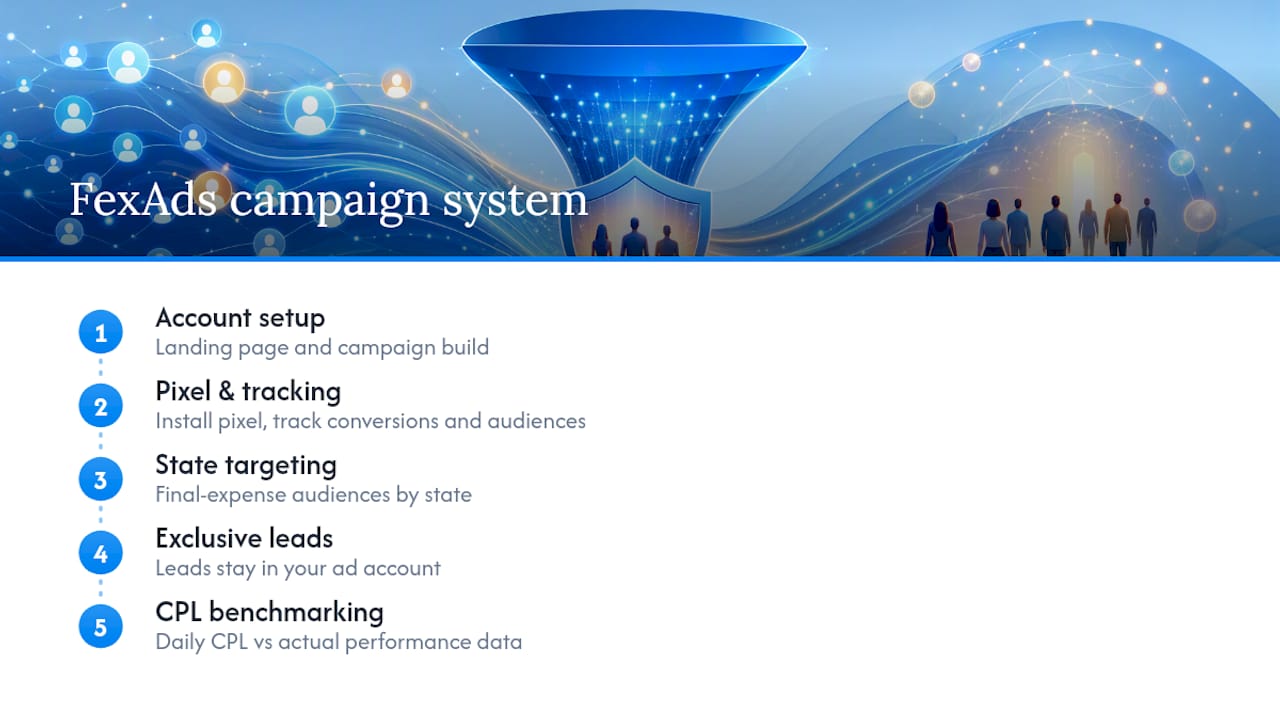
Setup runs through an application, campaign build, and a compliance review before launch, with ongoing daily optimization once ads go live. Owning leads inside your own account keeps the audience data working for you instead of disappearing into a shared vendor pool.
The Part Most Agents Get Backward
Most advice on this topic obsesses over design polish, button colors, headline formulas, when the bigger lever is almost always lead ownership and delivery speed. A gorgeous page feeding into a rented, shared lead pool will still underperform a plain page connected to exclusive delivery and fast follow-up. Design earns you the click. Ownership determines what that click is worth six months later.
The conventional advice also underrates how much confusion final expense messaging creates. Agents borrow language from pre-need funeral plans, and prospects show up expecting a funeral home payout instead of a flexible check to a beneficiary. That mismatch quietly kills conversion rates nobody bothers to diagnose.
If you’re choosing where to spend your first dollar, spend it on the lead-delivery decision before you spend it on a designer. A template with exclusive leads and instant CRM delivery will outperform a custom page feeding a shared list every time. Test copy and layout second. Get the ownership model right first, then treat the page itself as something you keep improving with real data instead of guesswork based on someone else’s screenshot.
— Nick
Ready to Run Your Own Final Expense Lead Funnel?
Building a page is one decision. Running the traffic behind it well is the harder problem, and it’s the one FexAds actually solves. Rather than handing you a template and wishing you luck, FexAds builds your final expense campaign inside your own Facebook ad account, so every lead that hits your form belongs to you alone, with no sharing and no reselling.
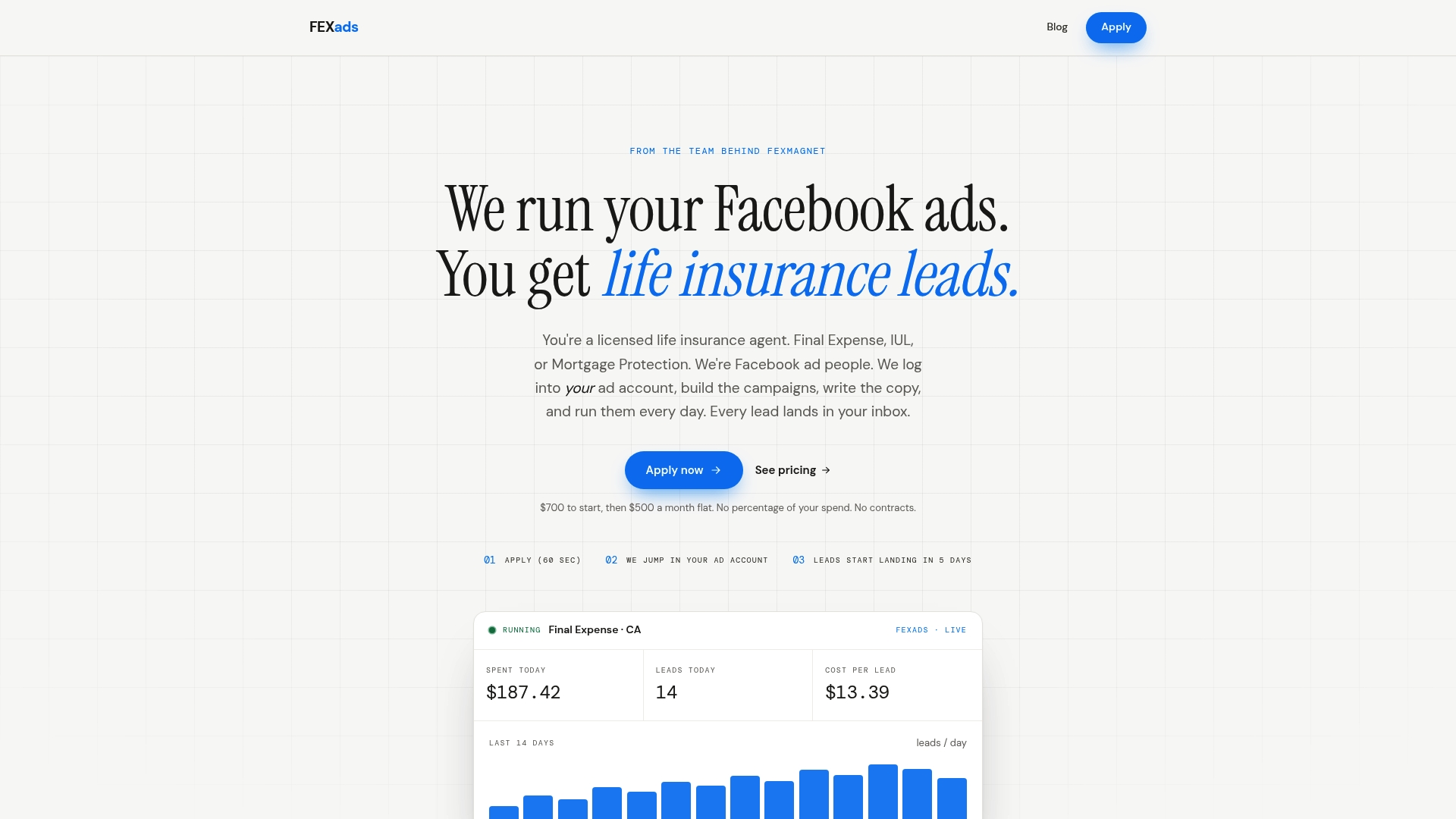
Getting started means having your license state, target ZIP codes, and monthly ad budget ready before you apply. From there, FexAds handles campaign setup, pixel installation, audience targeting, and daily optimization for a one-time setup fee plus a monthly management retainer, separate from ad spend. Check what state-specific final expense campaigns typically look like on the FE Facebook Ads by State page, or run your numbers first with the CPL calculator before you apply.
Sources
- Building A Final Expense Marketing Funnel That Drives Inbound Calls: Best Practices
- Final Expense Life Insurance for Seniors | Corebridge Direct
Recommended
Want us to run your FE ads?
$200 to launch, custom website included. $500 a month flat, starting at your first sale.
Apply now