Strategy
Stop Splitting Leads: First-Party vs Third-Party for Insurance Agents
By Nick Georgalos · 11 min read · Updated 2026-09-19
Stop Splitting Leads: First-Party vs Third-Party for Insurance Agents ! Insurance agent reviewing owned lead funnel For agents who want exclusive Facebook leads and true audience ownership, first-party leads win.

For agents who want exclusive Facebook leads and true audience ownership, first-party leads win. Build your own funnel, own your pixel and lookalikes, and your cost-per-acquisition drops over time even though the sticker price per lead runs higher. Third-party leads still have a place for short-term volume or market testing, but compliance risk and shrinking contact rates make them a weak long-term foundation for a final expense, IUL, or mortgage protection book.
TL;DR:
- Building first-party leads involves owning your landing pages, pixels, and audiences, which lowers long-term contact and compliance risks compared to third-party sources.
- Contact rates for verified first-party lists typically exceed 60 to 70 percent, while third-party leads often see contact rates decline quickly due to shared usage and fraud.
- A compliant funnel requires a dedicated landing page with trusted timestamping, SMS verification, session recording, and clear seller disclosures to withstand FCC and legal scrutiny.
- Setting up a first-party funnel involves installing pixels and API, connecting CRM for instant lead routing, and refining audiences based on verified, high-value data over three to four weeks.
- Most agencies see a 12 to 36-month timeline to fully mature owned channels, with the first 90 days emphasizing pilot testing, contact rate improvement, and tracking cost-per-funded-policy trends.
Table of Contents
- First-Party vs Third-Party Data: What It Actually Means for Insurance Agents
- Contact Rates, Fraud, and the Real Economics of Each Model
- Consent Rules That Make Owned Funnels the Safer Bet
- How to Build and Own Your First-Party Facebook Funnel
- When Buying Leads Still Makes Sense
- Tracking the Numbers That Prove It’s Working
- Your First 90 Days: A Practical Build Checklist
- What Agents Get Wrong About Making the Switch
- Why FexAds Is Built for Agents Who Want to Own Their Leads
- Sources
- FAQ
First-Party vs Third-Party Data: What It Actually Means for Insurance Agents
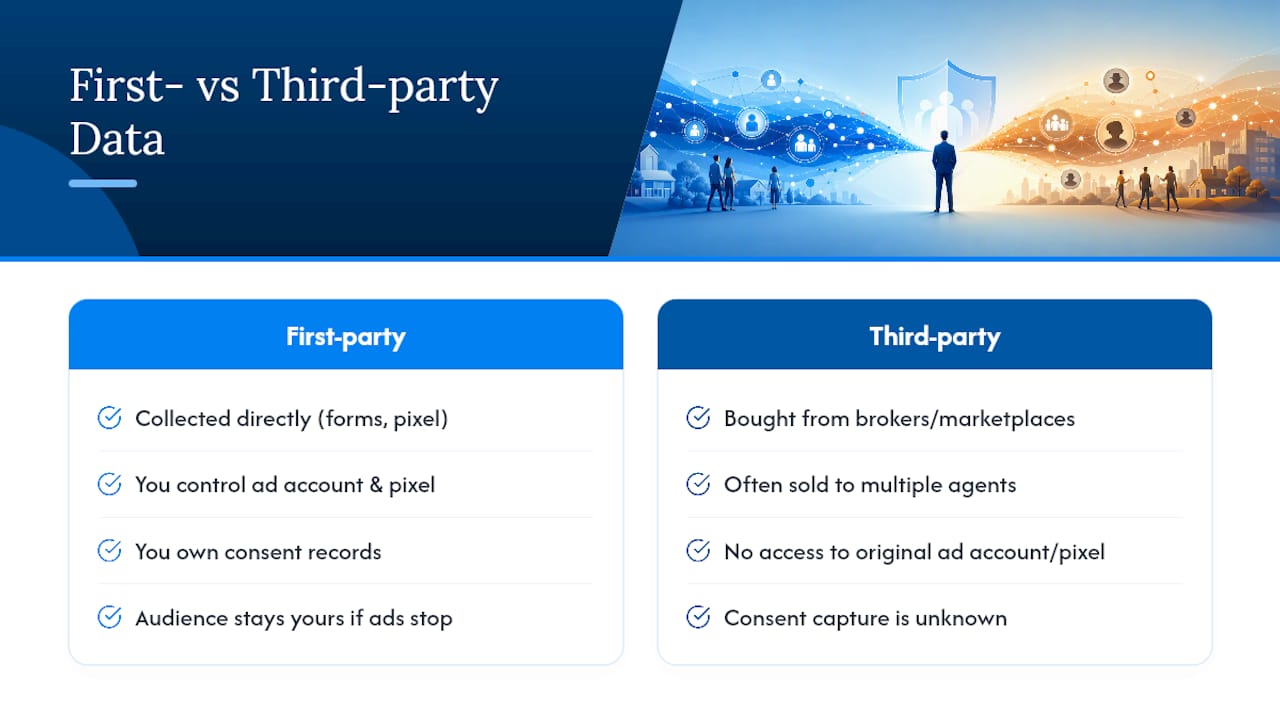
First-party data is anything you collect and own directly: the prospect who filled out a form on your landing page, the pixel that recorded their visit, the custom audience built from your CRM. You control the ad account, the pixel history, and the consent record. If you stopped running ads tomorrow, that audience data stays yours.
Third-party leads come from marketplaces, aggregators, or resellers who sold the same contact information to you and, often, to two or three other agents simultaneously. You never touch the ad account that generated the lead. You inherit a name, a phone number, and whatever consent language the seller used, with no visibility into how that consent was captured.
A concrete example: an agent running Facebook ads through their own account, with their own pixel firing on a branded quote page, is building first-party data. An agent buying a spreadsheet of “aged final expense leads” from a lead broker is buying third-party data, full stop, regardless of how recent the leads claim to be.
Contact Rates, Fraud, and the Real Economics of Each Model
The gap between first-party and third-party shows up fastest in contact rates. Uploaded, verified first-party lists commonly match at 60 to 70 percent inside Meta’s ad system, because the data came from a real conversion event you controlled. Third-party leads, sold to multiple buyers at once, see contact rates erode fast simply because five agents are racing to be the first phone call.
Fraud and return rates follow the same pattern. Agents who control OTP verification, session capture, and lead validation see materially lower return rates than buyers of third-party leads, where fake entries and duplicate submissions are common and undocumented.
- First-party final expense CPL often runs $32 to $45, noticeably above a shared lead’s sticker price.
- Close rates on exclusive leads run high enough that true cost-per-funded-policy frequently lands lower than cheaper shared leads.
- Low-cost shared leads still make sense for pure volume testing or when cash flow won’t support a higher upfront CPL.
Higher CPL is not the same as higher CPA. That distinction is the entire argument for building an owned funnel instead of chasing the cheapest lead price on the market.
Consent Rules That Make Owned Funnels the Safer Bet
The FCC’s one-to-one consent standard requires that a consumer’s consent name the specific seller they’re agreeing to be contacted by, not a blanket list of unnamed partners. That single rule reshaped how agents should think about lead capture. Combined with Meta’s evolving lead-ad policies, it raises the evidentiary value of external landing pages over native, in-platform lead forms.
Here’s what a defensible funnel actually needs:
- A landing page with TrustedForm or Jornaya embedded to timestamp and certify consent.
- SMS one-time-password verification to confirm the phone number belongs to a real, reachable person.
- Session recording that captures exactly what the prospect saw and clicked before submitting.
- A named-seller disclosure that states who will be calling, not a vague list of “partners.”
Native Facebook lead forms are faster to fill out, but they provide less consent documentation than an external page built for compliance. If a TCPA complaint ever surfaces, “the prospect tapped a Facebook button” is a much weaker defense than a timestamped, recorded consent trail.
Pro Tip: Keep your TrustedForm certificates and session recordings in the same CRM record as the policy application. If a dispute ever comes up, you want that evidence one click away, not buried in a third-party dashboard you no longer have access to.
How to Build and Own Your First-Party Facebook Funnel
Standing up an owned funnel is not complicated, but skipping a step usually shows up later as a bad match rate or a compliance gap. Here’s the sequence that works:
- Choose a landing page over a native lead form when compliance matters more than form-fill speed. Native forms convert faster inside the Facebook app, but a landing page with embedded verification gives you a stronger consent record and better data ownership.
- Install your pixel and Conversions API together, not one or the other. The pixel alone loses signal to browser tracking restrictions; the Conversions API sends server-side events that survive those losses. Keep the ad account in your name, not your agency’s shared account.
- Wire your CRM to the landing page with a webhook so leads route to your phone or dialer within seconds of submission, not minutes. Speed-to-lead is often the single biggest lever on contact rate.
- Build lookalike audiences at the 1 to 5 percent range off your best converting policyholders, not off raw lead submissions. Tighter lookalikes built from verified, high-value lists tend to outperform broad interest targeting inside Special Ad Category restrictions.
- Exclude existing customers and recent non-converters from prospecting campaigns so your budget isn’t wasted re-showing ads to people who already said no or already bought.
Pro Tip: Ask two extra qualifying questions on your form, such as coverage amount desired and current health status. It slightly lowers your form-fill rate but sharply raises the quality of who actually books a call.
When Buying Leads Still Makes Sense
Third-party leads earn their keep in a few specific situations: you need volume immediately, you’re testing a new state or a new product line before committing ad budget, or your team is too small right now to run a funnel build correctly. None of that makes bought leads a permanent strategy.
Run a hybrid model with clear separation. Route third-party leads to newer agents or dedicated volume teams, and reserve first-party leads for your strongest closers, since workflow segregation by lead source protects your CPA targets on both sides. Track return rates separately too. If a third-party source runs above a 15 to 20 percent return rate, drop it rather than argue with the data.
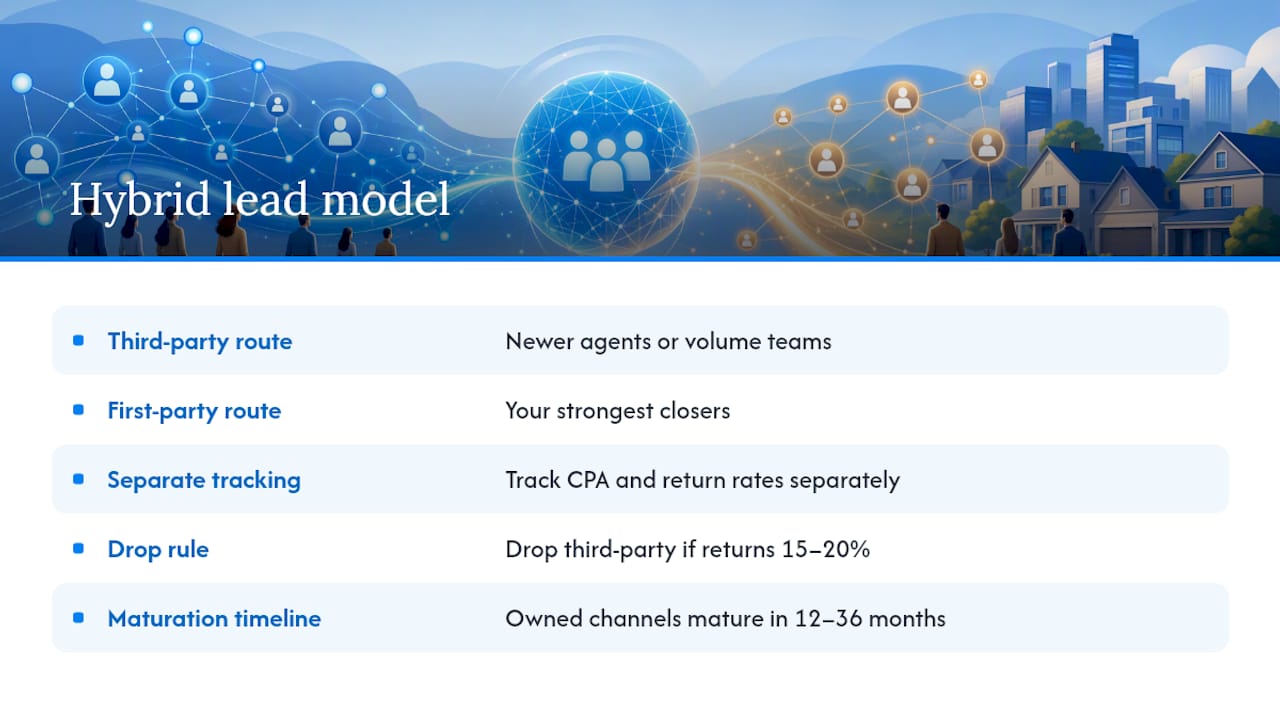
Most agencies see owned channels take 12 to 36 months to fully mature and out-earn a purchased-lead strategy. Plan the transition in stages, not as a single cutover.
Tracking the Numbers That Prove It’s Working
Five metrics matter more than the rest: cost-per-lead, contact rate, lead-to-issue conversion, cost-per-funded-policy, and return rate. Track them weekly, not monthly, especially in the first 90 days of a new funnel.
The formula is simple: total ad spend divided by policies issued equals your true CPA. If you spent $3,000 on ads and issued 6 policies, your CPA is $500, regardless of what your average CPL looked like on the way there.
- A healthy first-party funnel usually shows contact rates above 50 percent within the first month.
- Cost-per-funded-policy should trend downward as your lookalike audiences mature, not stay flat.
- Tie CRM policy issue dates back to the originating ad set so you know exactly which campaign paid for itself.
Your First 90 Days: A Practical Build Checklist
Standing up a first-party funnel properly, not just quickly, follows a predictable sequence:
- Week 1 to 2: Build the compliance-ready landing page, embed TrustedForm, and set up SMS OTP verification before a single dollar of ad spend goes live.
- Week 2 to 3: Install the pixel and Conversions API, confirm event matching in Ads Manager, and connect your CRM via webhook for instant lead routing.
- Week 3 to 4: Set a speed-to-lead SLA of under five minutes and assign a specific team member to own that response window.
- Month 2: Launch with a modest pilot budget, watch contact rate and cost-per-funded-policy closely, and refine ad creative and form fields based on early data.
- Month 3: Scale spend only after return rates stay under your threshold and CPA trends favorably, then start building lookalikes off your first real conversion data.
What Agents Get Wrong About Making the Switch
First-party data is a strategic asset, not a quick fix. It takes real operational commitment, not just a bigger ad budget, to build right.
Run a pilot before you go all in. Measure true CPA, not just CPL, and don’t drop third-party sources cold turkey while your owned funnel is still finding its footing.
— Nick
Why FexAds Is Built for Agents Who Want to Own Their Leads
FexAds builds and manages your Facebook ad campaigns entirely inside your own ad account, so every lead, every pixel event, and every audience you generate belongs to you, not a shared pool sold to three other agents. Setup includes a custom-built landing page, pixel and compliance-first ad management, and direct support for daily optimization to help with Meta’s ad platform.
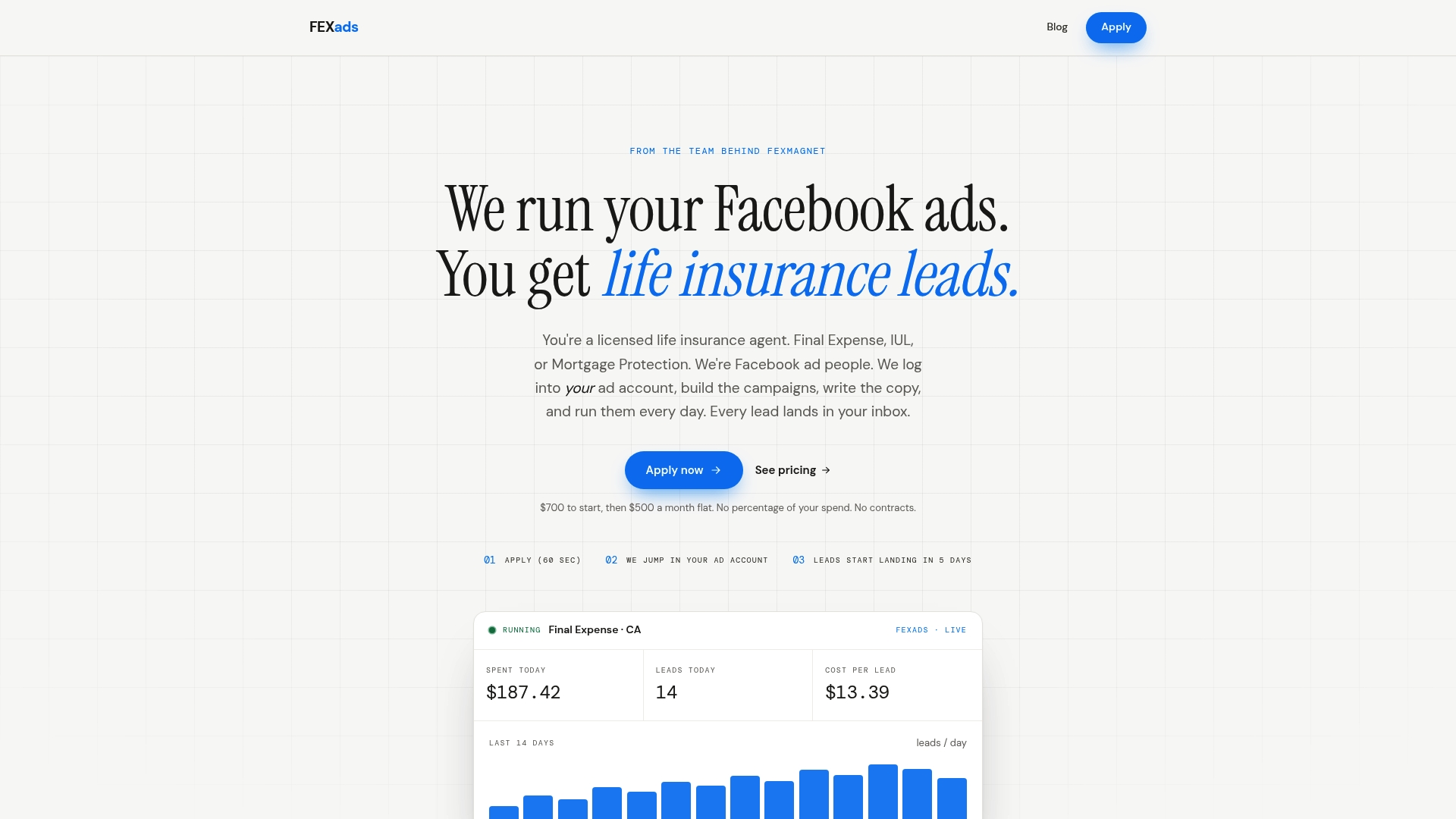
The pricing model is straightforward: a one-time $700 setup fee covers your custom campaign build, followed by $500 a month for ongoing management, billed separately from your ad spend. There’s no rented software, no shared leads, and no long-term contract locking you in.
If you’re ready to stop splitting leads with competing agents and start building an audience you actually own, visit the FexAds management page to get your custom campaign set up.
Sources
- Insurance Lead Generation Agency vs Marketplace: Real CPA Math - Elevarus
- Insurance Lead Generation Playbook for 2026
- Facebook Lead Ads Insurance Compliance 2026: The Agent’s Guide | Stallion Leads Blog
- Social Selling: Mastering Facebook Ads for Insurance Agents | AQ Marketing
FAQ
What Is the Main Difference Between First-Party and Third-Party Leads?
First-party leads come from your own Facebook ad account, pixel, and landing page, so you own the contact data and consent record. Third-party leads are purchased from a broker or marketplace that often sells the same contact to multiple agents at once.
Are First-Party Leads Worth the Higher Cost?
Usually, yes, because first-party leads convert at higher rates and typically show stronger contact and match rates than shared leads. A higher CPL often produces a lower true cost-per-funded-policy once you account for close rates and return rates.
How Long Does It Take to See ROI From an Owned Funnel?
Most agents see owned channels mature over 12 to 36 months, with meaningful traction often visible within the first 90 days if speed-to-lead and consent verification are handled correctly. Early pilots should focus on validating contact rate and CPA before scaling budget.
Does FexAds Give Agents Ownership of Their Leads and Data?
Yes. FexAds builds every campaign inside the agent’s own ad account, so leads, pixel data, and audience assets belong to the agent, not to FexAds. Pricing runs a $700 one-time setup fee plus $500 a month for ongoing management.
Is TrustedForm or Jornaya Required for Compliance?
Neither is legally mandatory, but both provide timestamped consent verification that strengthens your defense under FCC one-to-one consent rules. Most compliance-conscious agencies treat this documentation as standard practice for external landing pages.
Recommended
Want us to run your FE ads?
$700 to launch, custom website included. $500 a month flat after that.
Apply now