Strategy
Cut Cost per Close: Exclusive Insurance Leads for Licensed Agents
By Nick Georgalos · 19 min read · Updated 2026-09-22
Cut Cost per Close: Exclusive Insurance Leads for Licensed Agents ! Agent answering an exclusive insurance lead The fastest way to get exclusive insurance leads is buying from a vetted exclusive-seller who can prove real-time suppression and TCPA documentation.

The fastest way to get exclusive insurance leads is buying from a vetted exclusive-seller who can prove real-time suppression and TCPA documentation. The most durable way is building leads you own through targeted Meta campaigns and smart intake funnels. Buy when you need appointments this week; build when you want lower long-term cost per close and full ownership of your pipeline. The build path can be run directly inside your own ad account, covering the second route without needing a separate vendor relationship.
TL;DR:
- Exclusive leads typically cost $35 to $65 each, with higher prices for complex products like IUL and Medicare, and are most valuable for high-commission policies.
- Verifying a vendor’s exclusivity claims requires TrustedForm or Jornaya certificates, raw lead samples, and real-time suppression logic checks before purchase.
- Building your own leads through Meta campaigns and optimized intake forms offers lower long-term costs and full ownership of your pipeline.
- Speed is crucial, so contacting leads within five minutes and automating follow-up cadences significantly increases chances of closing policies.
- A blended strategy of buying immediate leads and building owned channels proves most effective, especially when operational systems are set up for quick response and proper lead qualification.
Table of Contents
- What Are Exclusive Insurance Leads, and Why Does Exclusivity Matter?
- How Much Do Exclusive Insurance Leads Cost, and How Do You Calculate True ROI?
- How Do You Verify a Lead Vendor’s Exclusivity Claims?
- What Channels Actually Deliver Exclusive Insurance Leads?
- What Operational Systems Turn Exclusive Leads Into Closed Policies?
- What the Evidence Actually Shows About Exclusive Lead Economics
- What Should Agents Actually Prioritize First?
- How Fexads Builds Exclusive Leads Inside Your Own Ad Account
- Sources
- FAQ
What Are Exclusive Insurance Leads, and Why Does Exclusivity Matter?
An exclusive insurance lead is sold or generated for one agent only. Nobody else calls that prospect from a competing pitch, because nobody else has the record. Compare that to a shared lead, which a vendor typically resells to three to eight agents simultaneously, or an aged lead, which is a shared lead that already got worked hard and rejected weeks or months ago. Live-transfer leads sit somewhere in between: exclusive to the receiving agent for that call, but often generated through aggressive outbound scripts that inflate contact rates without necessarily improving intent.
The economics come down to one uncomfortable fact: exclusivity is expensive because it’s scarce. Exclusive leads typically cost 2x to 4x more than shared leads across most lines, with final expense and Medicare often landing at the high end of that range. That premium buys you something shared leads structurally cannot deliver: a prospect who hasn’t already heard five sales pitches and hung up twice.
Here’s the part most agents underweight. When five agents are calling the same shared lead, the first call wins the contact. By the third or fourth call, you’re not selling insurance, you’re apologizing for being the fifth stranger to phone someone about their final expense policy today. Exclusivity removes that race entirely. You get first contact, first framing, and the prospect’s full attention instead of their patience running out.
That shift shows up in three measurable ways:
- Contact rate improves because the prospect isn’t screening five unknown numbers in one afternoon.
- Qualification improves because the conversation isn’t rushed by a prospect who’s already annoyed.
- Close rate improves because trust builds faster when you’re not competing against your own lead source.
Pro Tip: Don’t judge a lead source by cost per lead alone in the first thirty days. Shared leads often look cheaper on a spreadsheet and more expensive on a P&L once you factor in the hours burned chasing prospects who already bought from a faster caller.
The trade-off is real, though. Exclusive leads cost more upfront, and a slow month can hurt more when your cost per lead is higher. That’s exactly why the next question matters more than the sticker price: what does that lead actually cost you once it becomes a policy?
How Much Do Exclusive Insurance Leads Cost, and How Do You Calculate True ROI?
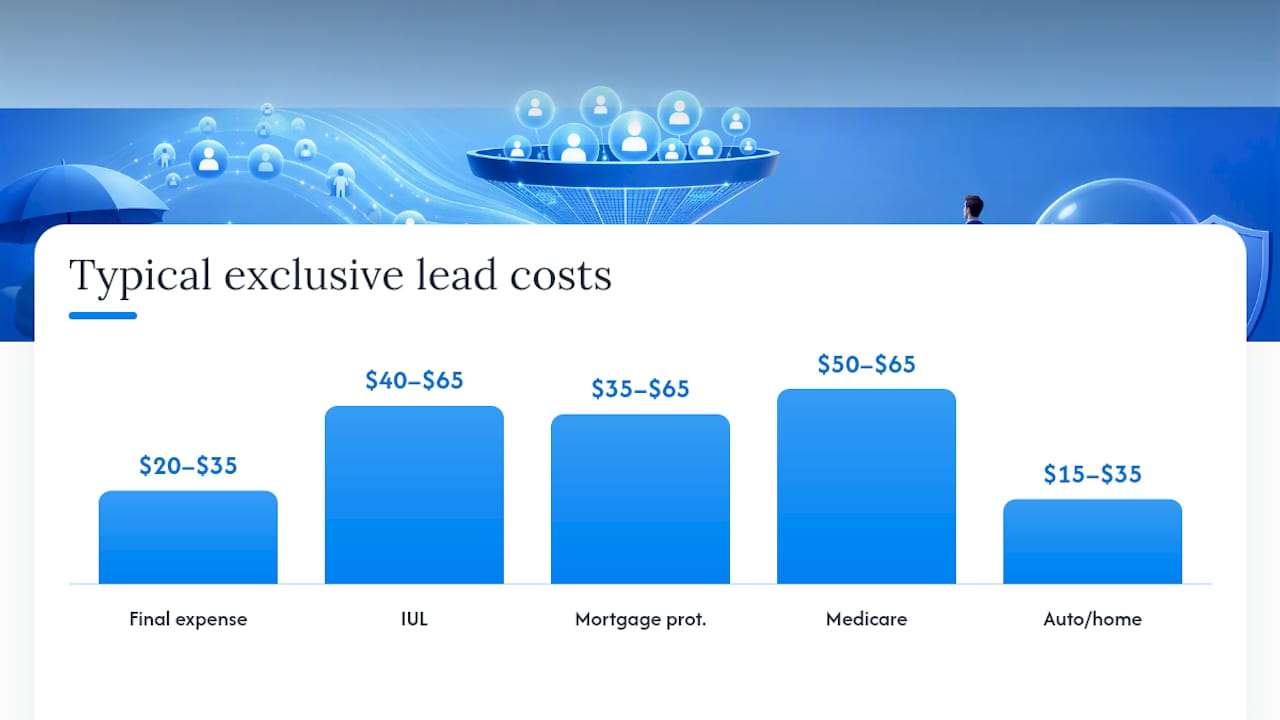
Exclusive real-time life insurance leads generally run $35 to $65 depending on the vertical, with live transfers and Medicare leads frequently priced above that band. Final expense tends to sit at the lower to middle end of that range because ticket sizes are smaller and volume is higher. IUL and mortgage protection often price higher per lead because the commission on a bound policy justifies a bigger acquisition spend.
| Vertical | Typical exclusive lead cost range | Why it prices this way |
|---|---|---|
| Final expense | $20 to $35 | High volume, smaller face amounts, competitive vendor market |
| IUL | $40 to $65 | Complex sale, higher commission justifies higher CPL |
| Mortgage protection | $35 to $65 | Tied to mortgage data triggers, moderate competition |
| Medicare | $50 to $65 | Regulatory complexity and seasonal demand spike costs |
| Auto/home | $15 to $35 | Lower commission per policy, higher volume compensates |
Cost per lead is the number every vendor leads with, and it’s also the number that misleads agents most often. The metric that actually predicts profitability is cost per bound policy, not cost per lead. Here’s the math:
Cost per close = total lead spend ÷ number of appointments closed. Cost per bound policy = total lead spend ÷ number of policies actually issued and paid for.
Say you buy 40 exclusive final expense leads at $30 each, spending $1,200. You close 8 of them into bound policies. Your cost per bound policy is $150. Now compare a shared-lead vendor selling the same volume at $12 each, also $480 total spend, but your close rate drops to 4 policies because three other agents already worked those same names. Your cost per bound policy jumps to $120 on paper, but factor in the hours spent chasing dead leads and the real number often runs higher once you price your own time. Testing small batches before committing to volume is the only way to know which scenario you’re actually in.
A few costs get buried in vendor contracts and catch agents off guard:
- Minimum order commitments that lock you into weekly volume even during a slow personal schedule.
- Return/replacement policies that only cover disconnected numbers, not bad intent or wrong state licensing.
- Delivery fees for webhook integration or CRM routing that aren’t disclosed until after signup.
- Aged-lead upsells disguised as “bonus volume” bundled into an exclusive order.
- State licensing mismatches, where a lead gets delivered outside your licensed territory and the vendor won’t refund it.
Run the cost per lead calculator against your own close rate before you commit to a vendor’s monthly minimum. A lead that’s $10 cheaper but closes at half the rate isn’t a deal.
How Do You Verify a Lead Vendor’s Exclusivity Claims?
Every vendor says “exclusive.” Not every vendor can prove it, and the ones who can’t usually reveal themselves fast once you ask the right questions.
- Request TrustedForm or Jornaya certificates on every lead delivered. These TCPA consent documentation tools timestamp when and where a prospect gave consent, which protects you legally and confirms the lead wasn’t scraped or recycled.
- Ask for a sample raw lead record, not a cleaned-up demo. You want to see the actual consent language the prospect clicked through, including the exact opt-in checkbox wording.
- Confirm real-time suppression logic. The vendor should be able to explain, in plain terms, how their system prevents the same lead record from routing to two buyers within the same delivery window.
- Check duplicate detection against your own CRM. If you’ve bought from this vendor before, cross-reference new deliveries against old records by phone number and email.
- Request webhook delivery logs showing timestamp, destination, and confirmation of single delivery. A vendor with nothing to hide will have this ready in a day, not a week.
Beyond paperwork, run a small operational test before committing real budget. Buy a test batch of 10 to 20 leads. Call every single one within minutes of delivery and ask directly: “Has anyone else contacted you about this recently?” You’re not trying to catch the vendor in a lie, you’re measuring leakage. Some leakage is normal, even from honest vendors, because prospects sometimes fill out multiple forms across different sites without realizing it. Anything above 20%, especially paired with a vendor who gets defensive when you ask about it, is a red flag worth walking away from.
Pro Tip: *Keep a simple spreadsheet logging every “have you talked to anyone else” answer for your first 50 leads from a new vendor.
The mystery-caller method works too: have a colleague or assistant call a handful of your recent leads posing as a satisfaction survey, asking how many agents have reached out. It’s a blunt instrument, but it catches vendors who quietly sell the same record twice under different product names.
What Channels Actually Deliver Exclusive Insurance Leads?
There isn’t one right answer here. There’s a buy lane, a build lane, and a handful of tactics that work inside each. Here’s how the best ways to find insurance leads actually break down by effort and durability.
Buying exclusive lead feeds
This is the fastest lane. You’re paying a vendor to generate and deliver leads exclusively to you, typically through webhook, SMS, email, or live transfer.
- Negotiate delivery format first. Webhook delivery into your CRM is faster and more reliable than email drops, which sit in an inbox until someone checks it.
- Avoid long-term contracts with vendors who won’t offer a trial period or small test batch.
- Get replacement terms in writing before you pay, specifically what counts as a “bad lead” eligible for credit.
- Check state licensing filters so you’re not paying for leads outside your book of business.
The buy lane solves a real problem: it fills your calendar this week. It doesn’t solve the long-term problem of rising costs as vendor demand increases and margins compress.
Building exclusive leads through Meta campaigns
Running Facebook and Instagram campaigns in your own ad account is the build lane, and it’s the one Fexads specializes in for licensed life insurance agents. The mechanics matter more than the platform:
- Set up your own ad account rather than running through an agency’s shared account, so every lead and every dollar of ad data belongs to you.
- Install a pixel and connect webhook delivery so leads route into your CRM the moment they submit, not hours later.
- Build compliant creative that meets Meta’s financial services ad policies, since final expense and life insurance ads get flagged more aggressively than typical consumer products.
- Track cost per lead and cost per close inside the ad account itself, so you can kill underperforming audiences within days instead of waiting for a monthly report.
- Refresh creative on a rolling basis. Ad fatigue sets in faster in insurance verticals than most industries because the audience pool for certain age brackets is finite.
Owning the account means you keep optimizing the same audience data over months instead of starting from zero every time you switch vendors.
Designing intake forms and landing pages that qualify, not just collect
A generic “get a quote” form generates volume. A smart intake form that captures renewal date and branches by product type generates leads that are already halfway qualified before you dial. Renewal date alone is often the single highest-value field on the entire form, because it converts a vague inquiry into a time-bound opportunity you can prioritize. Compare lead forms against full landing pages for final expense specifically, since the two formats perform differently depending on whether the prospect is coming from a cold audience or a warmer retargeting pool.
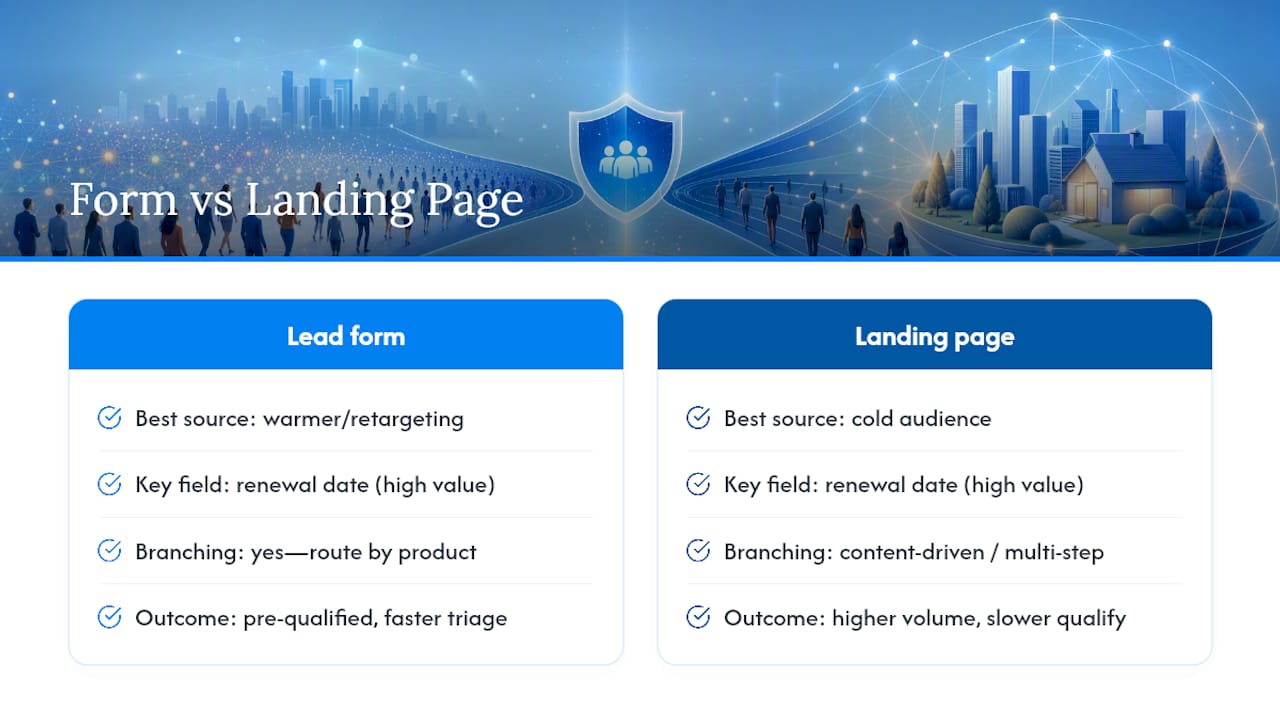
Branching logic matters too. A form that asks “are you looking for coverage for yourself or a parent” and routes accordingly lets you triage by urgency before the first call, which shortens your average time-to-appointment.
Local search, reviews, and referral engineering
A claimed and optimized Google Business Profile generates leads that are exclusive by definition, since nobody else owns your listing. These leads cost little once the profile is established, though it takes months of consistent reviews and local content to build momentum.
Referrals deserve more structure than most agents give them. Instead of a passive “let me know if you know anyone,” build a simple ask into your closing conversation: “Who’s the first person you’d want to make sure has this same protection?” Pair that with offline QR-code deployments at community events, church bulletins, or senior centers, pointing directly to your intake form. It’s low-tech, but it produces leads that arrive already trusting you by association.
Pro Tip: Blend the two lanes instead of picking one forever. Buy exclusive leads to keep your calendar full while your Meta campaigns and local assets ramp up, then shift spend toward the build lane as your cost per bound policy drops.
What Operational Systems Turn Exclusive Leads Into Closed Policies?
Buying or building exclusive leads is only half the equation. The other half is what happens in the first sixty seconds after a lead lands, and most agents lose more deals to slow follow-up than to bad lead quality.
Speed to contact is the single biggest lever you control. Aim to call within five minutes of delivery, not five hours. A prospect who just filled out a form is still in the mindset that prompted them to fill it out. Wait until end of day and that mindset has moved on to dinner, kids, or a completely different problem.
Your CRM needs to be wired for this speed before the leads start flowing, not after:
- Webhook routing directly from your ad platform or vendor into your CRM, skipping manual entry entirely.
- State and license filters that automatically flag leads outside your licensed territory so you’re not wasting a call.
- Renewal-window tagging that surfaces mortgage protection or term conversion leads at the right moment instead of burying them in a general queue.
- Consent logging that stores the TrustedForm or Jornaya certificate against the record permanently, not just at intake.
On the dialing side, compliant power-dialer use matters more than most agents realize. TCPA rules govern how and when you can auto-dial a consumer number, and the safest practice is logging every call attempt with a timestamp and outcome directly in the CRM record tied to that lead’s consent certificate. If a prospect later disputes contact, your log is your defense.
Follow-up cadence is where most exclusive leads actually get wasted. A single call attempt followed by silence is the most common failure pattern in the industry. Build three tiers instead:
- Immediate (0 to 24 hours): Call, and if no answer, a text confirming you tried and a specific time you’ll try again.
- Short-term (days 2 through 10): Alternating call and text attempts, spaced roughly every other day, referencing the specific product they inquired about.
- Long-term nurture (weeks 2 through 12): Monthly touchpoints, often email or text, that stay useful rather than pushy, like a reminder about open enrollment windows or a life-event check-in.
A marketing automation checklist built for small teams can help structure this cadence without requiring a full-time assistant to manage it manually. The goal isn’t more touches, it’s consistent touches that don’t stop after one missed call.
What the Evidence Actually Shows About Exclusive Lead Economics
The pricing and exclusivity data across the industry point to the same conclusion from different angles: exclusive leads cost more per unit and less per outcome, provided you have the operational discipline to close what you buy or build. The premium on exclusive leads exists because contact rates and close rates both improve when a prospect isn’t being worked by three other agents simultaneously.
One effective approach involves running campaigns inside the agent’s own ad account so the agent owns the leads outright, with continuous audience optimization possible because the data never leaves that account. That’s a meaningfully different arrangement from renting leads through a third-party pool, where the data and the learnings both belong to the vendor.
A few things worth stating plainly, based on how this economics actually plays out for agents:
- Exclusive leads are worth the premium mainly in higher-commission verticals like final expense, IUL, and Medicare, where lifetime value absorbs a higher acquisition cost.
- A blended approach, buying to fill the calendar while building owned channels, is the pragmatic path most agencies actually take rather than picking one lane permanently.
- The agents who struggle most with exclusive leads aren’t buying badly, they’re following up badly. Lead quality can’t fix a five-hour response time.
Renewal date capture turns a generic inquiry into a time-bound opportunity. It’s a small field on a form, but it’s often the difference between a lead that sits in a queue and one that gets called first.
That single data point, drawn from intake form research across the industry, explains why the build lane keeps outperforming raw lead-buying over time: the forms get smarter, and smarter forms produce leads that need less guesswork to prioritize.
What Should Agents Actually Prioritize First?
Most advice on this topic treats “buy versus build” as a permanent identity choice, and that’s the part I’d push back on hardest. It’s not. It’s a cash-flow and timeline decision that should change month to month based on what your calendar actually looks like.
The overrated piece of conventional wisdom is cost per lead as a standalone metric. Agents fixate on shaving five dollars off a lead price while ignoring that a $15 cheaper shared lead with a 4% close rate costs more per bound policy than a pricier exclusive one closing at 15%. Run the math before you chase the discount.
What actually matters, in order: verify exclusivity claims before you pay for volume, wire your CRM for speed before leads start flowing, and only then start comparing vendors or ad platforms on price. Operational readiness beats source selection almost every time. An agent with a five-minute response time and a mediocre lead source will outsell an agent with premium exclusive leads and a same-day callback habit.
— Nick
How Fexads Builds Exclusive Leads Inside Your Own Ad Account
An alternative to buying rented leads from a shared pool is running campaigns inside your own Meta ad account, so every lead, audience insight, and dollar of ad performance data belongs to you, not to a vendor.
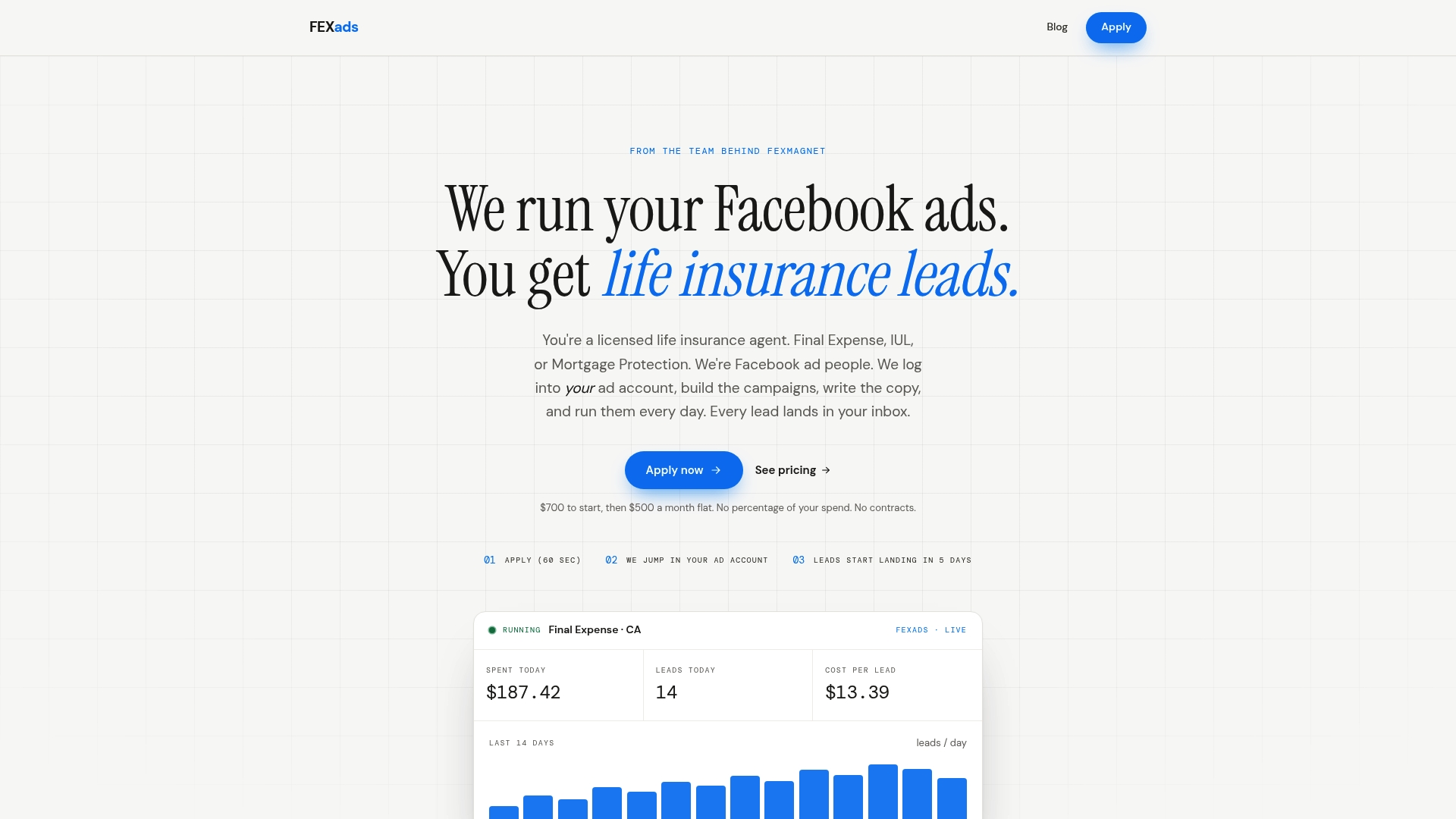
This service includes a custom campaign built around your specific offer, a dedicated landing page, a full ad account audit and pixel installation, compliance checks tailored to financial services ad policies, and ongoing creative refreshes so campaigns don’t go stale after a few weeks, without software rental fees or long-term contracts.
Choose the buy lane when you need appointments booked this week and don’t yet have the budget or patience for campaign ramp-up. Choose Fexads when you want a pipeline that gets cheaper to run every month you’re in it, because the audience data keeps compounding instead of resetting with a new vendor. Setup runs as a one-time $700 fee, with ongoing management at $500 per month billed separately from your ad spend. If you’re ready to see what a campaign built for your specific state and product line looks like, check Facebook ads by state to see what’s already running near you, then start your application.
Sources
For agents who want to dig deeper into the pricing and compliance details covered above, these resources back the figures and frameworks referenced throughout this article:
- Exclusive Insurance Leads: Costs and How to Buy Them | Lead Distro AI
- How Much Do Life Insurance Leads Cost in 2026? FE, IUL, and MP Pricing Breakdown — FEXmagnet Blog
- Insurance lead generation: Exclusive leads, no lists | MeritsOnly
- The Advisor’s Guide to Buying Life Insurance Leads
FAQ
Where Can I Get Exclusive Insurance Leads?
You can get exclusive insurance leads either by buying from a vetted vendor who provides TrustedForm or Jornaya documentation, or by building them through your own Meta ad campaigns and intake forms. The build path involves running campaigns inside your own ad account so the leads and data belong to you.
How Do I Generate Leads for My Insurance Business Without Buying Them?
Running targeted Facebook and Instagram campaigns in your own ad account, combined with a smart intake form that captures renewal date, is the most reliable way to generate inbound leads you own outright. A claimed Google Business Profile and referral engineering add durable, lower-cost volume over time as those channels mature.
What Is the Hardest Insurance Product to Sell From Leads?
Medicare and IUL tend to be the hardest products to sell from cold leads, since both require longer educational conversations and carry more regulatory complexity than a straightforward final expense policy. That complexity is part of why exclusive leads matter more here: a prospect who’s already fielded four other calls has little patience left for a longer, more technical pitch.
How Do I Know If a Lead Vendor’s “Exclusive” Claim Is Real?
Ask for TrustedForm or Jornaya certificates, sample raw lead records, and webhook delivery logs before you commit to volume. Running a small test batch and calling each lead to ask directly whether other agents have already reached out is the most reliable way to catch a vendor overselling the same record.
Recommended
Want us to run your FE ads?
$700 to launch, custom website included. $500 a month flat after that.
Apply now