Strategy
Ready to Paste Life Insurance Ad Copy: Tested for Agents
By Nick Georgalos · 15 min read · Updated 2026-09-10
Ready to Paste Life Insurance Ad Copy: Tested for Agents ! Agent recording a life insurance ad This article gives you paste-ready life insurance ad copy for Facebook, including headlines, body text, and CTAs across final expense, IUL, and mortgage protection, plus a testing playbook to run them.

This article gives you paste-ready life insurance ad copy for Facebook, including headlines, body text, and CTAs across final expense, IUL, and mortgage protection, plus a testing playbook to run them. You’ll find templates for single-image, short video, carousel, and lead form placements. Pick one template below, launch it, and give it 72 hours before you judge the results.
TL;DR:
- Facebook ads that convert combine emotional storytelling or utility hooks with low-friction offers, tailored to specific audiences and fears.
- Using short, attention-grabbing videos with on-screen text and a clear hook within the first few seconds significantly reduces cost per click and improves trust.
- Testing creative elements every 10 to 14 days and monitoring key metrics like click-through rate and cost per lead helps avoid rising CPA and campaign fatigue.
- Lead forms should be simple with three to four fields, and ad copy must avoid false guarantees or vague claims to stay compliant.
- Mismatched messaging for different product types, such as price for term life or permanence for final expense, diminishes audience targeting efficiency.
Table of Contents
- What Makes Life Insurance Ad Copy Convert on Facebook?
- Ready-to-Use Facebook Ad Templates for Life Insurance
- What Visual Formats Actually Convert for Insurance Ads?
- How Should You Target and Frame Offers by Funnel Stage?
- How Often Should You Test and Refresh Insurance Ad Creative?
- Deploying Ad Templates in Facebook Business Manager
- What Emotional Triggers Actually Drive Life Insurance Ad Response?
- How Do You Handle Objections Directly in Your Ad Copy?
- Should Term, Whole, and Universal Life Copy Read Differently?
- What Ethical Lines Should Insurance Ad Copy Never Cross?
- Practitioner Notes From Running These Campaigns
- Get Exclusive Facebook Leads Without Managing Ads Yourself
- Sources
What Makes Life Insurance Ad Copy Convert on Facebook?
Life insurance ad copy that converts on Facebook does three things at once: it interrupts the scroll in the first line, names a fear or hope the reader already has, and gets to a low-friction offer fast. Agents who treat this like generic insurance advertising, heavy on jargon and light on emotion, get expensive clicks and thin leads. The copy that actually pulls quote requests read more like a text message from a friend than a brochure line.
Campaigns that pair emotional storytelling with a clear, distinct value proposition consistently build more trust and recall than copy that leads with product features. That’s the whole game in effective insurance advertising: lead with the person, not the policy.
Emotion-first hooks
These work because life insurance is rarely bought logically. It’s bought to solve a worry.
- “Who pays for your funeral if you don’t plan for it?”
- “Your family shouldn’t have to choose between grieving and paying bills.”
- “$20,000 in final expenses. $0 saved. This is the gap most families never talk about.”
Utility-first hooks
Some buyers respond better to speed and simplicity than sentiment.
- “See your rate in under 2 minutes. No medical exam required for many plans.”
- “Coverage starting at less than a dollar a day.”
- “Get your free quote before your next birthday, rates only go up with age.”
Audience-specific hooks
- Seniors: “Still paying rent at 68? Here’s coverage that doesn’t outlive you.”
- New parents: “You just became someone’s whole world. Here’s how to protect it.”
- Homeowners: “If something happened to you tomorrow, could your family keep the house?”
One line of legal hedging matters more than most agents realize: never promise guaranteed approval, specific savings amounts, or “no medical questions” unless the exact product supports it. Meta’s ad review and state insurance regulators both flag copy that implies universal eligibility.
Ready-to-Use Facebook Ad Templates for Life Insurance
Copy any of these into the primary text and headline fields in Meta Ads Manager. Swap the bracketed details for your state, carrier, or offer.
- Term life, single image. Primary text: “A 20-year term policy can cost less than your streaming subscriptions. Lock in your rate while you’re young and healthy.” Headline: “See Your Term Life Rate in 60 Seconds.” CTA: Get Quote.
- Term life, retargeting. Primary text: “Still thinking about that quote? Rates go up every year you wait. Lock yours in today.” Headline: “Your Rate Is Waiting.” CTA: Learn More.
- Final expense, lead form. Primary text: “Funeral costs average over $9,000 in most states. See if you qualify for coverage that won’t burden your family.” Headline: “Check Your Eligibility.” CTA: Sign Up. Keep the lead form to 3 fields for the strongest completion rate.
- Final expense, UGC video. Script: Open on a real person talking to camera: “I didn’t want my kids stuck with my funeral bill. So I did this.” Cut to phone screen showing a quote form. Overlay text: “Takes 60 seconds. No exam for most applicants.”
- IUL, short video. Script: Hook on screen at second one: “What if your life insurance could also grow your retirement?” Voice-over explains cash value growth tied to market index performance, capped downside. Overlay: “Ask how IUL works for you.” Full IUL creative guidance covers scripting in more depth.
- IUL, carousel. Card 1: “Protect your family.” Card 2: “Grow tax-advantaged cash value.” Card 3: “Access funds while you’re alive.” CTA: Request a Consultation.
- Mortgage protection, carousel. Card 1: “$350,000 mortgage. $0 saved for the unexpected.” Card 2: “See how much coverage costs to protect your monthly payment.” Card 3: “Get your free quote today.” Details in the mortgage protection playbook.
- Mortgage protection, single image. Primary text: “If something happened to you, could your spouse keep making the mortgage payment alone?” Headline: “Protect Your Home Payment.” CTA: Get Quote.
- Universal life, testimonial-style. Primary text: “I wanted coverage that lasts my whole life, not just 20 years. Here’s what I found.” Headline: “Coverage That Never Expires.” CTA: Learn More.
- Cold audience, broad awareness. Primary text: “Most people overpay for life insurance because they never compare rates. See yours free.” CTA: Get Quote for top-of-funnel; switch to Sign Up once retargeting warms the audience.
What Visual Formats Actually Convert for Insurance Ads?
Short vertical video with a pattern interrupt in the first 1.5 to 3 seconds is the highest-performing format for insurance ads right now, and it cuts cost per click by 30 to 45% in tested accounts. A shaky phone-camera testimonial often beats a polished studio ad because it looks like a scroll-stopping moment, not a commercial.
- Open on a face or a bold on-screen question, never a logo or slow zoom.
- Use UGC-style footage for trust-building and cost-focused offers. Use cleaner studio footage for IUL and higher-ticket products where credibility matters more than relatability.
- Keep on-screen text under 8 words per frame, high contrast, and Meta’s native fonts rather than custom overlays that can look like clip art.
- For a 15 to 30 second ad, storyboard it as: second 0 to 2 (hook question), second 3 to 10 (problem), second 11 to 20 (solution and proof), second 21 to 30 (CTA card).
Pro Tip: Film three different opening lines for the same video body. Swapping only the first three seconds is the cheapest way to test hooks without rebuilding the whole creative.
How Should You Target and Frame Offers by Funnel Stage?
Cold audiences need broad appeal and low-commitment offers. Warm audiences need proof and urgency.
- Cold setup: Target by age band (35 to 65), homeowner status, or parental status, layered with broad interest categories like “life insurance” or “financial planning.” Avoid over-narrowing; Meta’s algorithm generally finds converters faster with room to work.
- Warm retargeting: Use social proof hooks like “Join the thousands who got covered this year” and pair with a countdown or rate-lock message.
- Lead form vs landing page: Instant lead forms typically produce more volume at a lower cost per lead, while a dedicated landing page tends to convert lower volume but higher-quality leads because it filters out casual clicks. Choose lead forms when speed matters most; choose a landing page when you need pre-qualification before a call.
- Friction-reducing offers: “See your rate in 60 seconds” or “No medical exam for many applicants” reduces hesitation better than a vague “get a free quote.”
Facebook remains the strongest platform for consumer life insurance, while LinkedIn tends to work better for business-owner audiences buying key-person or larger policies.
How Often Should You Test and Refresh Insurance Ad Creative?
Track four numbers: click-through rate, cost per lead, cost per quote, and quote-to-bind rate. Benchmarks put life insurance CPCs around $15 to $35 and CPLs commonly between $90 and $300, depending on vertical and funnel depth. Chasing CTR alone is a trap; a cheap click that never quotes is worthless.
Once a creative’s frequency climbs to roughly 2.5 to 3.0, CPA typically starts rising, which is your signal to swap the asset before it drags down the whole campaign.
- Refresh creative every 10 to 14 days, or sooner if frequency crosses 2.5.
- Run a test matrix across one variable at a time: hook, then creative format, then CTA, then audience. Testing all four at once tells you nothing.
- Use a fixed CPL calculator to sanity check whether your cost per lead lines up with your close rate before scaling spend.
- Give each test 3 to 5 days minimum before pulling the plug. Killing an ad after 12 hours usually kills a winner by accident.
Deploying Ad Templates in Facebook Business Manager
- Choose placement by format. Feed works for single-image and carousel; Reels and Stories favor vertical video with fast cuts and on-screen text.
- Structure the ad fields deliberately. Primary text carries the emotional hook and offer in the first line since Facebook truncates longer text. Headline restates the benefit in 5 to 6 words. CTA button should match funnel stage, Get Quote for cold traffic, Sign Up or Learn More for warm.
- Build lean lead forms. Stick to 3 or 4 fields (name, phone, email, maybe state), include the required carrier disclosures, and end with a confirmation screen that sets a callback expectation.
- Watch the first 72 hours closely. If cost per lead is running double your target benchmark, pause and swap the hook before touching the audience.
What Emotional Triggers Actually Drive Life Insurance Ad Response?
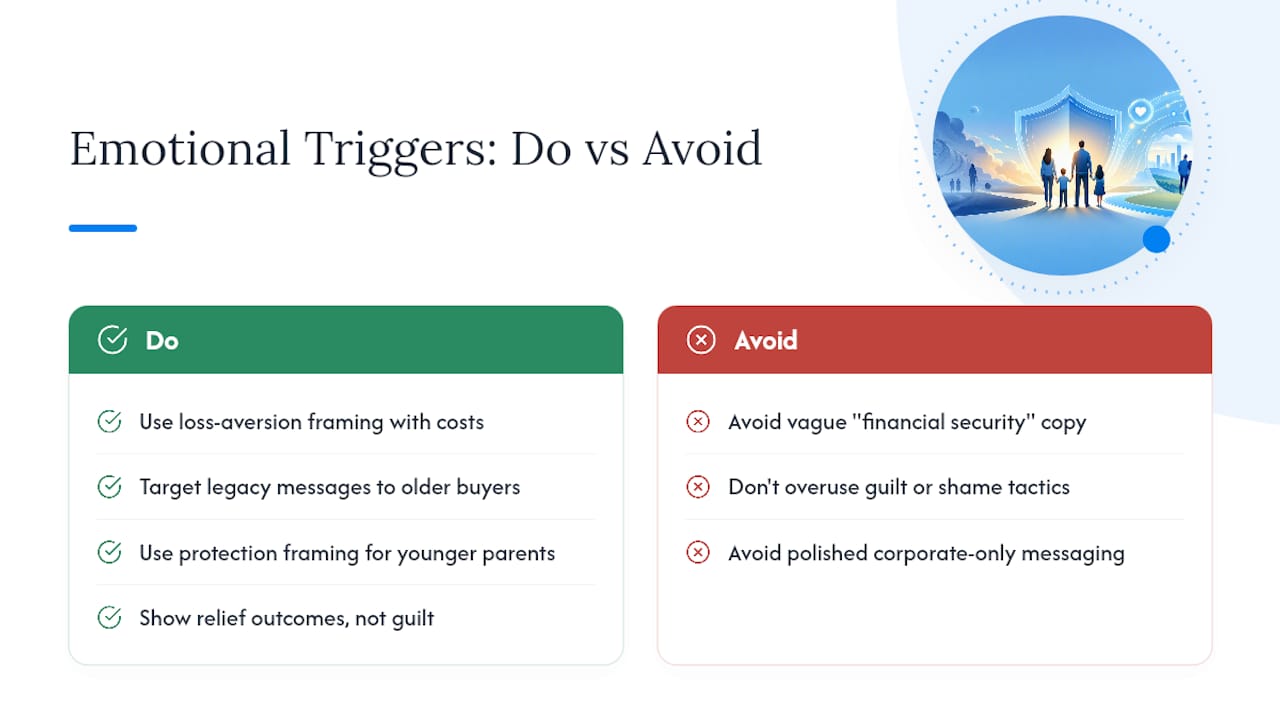
Loss aversion outperforms almost every other emotional lever in this category. People respond faster to the fear of leaving family with debt than to the abstract idea of “financial security.” Framing copy around a concrete cost, funeral bills, an unpaid mortgage, lost income for a spouse, works better than vague reassurance because it turns an abstract worry into a specific number the reader can picture.
Legacy and dignity messaging works especially well with older buyers shopping final expense coverage: “Leave something behind, not a bill” lands harder than “affordable coverage options.” For younger parents, protection framing beats legacy framing: “Who takes care of them if you can’t?” taps into an immediate, active fear rather than a distant one.
Guilt and burden messaging needs a light touch. Overdo it, “Don’t be selfish, protect your family,” and it reads as manipulative, which erodes trust fast in a category already associated with pushy sales tactics. The stronger move is anchoring on relief instead of guilt: show what it feels like when the burden is already handled, not what happens if it isn’t.
Humanized storytelling remains the connective tissue across all of this. A short personal anecdote paired with a clear offer tends to outperform polished corporate messaging, because it signals a real person solved this exact problem already.
How Do You Handle Objections Directly in Your Ad Copy?
The three objections that kill life insurance ad performance before a prospect even clicks are cost, distrust, and procrastination. Address them in the copy itself rather than waiting for the sales call.
“It’s too expensive.” Counter this with a specific, low anchor number rather than a vague affordability claim: “Coverage starting at less than a dollar a day” works better than “affordable rates.”
“I don’t trust insurance ads.” This is where the UGC-style, unpolished video format earns its keep. A real person talking directly to camera reads as more credible than a stock-photo family on a beach.
“I’ll do it later.” Urgency has to be honest to work in this category. “Rates increase with age, lock in yours while you qualify” is true and effective. Fake countdown timers or manufactured scarcity (“Offer ends tonight!”) on an evergreen insurance product will get flagged by Meta’s ad review and damage trust when prospects notice the same “deadline” the following week.
Build the rebuttal into the headline or the second line of primary text, not just the landing page. By the time someone clicks, the objection should already feel partly answered.
Should Term, Whole, and Universal Life Copy Read Differently?
Yes, and treating them the same is one of the more common mistakes agents make when repurposing one ad template across every product line.
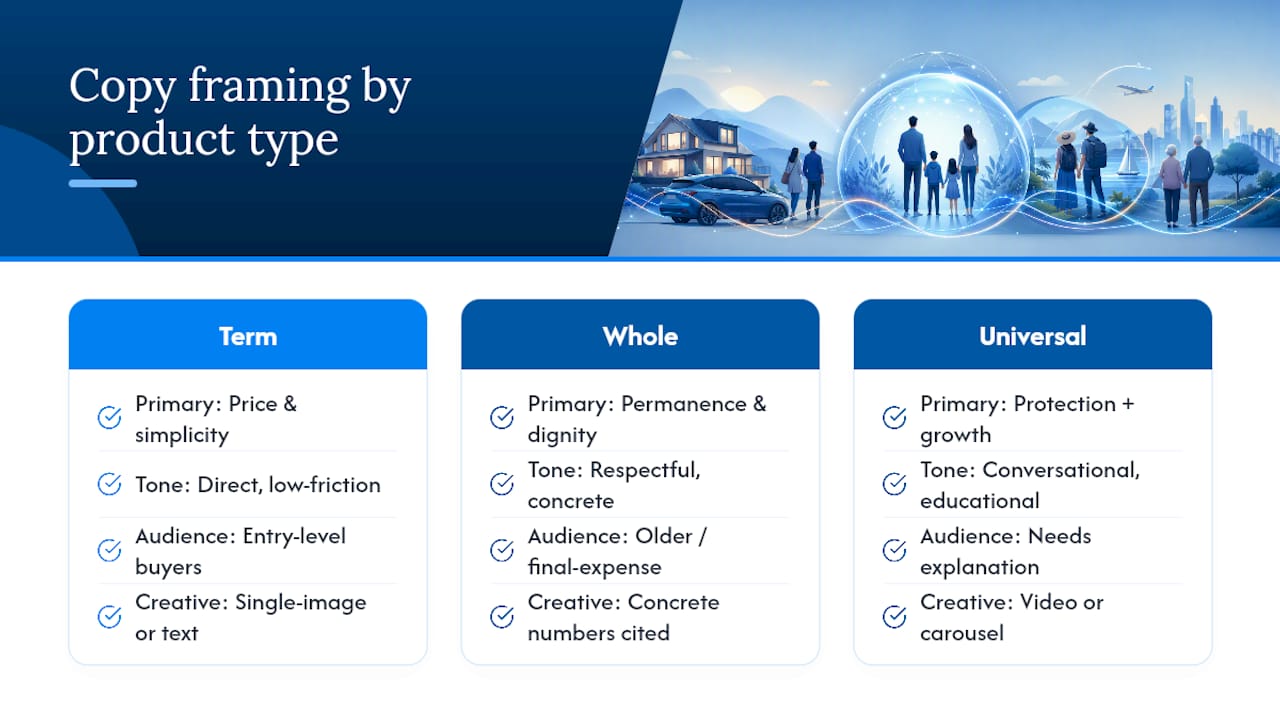
Term life copy should lean on price and simplicity, since term is the entry-level, easiest-to-understand product. “Lock in your rate for 20 years” or “Coverage for less than your coffee budget” fits the buyer who wants protection without complexity.
Whole life and final expense copy should lean on permanence and dignity. These buyers, often older, are thinking about guaranteed payouts and covering a specific, known cost like a funeral. Copy should reference concrete numbers (“funeral costs average over $9,000”) rather than abstract financial planning language.
Universal life and IUL copy needs to do more work, since the product itself is harder to explain in one line. Lead with the dual benefit: protection plus growth. “What if your life insurance could also build cash value?” sets up a conversation rather than trying to close in the ad itself. IUL ad copy almost always needs a video or carousel format to explain the mechanism, single-image ads with dense IUL copy tend to underperform because the concept doesn’t fit in one line.
Mixing these frames, running price-focused copy for a whole life product, or dignity-focused copy for term, confuses the targeting too. Facebook’s algorithm learns from who engages, and mismatched messaging attracts the wrong audience for the product you’re actually selling.
What Ethical Lines Should Insurance Ad Copy Never Cross?
Misleading claims in life insurance ad copy don’t just risk a Meta ad account ban, they create real legal exposure with state insurance regulators. The most common violations are subtler than agents think.
Avoid implying guaranteed approval unless the specific product is genuinely guaranteed issue. “No medical exam” copy needs to specify which product that applies to, since blanket claims mislead applicants who don’t qualify. Avoid stating a specific premium or coverage amount as universal (“Get $50,000 in coverage for $9.99”) when the real number depends on age, health, and state, use “starting at” language instead and be exact about what the reader is starting at.
Testimonials in insurance ads carry their own compliance weight. Only use real client statements with documented consent, and never fabricate a satisfied-customer quote to fill space, that’s not just an ethics issue, it’s a fast way to trigger a compliance complaint you can’t defend.
The honest version of these ads usually converts better anyway. Precise, specific claims read as more credible than vague superlatives, and credibility is the entire currency of this category.
Practitioner Notes From Running These Campaigns
Across final expense, IUL, and mortgage protection accounts, the pattern repeats: agents who trim primary text to two punchy lines and keep lead forms under four fields consistently outperform those running paragraph-length copy and long forms. The most common mistake isn’t the hook, it’s ignoring frequency until CPA has already climbed. Watch it weekly, not monthly.
— Nick
Get Exclusive Facebook Leads Without Managing Ads Yourself
These exact templates can be run and refreshed inside your own ad account, ensuring every lead belongs to you rather than being shared across agents buying the same rented list. That’s the core difference from buying leads: you own the pixel data, the audience learnings, and the account history, so your cost per lead actually improves over time instead of resetting with every new lead vendor.
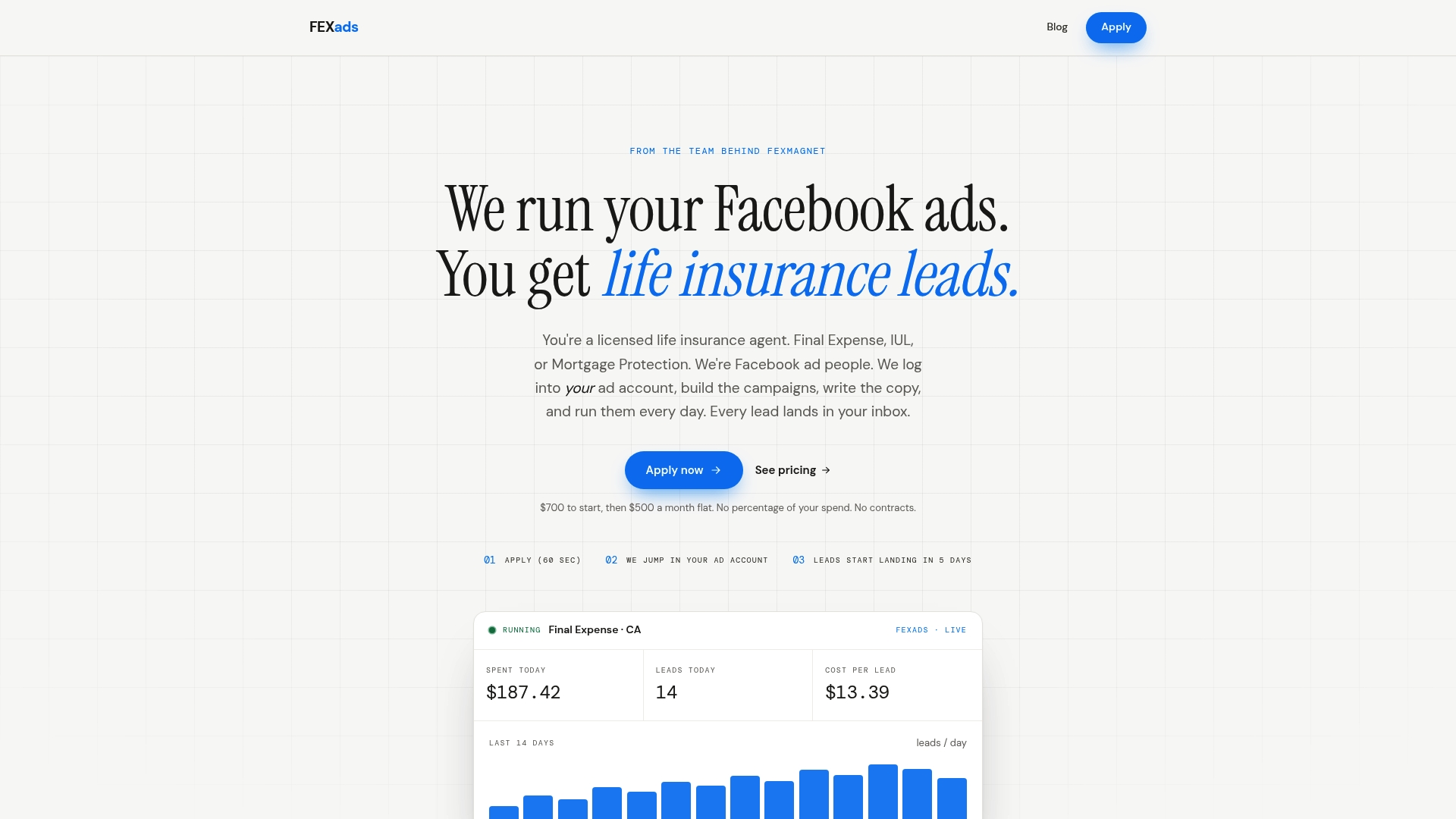
Setup can include campaign build, website and lead form creation, pixel installation, audience targeting, and ongoing creative refreshes tailored to life insurance products. Monthly management may cover daily optimization and compliance checks to help keep your ad account in good standing. Check state-specific final expense campaign details or start with the FexAds service overview to see what setup looks like for your book of business.
Sources
Benchmarks, creative strategy, and testing cadence above draw on the insurance ad performance guide and Meta’s frequency guidance.
- 10 High-Converting Insurance Ad Examples & Why They Work 2025 Guide
- The marketing tactics winning insurance customers today
- Insurance Ads 2026: benchmarks and funnel expectations
Recommended
Want us to run your FE ads?
Two plans from $200 setup. A flat monthly fee from $500 that starts at your first sale.
Apply now