Strategy
12 Life Insurance Ad Creatives Agents Can Use in Two Weeks
By Nick Georgalos · 10 min read · Updated 2026-09-07
12 Life Insurance Ad Creatives Agents Can Use in Two Weeks ! Agent arranging life insurance ad concepts This article gives you ready-to-use creative ideas and a short playbook for building high-impact life insurance ad creatives.

This article gives you ready-to-use creative ideas and a short playbook for building high-impact life insurance ad creatives. You’ll get twelve example concepts you can adapt this week, format and placement guidance, tested messaging hooks, targeting tactics that protect lead quality, and a two-week test sprint to get your first real data.
TL;DR:
- Family-first video and local county-specific headlines significantly outperform generic messaging among targeted audiences.
- Matching the creative angle to the correct age group improves conversion rates and reduces wasted ad spend.
- Tracking cost per lead, lead-to-application rate, and speed to contact are the most critical benchmarks for campaign success.
- Running disciplined two-week tests with aligned landing pages and consistent creative refreshes optimizes ad performance.
- Partnering with a managed campaign provider can help agents secure exclusive leads and improve workflow efficiency.
Table of Contents
- Life Insurance Ad Creatives Worth Copying Right Now
- Which Ad Format Fits Which Placement?
- What Messaging Hooks Actually Convert Leads?
- How Do You Match Creative to the Right Audience?
- What Benchmarks Should You Track?
- A Two-Week Playbook to Launch Your First Test
- What Can You Learn From Award-Winning Campaigns?
- The Gap Between Inspiration and Execution
- Get Exclusive Leads Without Building the Funnel Yourself
- Sources
Life Insurance Ad Creatives Worth Copying Right Now
The best life insurance Facebook ad examples share one trait: they make a huge, uncomfortable decision feel small and immediate. Below are twelve concepts that consistently outperform generic “get a quote” creative.
- The coffee-cost anchor. A static image with a coffee cup and the line “Less than $1 a day protects your family for 20 years.” Works because it converts an abstract premium into something the reader already spends money on.
- The regret testimonial. A short video of someone saying what they wished a parent or spouse had done sooner. Hindsight framing outperforms fear-based copy because it feels like advice, not a pitch.
- Family-first video (15 seconds). Open on a kitchen table scene, cut to a voiceover: “If something happened to you tomorrow, could they keep the house?” Ends on a soft CTA, not a hard sell.
- Mascot or personality-led creative. A recurring character or spokesperson builds recall across a campaign, the same way insurance ad campaigns that used character-led spots drove outsized awareness.
- County-specific headlines. “Franklin County families: here’s what a $25,000 policy actually costs.” Local specificity beats generic state or national framing, a tactic documented in Facebook ad examples from the insurance space.
- Final-expense direct-response static. Bold text, a senior-friendly font size, and a single question: “Been turned down for life insurance before?”
- The “secret” teaser video. A 10-second hook that promises to reveal “the one policy detail agents don’t explain,” driving curiosity clicks before the reveal in the landing page.
- Carousel comparing coverage tiers. Three cards, three price points, one CTA per card.
Which Ad Format Fits Which Placement?
Format choice depends on what the placement rewards, not personal preference.
- Feed video (15 to 30 seconds) carries storytelling weight. Use it for the family-protection narrative or regret testimonial, where tone matters more than speed.
- Static images and carousels communicate price and feature comparisons fast. These work well for the coffee-cost anchor or coverage-tier breakdowns.
- Stories and Reels reward urgency. A countdown-style CTA (“Rates go up with age. Check yours in 60 seconds.”) performs better here than a slow narrative.
- Feed video for awareness, paired with a retargeting sequence, tends to build the trust that a cold static ad can’t.
Design thumbnails so the first frame reads as a complete idea; most viewers decide in the first three seconds. Refresh creative every two to three weeks once frequency climbs, since life insurance audiences are narrow and fatigue sets in faster than in broader consumer categories.
What Messaging Hooks Actually Convert Leads?
Three frames dominate the highest-performing life insurance ad creatives, and each does a different psychological job.
- Everyday-cost anchoring. Translate the premium into a daily or weekly comparison the reader already understands, like a coffee, a streaming subscription, or a gym membership. This is a common practitioner technique for reducing the sticker shock of a monthly premium quote.
- Regret versus living-forward framing. Regret creative (“I wish my dad had done this”) drives urgency for older or risk-aware audiences. Living-forward creative, in the style Vitality used to win awards and double sales, works better for younger, health-conscious buyers who respond to reward framing rather than fear.
- Trust-building lines. “Apply in 5 minutes, no medical exam for many plans” pairs a speed promise with a friction-reducer. Keep compliance language accurate: never promise guaranteed approval or specific rates you can’t back.
Pro Tip: Test one regret-based hook against one living-forward hook in the same ad set. The winner tells you more about your audience’s mindset than any demographic data will.
Avoid stacking two emotional triggers in one ad. A single fear plus a single reward frame in the same creative usually confuses the message rather than reinforcing it.
How Do You Match Creative to the Right Audience?
Pairing the wrong hook with the wrong audience wastes spend before the ad ever gets a fair test.
- Seniors (65+): final-expense and “been turned down” creative outperforms general family-protection messaging.
- Parents (30 to 45): family-first video and mortgage-protection framing convert better than price-only anchors. See how this plays out in mortgage protection Facebook ads.
- Younger adults (25 to 35): coffee-cost anchoring and living-forward storytelling resonate more than regret framing, which can feel premature to this group.
- Use owned lists and lookalikes built from your best existing clients rather than broad interest targeting, and layer in county-level headlines for local trust.
Audience choice affects more than click-through rate. It shifts your cost per lead and your speed-to-lead expectations, since narrower, higher-intent audiences often convert faster but cost more per click.
What Benchmarks Should You Track?
Three numbers matter more than any vanity metric: cost per lead, lead-to-application conversion rate, and speed to lead (how fast you or your CRM contacts a new lead).
Benchmark check: Selected major insurance carriers report substantial digital ad spend in the U.S., a signal of how competitive this category has become for insurance ad spend. Independent agents won’t match that spend, but the takeaway holds: budget expectations should account for real competition in the auction, and CPL will vary significantly by vertical, age targeting, and creative quality.
Run any test long enough to gather a meaningful sample before judging it. A single day of data on a $20 daily budget tells you almost nothing; give each variant at least three to five days and a few dozen clicks before drawing conclusions.
A Two-Week Playbook to Launch Your First Test
Building life insurance ad creatives that convert isn’t about volume. It’s about a tight, disciplined test loop.
- Pick one angle (coffee-cost, regret, or family-first) and build 2 to 3 creative variants around it, not five unrelated ideas.
- Align your landing experience. Whether you use a lead form or a full landing page, the headline on the ad must match the headline on the landing page word for word.
- Confirm pixel and event tracking are firing correctly before you spend a dollar; broken tracking invalidates the entire test.
- Launch with a modest daily budget split evenly across variants, and resist touching it for the first 72 hours.
- Kill underperformers once one variant shows a CPL at least 30% higher than the leader with a reasonable sample size; scale the winner instead of adding new variants mid-test.
- Refresh creative at the two-week mark regardless of performance, since frequency creep quietly raises CPL even on winning ads.
Pro Tip: Build your instant form and your ad copy at the same time, not sequentially. Mismatched expectations between the ad and the form are one of the most common reasons a promising creative underperforms.
What Can You Learn From Award-Winning Campaigns?
Two campaigns outside the direct-response world hold real lessons for agents. Partners Life’s “The Last Performance” embedded life insurance messaging into a television entertainment property and reported strong audience reach and measurable sales uplift by meeting viewers inside content they were already engaged with, rather than interrupting them. Vitality’s storytelling worked because the creative matched an actual product mechanic, rewarding healthy behavior with lower costs, not just a nice narrative layered on top.
- Borrow the instinct to reduce ad fatigue by making the message feel earned, not intrusive.
- Avoid copying big-budget entertainment integrations directly; most agents lack that production scale.
- Use these cases as proof that tone and product truth matter more than production value.
- If running tests, refreshes, and pixel audits in-house stretches your time too thin, a managed provider that specializes in this exact niche can shorten the learning curve considerably; see this Marketing AI Adoption: From Rollout to Proven ROI · Tekkr for practical guidance on introducing AI into marketing workflows.
The Gap Between Inspiration and Execution
Most advice on life insurance advertising stops at “here are some ad examples,” as if inspiration were the hard part. It isn’t. The hard part is the boring middle: pixel setup, creative refresh cadence, and knowing when a CPL spike means the audience is exhausted versus when it means the creative genuinely failed.
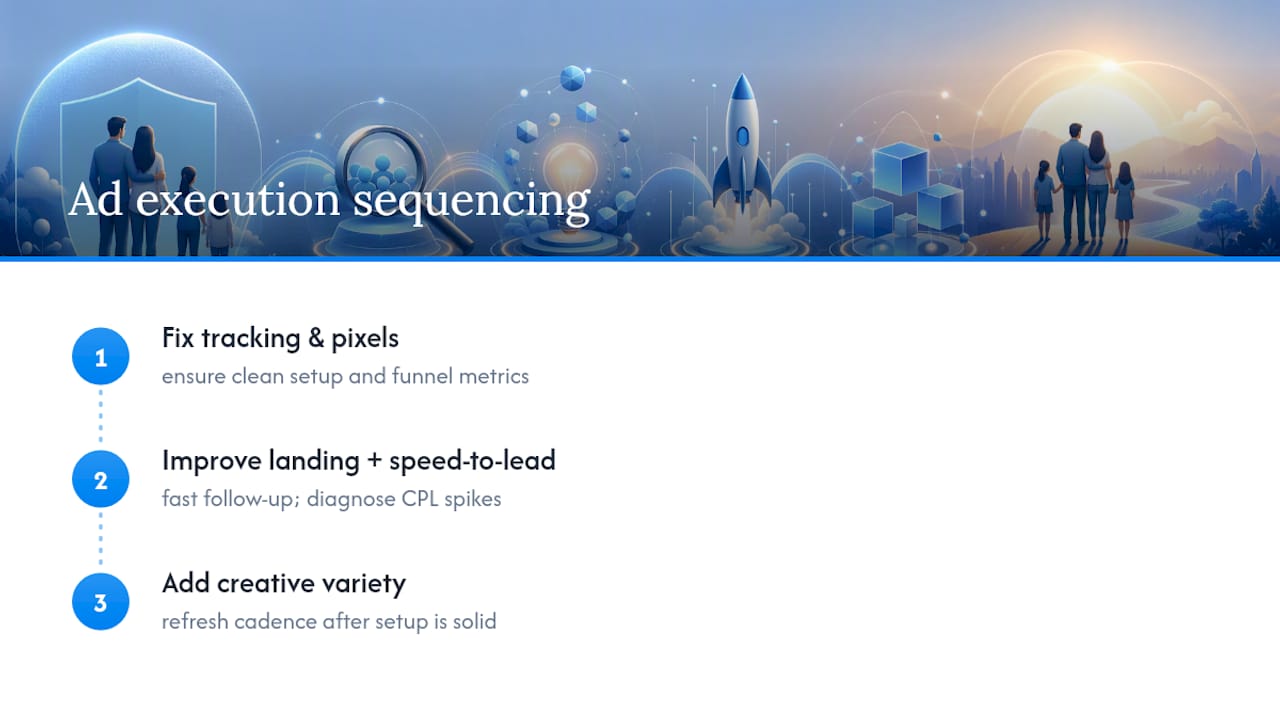
Conventional wisdom overweights emotional storytelling and underweights structural discipline. A gorgeous regret-based video with a broken instant form or a mismatched landing page headline will underperform a mediocre static ad with tight tracking and a fast follow-up process. Speed to lead, not creative polish, is often the single biggest lever agents leave untouched.
If there’s one priority to take from this, it’s sequencing: fix your tracking and your landing experience first, then invest in creative variety. Agents who reverse that order burn budget testing creative against a leaky funnel and blame the ad when the real problem was the setup underneath it.
— Nick
Get Exclusive Leads Without Building the Funnel Yourself
A managed provider can run the entire creative and campaign process for licensed agents so leads land directly in the agent’s own ad account, not in a shared pool sold to multiple agents. That distinction matters more than most agents realize until they’ve paid for rented leads that someone else already called.
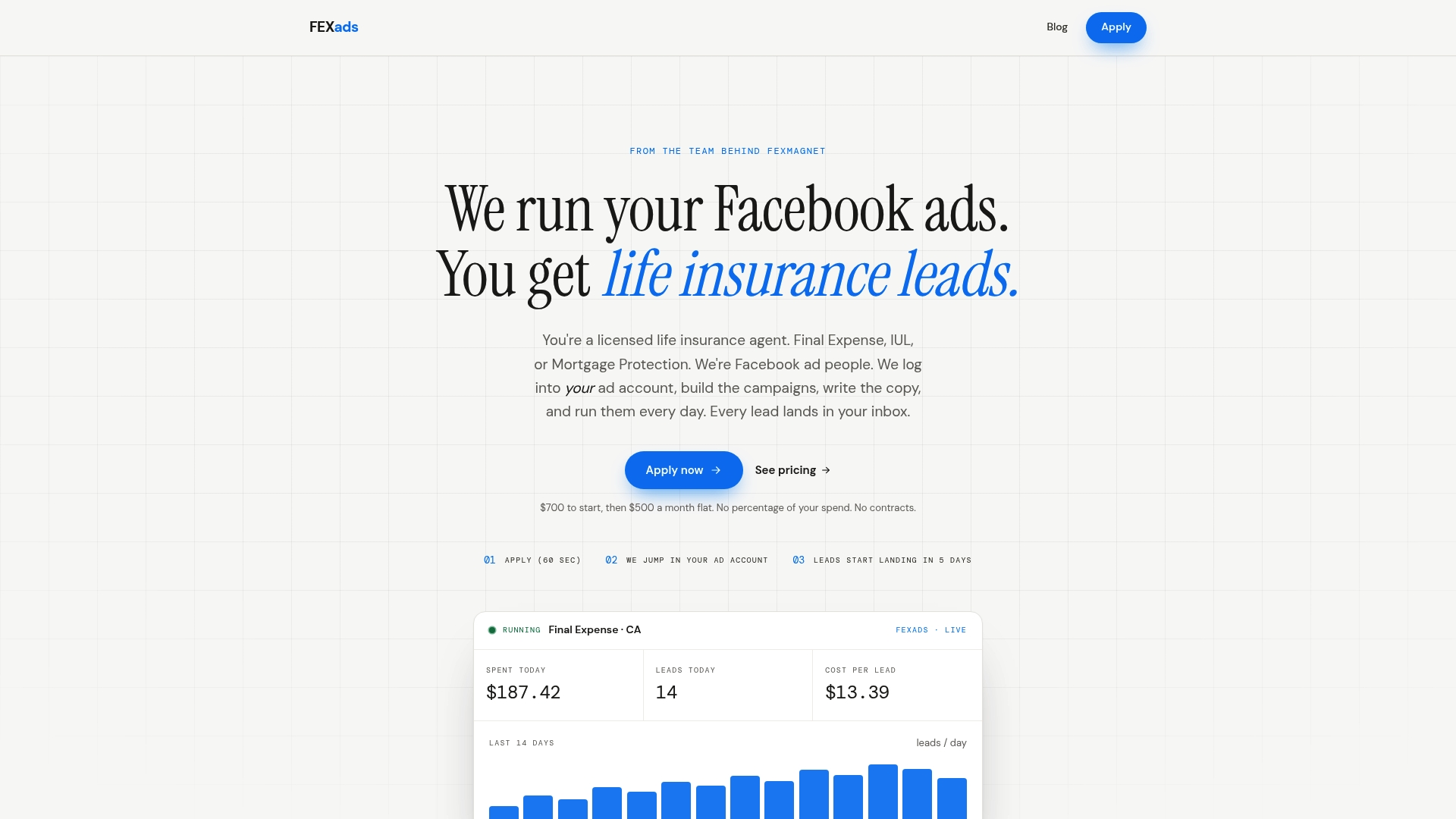
A typical engagement starts with a one-time setup covering campaign build, website or lead-form creation, pixel installation, and audience targeting, followed by ongoing monthly management that includes creative refreshes and daily optimization. Leads and campaign data remain owned by the agent. If you sell final expense, IUL, or mortgage protection and want to see what managed campaigns look like in your state, check FE Facebook ads by state to get started.
Sources
- Ad spend of selected insurance companies in the U.S. | Statista
- The 10 Best insurance ad campaigns | Insurance Business Magazine
- (SAVE A) LIFE INSURANCE – Unblock Coffee
- How Vitality won awards and doubled sales through storytelling – Amber Otting, RPC
Follow the campaign links above for full creative breakdowns and additional visual inspiration.
Recommended
Want us to run your FE ads?
Two plans from $200 setup. A flat monthly fee from $500 that starts at your first sale.
Apply now