Strategy
50 Conversions for Life Insurance Facebook Ads: Playbook for Agents
By Nick Georgalos · 14 min read · Updated 2026-08-28
50 Conversions for Life Insurance Facebook Ads: Playbook for Agents ! Hands sketching life insurance ad campaign ideas Yes, Facebook ads can generate quality life insurance leads, but only if you build the campaign around a screened conversion event instead of a raw form fill.

Yes, Facebook ads can generate quality life insurance leads, but only if you build the campaign around a screened conversion event instead of a raw form fill. The single biggest lever is technical: pass a qualified lead or booked call back through Conversions API so Meta’s algorithm learns from real intent, not just clicks. Everything else, targeting, creative, and funnel design, exists to support that one decision.
TL;DR:
- Using Conversions API to pass qualified leads or booked calls improves Meta’s algorithm learning and increases lead quality for life insurance campaigns.
- Geographic targeting remains effective at the state and regional level, while custom audiences from your CRM and website retargeting become crucial due to restrictions on demographic and interest targeting.
- Creative content should focus on short videos featuring agents speaking directly to viewers, emphasizing value and outcomes without referencing private attributes or using fear-based language.
- Qualifying questions on lead forms, combined with tracking proxy events like booked calls, help improve lead quality and campaign performance within slow underwriting timelines.
- Building a three-stage funnel—awareness, consideration, and conversion—along with deliberate sequencing and refreshment of creative assets, maximizes retargeting efficiency and overall ROI.
Table of Contents
- Why Facebook Still Works for Life Insurance Despite Special Ad Category Limits
- Targeting Strategies That Work Inside the Special Ad Category
- Ad Creative and Messaging That Convert Without Breaking the Rules
- Lead Forms, Qualification Fields, and the Right Conversion Event
- The Funnel and Retargeting Sequence That Nurtures Prospects
- Metrics and How to Calculate Your Allowable Cost Per Lead
- Practical Checklist to Launch a Compliant Test Campaign
- What Actually Works After Years of Watching These Campaigns Run
- How FexAds Runs This Playbook for You
- Where to Verify These Rules and Technical Details
- Sources
Why Facebook Still Works for Life Insurance Despite Special Ad Category Limits
Facebook remains one of the few channels where an agent can put a mortgage protection offer in front of a 32-year-old who just bought a house, or a final expense message in front of someone whose parent recently passed. The platform’s life-event signals and sheer reach make it a legitimate acquisition channel, not just a branding tool. The problem is that Meta doesn’t let you target on those signals directly anymore.
Life insurance falls under Meta’s Financial Products and Services Special Ad Category, a classification that strips out age, gender, and ZIP code targeting along with most detailed interest options. This rule exists to prevent discriminatory ad delivery in housing, employment, and credit-adjacent categories, and insurance got swept in with it. You can’t build an audience of “women 45 to 60 interested in retirement planning” anymore. That kind of granular targeting is gone for good.
What survives the restriction matters more than what got cut:
- State and regional geographic targeting, which stays fully intact for licensed agents working specific jurisdictions.
- Custom Audiences built from your own CRM or customer lists, which are exempt from most SAC limits.
- Broad, algorithm-driven delivery through Meta’s Advantage+ tools once you feed the system enough conversion data.
- Website and video retargeting based on pixel and Conversions API events, which becomes your primary compliant substitute for interest-based targeting.
The practical effect is that agents who used to lean on demographic filters now have to do more work upstream. Your lead form has to qualify people your targeting used to filter. Your creative has to attract the right viewer rather than relying on Meta to hand-pick them. And your first-party data, every CRM export, every past client list, becomes the closest thing you have to precision targeting.
Targeting Strategies That Work Inside the Special Ad Category
Losing granular demographic targeting doesn’t mean losing precision. It means moving precision upstream, into the data you already own and the creative that qualifies viewers before they click.
- Upload and segment your CRM lists. Past clients, aged leads, and even lapsed policyholders can become Custom Audiences. Split them by product line (final expense, IUL, mortgage protection) so your lookalike modeling stays clean rather than blended across unrelated buyer profiles.
- Seed Special Ad Audiences with your best customers. Special Ad Audiences are Meta’s SAC-compliant version of a lookalike. Feed them your highest-value converted clients, not your entire lead database, since seed quality drives match quality far more than seed size.
- Lean on life-event creative as a targeting proxy. Since you can’t target “new homeowners” directly, write and design creative that speaks to new homeowners, then let the message do the filtering your targeting can’t.
- Test Advantage+ once you clear a volume threshold. Advantage+ campaigns need real conversion data to work. If you’re generating 50 or more conversions a month, letting Meta’s algorithm find prospects often outperforms manual audience building.
- Prioritize retargeting segments by intent, not convenience. Quote-page visitors, 50%+ video viewers, and people who started but abandoned your lead form deserve separate ad sets, not one blended retargeting pool.
Pro Tip: Refresh your Custom Audience seed list every 60 to 90 days. A stale seed of clients from two years ago drifts from your current buyer profile, and Meta’s matching quality drifts right along with it.
First-party data is doing more work in this environment than it ever did before the SAC rules tightened, and agents who treat their CRM as a targeting asset consistently outperform those still trying to reverse-engineer interest targeting.
Ad Creative and Messaging That Convert Without Breaking the Rules
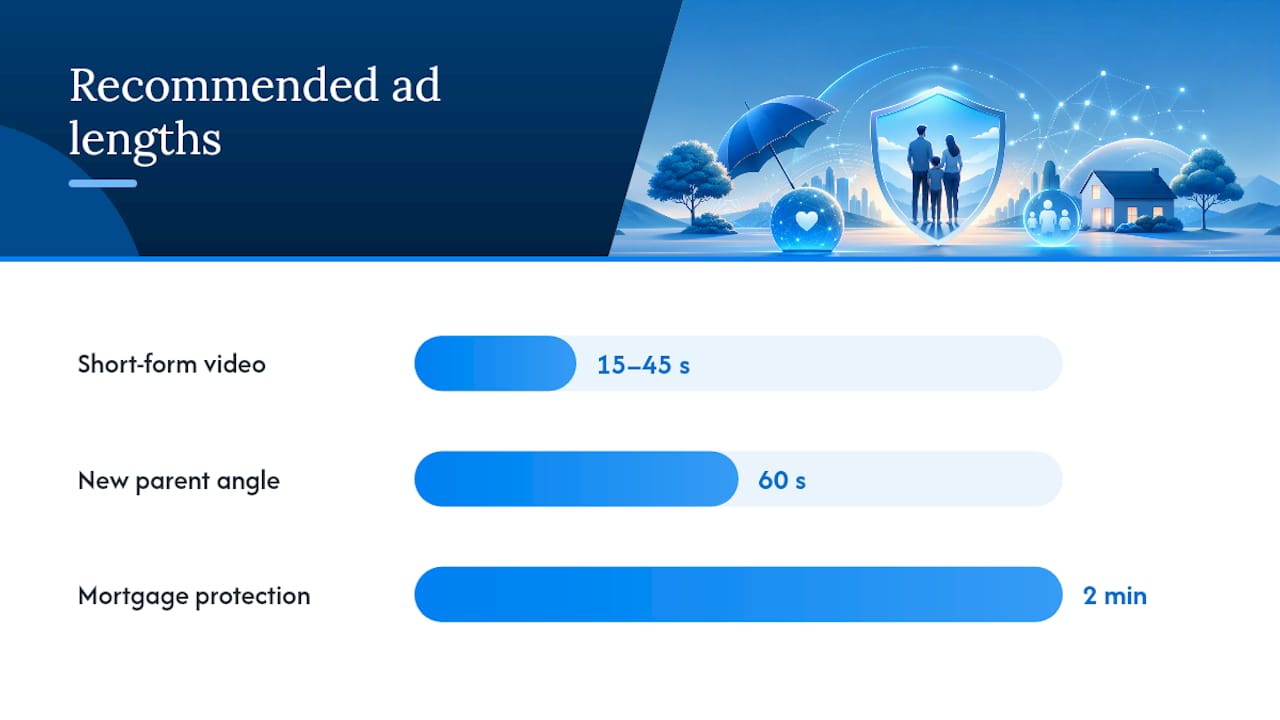
Short-form video, 15 to 45 seconds, built around an agent speaking directly to camera, consistently outperforms static images for life insurance advertising. It’s not a preference, it’s a trust mechanic: viewers qualify themselves in or out based on whether they believe the person on screen, and that self-selection is exactly what you want before someone reaches your form.
Statistic callout: Insurance verticals routinely show higher click and lead costs than most other advertising categories, largely because the audience is more skeptical and the product harder to explain in a single scroll, according to Scale Growth Digital. That’s exactly why value-first messaging, not price-first, tends to win.
Lead with value, not with a quote. Headlines like “See what final expense coverage actually costs at your age” or “Free mortgage protection calculator, 2 minutes” pre-qualify better than “Get a life insurance quote today,” because they promise something specific instead of asking for information first.
Language matters legally, not just stylistically. Meta’s Personal Attributes policy and the Special Ad Category rules bar creative that implies you know something private about the viewer, including their age or health status. That means you should avoid:
- Any direct age reference (“If you’re over 50…”)
- Health implications (“If you have a pre-existing condition…”)
- Fear-based framing (“You’re at risk without this coverage”)
Save those questions for your lead form, where the person has already opted in and disclosure is expected. On the ad itself, stick to product education and outcomes.
Angles worth testing:
- New parent: “What happens to your mortgage if something happens to you? See coverage options in 60 seconds.”
- Mortgage protection: “Most homeowners don’t know this about their mortgage. Here’s the 2-minute explainer.”
- Final expense: “The average funeral costs more than most people think. Here’s how to plan for it without breaking the bank.”
Lead Forms, Qualification Fields, and the Right Conversion Event
Meta gives you two form types for lead generation, and the choice between them shapes everything downstream. More Volume forms are shorter and produce more submissions at a lower cost per lead, but a bigger share of that volume is unqualified. Higher Intent forms add a confirmation step and support custom qualifying questions, which trims volume but consistently improves lead quality enough to justify the higher per-lead cost for most agents.
Two or three qualifying questions commonly balance lead quality and completion rate effectively, as adding more questions tends to reduce form completions. Good options include:
- “What’s your rough age range?” (broad buckets, not exact age, keeps this compliant on the form side)
- “Are you looking for coverage for yourself, a family member, or your mortgage?”
- “What’s the best time to reach you, morning, afternoon, or evening?”
None of these feel invasive, and each one gives you something to act on within minutes of the submission.
The harder technical decision is what event you optimize toward. A policy doesn’t issue for weeks after underwriting, which is far too slow and too rare an event for Meta’s learning window to optimize against. The fix is to pick a proxy event, a screened lead or a booked call, and pass it back through Conversions API rather than relying on the pixel alone.
Pro Tip: Set up server-side event deduplication between your pixel and Conversions API before you launch. Duplicate events inflate your reported conversions and quietly wreck the very optimization signal you’re trying to build.
Checklist for reliable event tracking: pixel installed and firing correctly, Conversions API connected through your CRM or a tag manager, and a defined “Qualified Lead” event triggered only when a submission clears your qualifying questions.
The Funnel and Retargeting Sequence That Nurtures Prospects
Life insurance rarely converts on the first touch. A three-stage funnel built around the natural length of that consideration cycle consistently outperforms single-ad campaigns:
- Awareness: Educational video content, myth-busting about cost or eligibility, run to cold and Special Ad Audiences.
- Consideration: A value-first lead magnet, a coverage calculator or a short checklist, retargeted to video viewers and landing page visitors.
- Conversion: A direct offer to book a call or complete a qualified lead form, shown to people who’ve already engaged with stages one and two.
Retargeting windows matter more than most agents realize. Landing page visitors who didn’t convert and form starters who abandoned midway are two more distinct groups, each needing a slightly different message: the first needs reassurance, the second needs a nudge to finish what they started.
Sequence your creative deliberately. Lead with information, follow with social proof or a testimonial-style angle, then close with the direct booking offer. Budget-wise, put the majority of spend into the awareness stage early on, then shift weight toward consideration and conversion once you see which creative earns real engagement. Refresh creative every two to three weeks, insurance audiences fatigue fast on repeated video, and a stale ad shows up in rising costs before it shows up anywhere else.

Metrics and How to Calculate Your Allowable Cost Per Lead
The math here is simple, but almost nobody in this industry runs it before launching a campaign. Your allowable cost per lead equals your average commission per issued policy multiplied by your historical close rate on similar lead sources, according to Scale Growth Digital.
Pay more than that consistently and the math doesn’t work, regardless of how the campaign feels day to day.
Track these KPIs alongside CPL, not instead of it:
- Lead-to-appointment rate (how many leads actually book a conversation)
- Appointment-to-application rate (how many conversations turn into paperwork)
- Application-to-issue rate (how many applications survive underwriting)
Compare in-house Meta leads against purchased exclusive leads at the issued-policy level, not the CPL level.
Chasing the lowest possible CPL is one of the more common ways agents sabotage their own campaigns. A cheaper lead that never answers the phone is worse than a pricier one that books a call, and issued-policy ROI, not CPL, is the number that should actually govern your budget decisions.
Practical Checklist to Launch a Compliant Test Campaign
Before spending a dollar, confirm the technical foundation is solid. A campaign built on a shaky pixel setup produces bad data faster than it produces leads.
- Verify your Business Manager and ad account, complete business verification, and confirm lead access permissions are set correctly for whoever needs to pull submissions.
- Install the pixel and connect Conversions API, then confirm both are firing the same qualified-lead event without duplication.
- Build ad sets segmented by life event or product line, final expense, IUL, and mortgage protection each get their own ad set rather than sharing a blended audience.
- Upload three to four creative variants per ad set, mixing video formats and messaging angles so you have real variation to test.
- Configure your lead form (Higher Intent for most campaigns), set up an immediate post-submit notification, and have a follow-up process ready before launch, not after.
Pro Tip: Give a new campaign at least 50 conversions before judging it. Killing an ad set after three days and eight leads tells you almost nothing about its real performance.
Run your first split test on creative angle, not audience, since creative is usually the bigger performance lever early on. Test form questions and audience seeds in the following round.
What Actually Works After Years of Watching These Campaigns Run
The mistake I see most often isn’t a targeting error or a creative flaw. It’s an agent chasing the lowest CPL number on the dashboard while ignoring how fast they’re actually calling leads back. A $35 lead contacted within five minutes beats a $20 lead contacted the next morning, every time, because intent decays fast once someone closes the app.
What consistently works: screened leads over raw form fills, owning your data instead of renting it, and short authentic video over polished stock creative…
Deciding whether to run this yourself or hire a managed partner comes down to one question: can you sustain the conversion volume needed to let Meta’s algorithm actually learn, and do you have the bandwidth to optimize creative weekly? If not, that gap is where a managed approach pays for itself.
— Nick
How FexAds Runs This Playbook for You
Fexads builds and manages Facebook ad campaigns that generate exclusive leads directly inside your own ad account, not a shared pool sold to three other agents in your area. That includes Conversions API setup, creative production, compliance checks, and daily optimization, all the technical groundwork this guide just walked through, handled for you.
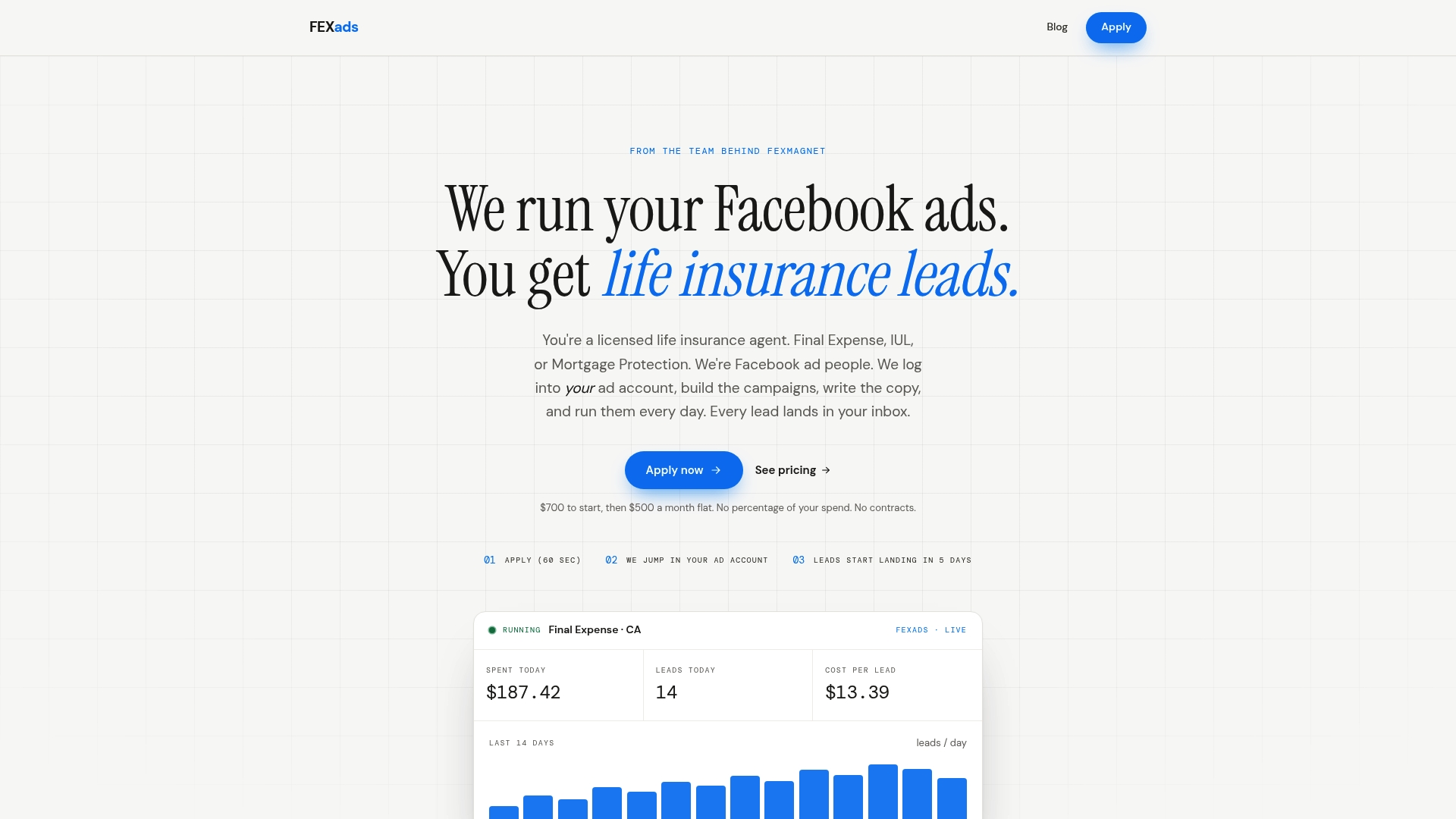
This fits best for final expense, IUL, and mortgage protection agents who want a predictable, quality-adjusted cost per lead without renting leads or managing pixel configurations themselves. Every lead lands in your account, every piece of audience data belongs to you, and the campaign keeps improving because you own the history behind it.
If you want to see what this looks like in your state, check FE Facebook Ads by State for setup details specific to your licensing region. And before you commit to a budget, run your numbers through the CPL calculator to know exactly what you should be paying per lead before you spend a dollar on ad spend.
Where to Verify These Rules and Technical Details
Platform rules change without much warning, so verify the current version before you launch anything.
- Meta’s Special Ad Category documentation covers the exact targeting restrictions for financial products and services.
- Meta Ads for Life Insurance Leads walks through Conversions API setup and screened-event strategy in more technical depth.
- Facebook Ads for Insurance: Lead Gen Strategy breaks down lead form types and CPL benchmarking further.
- FexAds’ blog hosts ongoing teardowns and state-specific playbooks as rules and formats shift.
Sources
- Special ad categories - Meta Business Help
- Meta Ads for Life Insurance Leads (2026) — Elevarus
- Facebook Ads for Insurance: Lead Gen Strategy - Scale Growth Digital
Recommended
Want us to run your FE ads?
$200 to launch, custom website included. $500 a month flat, starting at your first sale.
Apply now