Strategy
How to Break Even Buying Leads as a Life Insurance Agent
By Nick Georgalos · 14 min read · Updated 2026-10-28
How to Break Even Buying Leads as a Life Insurance Agent ! Calculator beside a life insurance lead calculation You break even on purchased leads when the commission from the policies they produce equals what you paid for them, plus your own costs.

You break even on purchased leads when the commission from the policies they produce equals what you paid for them, plus your own costs. The formula is short. Most agents get it wrong because they run it on the price per lead instead of the cost per placed policy. This guide shows the math, a worked example with final expense numbers, and how to test a lead source before it eats your month.
TL;DR
- Break-even is not a cost per lead. It is the highest cost per placed policy your commission can cover after overhead, chargebacks and lapses.
- Cost per placed policy = lead cost ÷ (contact rate × close rate × placement rate). A cheap lead with a low contact rate can cost more than an expensive one.
- Use net commission, not the advertised advance. A 15% first-year lapse can erase most of the margin on a final expense policy.
- Test any lead source with a small batch, track every lead to an outcome, and recalculate monthly.
- Exclusive leads from your own ad account change the inputs: nobody else is calling the same person first.
Table of Contents
- The break-even formula, in plain terms
- What to put in the calculation
- A worked example with final expense numbers
- Why commission is not the same as profit
- Exclusive leads versus shared or rented leads
- Lead age, contactability and follow-up speed
- How to test a lead source before committing
- How often to recalculate
- Our perspective
- Running your own ads as a break-even lever
- FAQ
- Sources
The break-even formula, in plain terms
The Small Business Administration defines break-even as the point where total cost equals total revenue. Its unit formula is fixed costs divided by the sales price per unit minus the variable cost per unit.
For a life insurance agent, translate it like this:
- Unit = one placed policy (issued, paid and in force), not one application.
- Revenue per unit = the commission you actually keep per policy.
- Variable cost per unit = lead cost per placed policy, plus anything that scales with sales, such as carrier chargebacks or dialer minutes.
- Fixed costs = CRM, licenses, E&O, phone, your website, any monthly ad management fee.
The lead cost per placed policy is where agents lose money without noticing. Kadence puts it as lead cost ÷ (contact rate × close rate × placement rate) on a per-lead basis. The useful part is that the formula separates three different failures: you never reached the person, you reached them and did not close, or you closed and the carrier did not issue.
ClosrLeads uses the same logic and adds a related number, the break-even write rate: the minimum write rate at which a lead program covers its lead cost. That is the number to know before you buy anything.
What to put in the calculation
A break-even that only counts the invoice from the lead vendor is a guess. The SBA suggests allocating fixed costs to the period you are analyzing, splitting semi-variable costs into fixed and variable portions where you can, and considering about 10% extra for unpredictable miscellaneous expenses.
For an agent working a monthly batch of leads, that means:
- Lead spend for the month, including any ad spend if you generate your own.
- Tools and fees you would not pay if you stopped buying leads: dialer, texting, funnel or website, management fees.
- Your time, if you want a true number. Set an hourly value and count the hours spent dialing dead numbers.
- A 10% cushion for the things that always come up.
- Net commission per placed policy, after expected chargebacks.
Write these on one page. If you cannot fill a line, that is the line to start tracking.
A worked example with final expense numbers
The figures below are illustrations, not benchmarks. Swap in your own.
Say you pay $20 per lead. Out of 100 leads:
- You reach 50 (50% contact rate).
- You close 10 of those (20% close rate).
- The carrier issues 8 (80% placement rate).
The composite rate is 0.5 × 0.2 × 0.8 = 8%. Your cost per placed policy is $20 ÷ 0.08 = $250. If your net first-year commission is $700 per policy, you keep $450 before fixed costs and the 10% cushion.
Now flip it. The break-even composite rate is lead cost ÷ commission: $20 ÷ $700 = about 2.9%. You can afford to be well below your current rate on paper. In practice, the gap shrinks quickly once overhead and lapses come in.
Three lead types, same commission
Here is how different inputs play out against the same $700 net commission:
| Lead type (illustrative) | Cost per lead | Contact | Close | Placement | Composite | Cost per placed policy |
|---|---|---|---|---|---|---|
| Older shared lead, called by several agents | $9 | 30% | 10% | 75% | 2.25% | $400 |
| Mid-priced lead, some competition | $20 | 50% | 20% | 80% | 8% | $250 |
| Exclusive lead, fast follow-up | $28 | 60% | 25% | 80% | 12% | $233 |
The cheapest lead has the highest cost per placed policy in this example. The most expensive has the lowest. That is the whole argument for judging a source by cost per placed policy and not by sticker price. For reference, final expense agents typically pay about $9 to $28 per lead on Facebook, and our final expense leads breakdown shows what each lead type costs.
Why commission is not the same as profit
Two things sit between a written policy and money in your account: whether the policy stays in force, and how the carrier pays.
The NAIC issue paper on policy acquisition costs notes that commissions are generally recognized when they are probably payable, and discusses arrangements tied to premium payment and persistency. In plain terms, many commissions are advanced against premiums that have not been paid yet. If the client stops paying, the advance can come back.
Payment method matters here. One industry source reports that annual pre-pay has a 3% to 5% annual lapse rate, against 20% to 30% for direct bill payments by check. Final expense buyers often prefer to pay in small monthly drafts, so check your own book instead of assuming the low number.

The effect is large. A final expense live transfer model from Decide Fast Business shows that at $100 per transfer, a $700 first-year commission and a 20% placement rate, lead cost is $500 per placed policy before overhead, chargebacks and lapse risk. It then shows a 15% first-year lapse raising the effective cost per retained policy and nearly eliminating the margin.
So adjust your commission input:
Net commission = advance × (1 − expected chargeback rate)
In the $700 example with a 15% chargeback rate, net commission is $595. Your $250 cost per placed policy now leaves $345 before fixed costs, not $450. Re-run the table with that figure and see which rows still work.
Exclusive leads versus shared or rented leads
The contact and close rates in your formula are not fixed facts. They depend on who else is calling. When a lead is sold to several agents, the first one to dial often gets the conversation, and everyone else gets a person who is tired of the phone. That pushes down contact rate and close rate, which are the two biggest multipliers in the denominator.

Exclusive leads cost more per lead because they cannot be resold. They can still cost less per policy, as the table shows. The honest way to compare is to run both through the same formula using your own tracked rates, not the vendor’s claims. Our guides on buying final expense Facebook leads versus running your own ads and first-party versus third-party leads go deeper on that comparison.
There is a second, quieter difference. When you buy a lead, the vendor owns the relationship with the source. When you run ads in your own account, you own the ad account, the pixel and the data, and your cost per lead can fall as the account learns. A rented lead gives you none of that.
Lead age, contactability and follow-up speed
Three inputs move your rates more than anything else:
- Age. A lead that raised a hand this morning is a different prospect from one who did so last month. Aged leads are cheap because the contact rate is low. If you buy them, use a contact rate from your own aged batches, not from fresh ones.
- Contactability. Landlines, wrong numbers and bad data all reduce the rate at which you can even start a conversation. Ask what is screened out before you pay. Verified phone numbers lift the contact rate, so a higher price can still be cheaper.
- Speed. Calling within minutes is a different game from calling the next day. If you cannot call fast, use the lower end of your contact and close rates when you model a source.
Follow-up after the first call also matters. Many sales happen on the third or fifth touch, not the first. Building a simple routine of lead nurturing strategies means leads that do not buy on day one still count toward your placed policies. Update your close rate when your follow-up improves, and not before.
How to test a lead source before committing
Do not buy a month of leads on a promise. Run a test small enough to survive being wrong.
- Set your ceiling first. Take your net commission, subtract fixed cost per policy and a 10% cushion. That is the most you can pay per placed policy.
- Buy a batch of 100 or more. Fewer leads give you noise. Ten sales from 40 leads tells you little.
- Tag every lead. Mark each one as no contact, contacted, appointment, application, issued or lapsed. A spreadsheet works.
- Compute the three rates. Contact, close and placement, separately, so you can see which one is failing.
- Compare to break-even. If your cost per placed policy is below your ceiling, scale slowly. If it is above, find the failing rate before blaming the vendor.
- Wait for placement. Early sales are not final. Check the batch again after the carrier has issued and again after the first lapse window.
Our article on how many final expense leads it takes to make a sale gives you a sense of what ratios to expect, and the cost per lead benchmarks for insurance agents help you sanity-check a quote.
How often to recalculate
Recalculate every month, and any time one input moves by a lot. Lead prices change. Carriers adjust commission schedules. Your own close rate improves as you get better at the call, and it falls when you are busy and slow to follow up. A number you worked out in January can be wrong by June.
A simple routine: on the first of the month, close out last month’s batch, update the three rates with real data, recheck net commission against chargebacks, and set the new ceiling. Rolling 90-day averages are steadier than one month, especially if you sell a few policies a month and a single sale moves the rate.
Our perspective
Most agents who tell us they are “breaking even” on leads are not measuring it. They know what they spent and roughly what they wrote, but not what lapsed, what was never contacted, or what the tools cost. The result is a feeling, not a number.
We built our service around making that number visible. Ads run in the agent’s own Meta account, so the agent owns the account, pixel, site and every lead. Nothing is shared or resold, which means the contact and close rates you measure are yours and no other agent’s. The FEXmagnet portal shows nightly spend, leads, cost per lead, sales and profit, so break-even is something you check daily and not something you work out in a spreadsheet after the month has gone.
We also think the monthly fee should not start before a sale. That is why our fee begins at the agent’s first sale. It keeps the early math honest while you find out what your numbers are. And we check every ad against Meta’s financial services rules before it runs, because a rejected ad is a cost nobody puts in the formula.
The best fit is an agent selling $5K or more a month in annual premium. Below that, fixed costs take a bigger bite, and break-even is harder to reach with any lead source.
— Nick
Running your own ads as a break-even lever
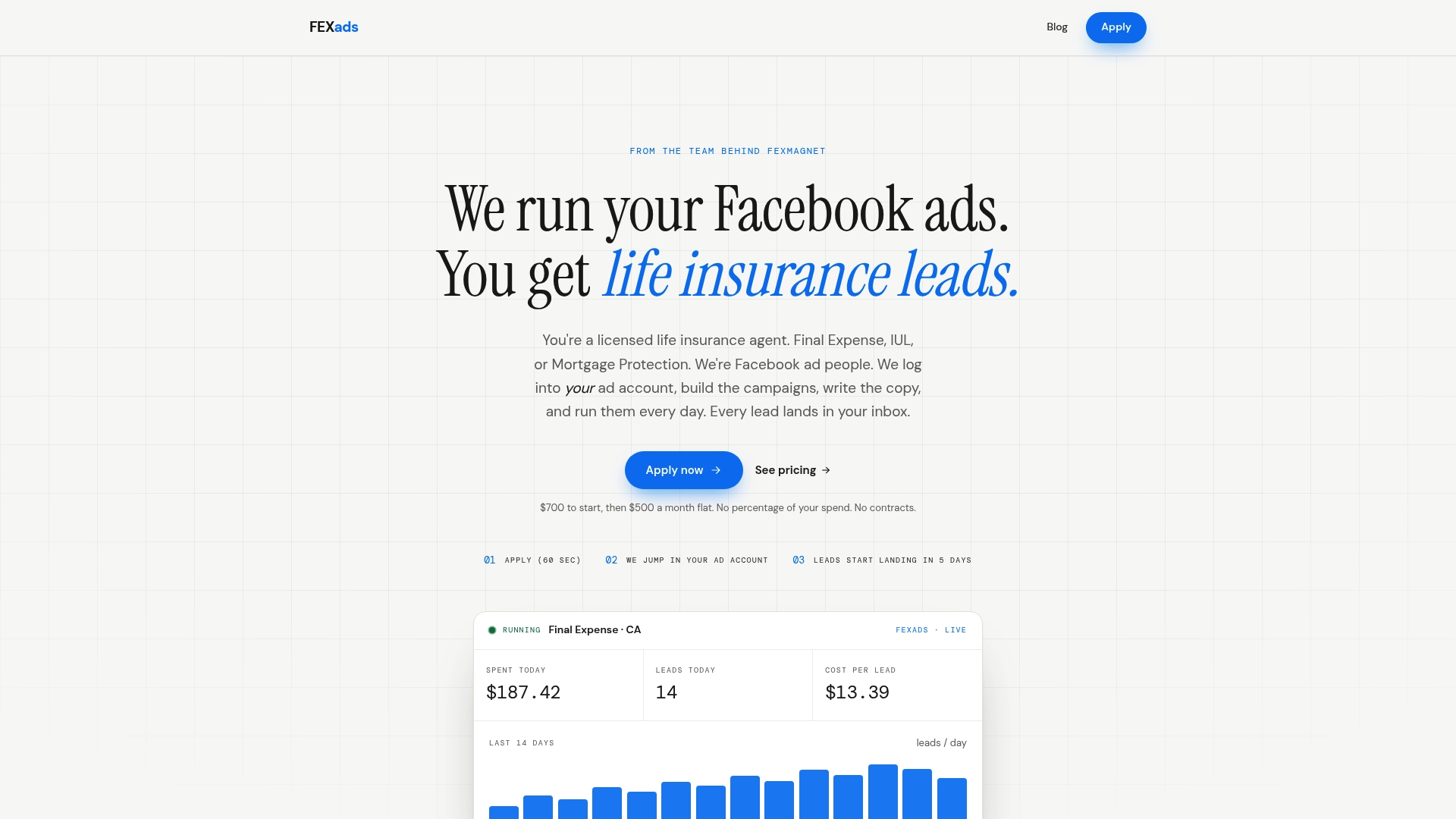
If your numbers show that rented leads barely clear break-even, the next step is to change the inputs rather than haggle over price. We set up and run Facebook ads for final expense, mortgage protection and Medicare agents inside the agent’s own Meta account.
There are two plans. Standard is a $200 setup, then $500 per month starting at your first sale, and includes instant-form ads and a simple website. Funnel is a $1,000 setup, then $750 per month from your first sale, and adds a quiz funnel site where every lead is verified by a text code and landlines are screened out. Ad spend is separate, at a $50/day minimum, paid to Meta on your card.
To see the arithmetic: $50 a day over a 30-day month is $1,500 in ad spend. With the $500 Standard fee, that is $2,000 a month. At the illustrative $700 net commission above, that is about three placed policies to cover the month. Your own cost per lead and rates will decide how quickly that happens, and we cannot promise a result. You can see how the process works on the Fexads site.
For a closer look at what Facebook leads cost, read our Facebook cost per lead data for insurance agents, or look up cost per lead in our glossary.
FAQ
What is a good break-even point for buying leads?
There is no universal number. It is the cost per placed policy at which your net commission covers lead cost, fixed costs and a cushion. Work it out from your own contact, close and placement rates, then compare each lead source against it.
How many leads do I need to break even?
Divide your total monthly cost by your net commission per placed policy to get the policies needed. Then divide that by your composite rate (contact × close × placement) to get the leads. At $2,000 in costs, $700 net commission and an 8% composite rate, that is three policies from about 38 leads.
Is a cheaper lead always better?
No. A cheap lead with a low contact rate can cost more per placed policy than a pricier one that people answer. Judge sources by cost per placed policy, measured on a batch of at least 100 leads.
Should I count lapses and chargebacks?
Yes. If a client stops paying, the advance can be reclaimed, so use net commission in your formula. Check your own lapse history by payment method rather than assuming a number.
Sources
- Break-even point, U.S. Small Business Administration
- How to Calculate True Cost Per Placed Policy, Kadence
- Insurance Lead ROI Calculator, ClosrLeads
- Policy Acquisition Costs and Commissions, NAIC
- Chargeback Prevention for Life Insurance Agents
- Final Expense Live Transfer Economics Explained, Decide Fast Business
Recommended
Want us to run your FE ads?
Two plans from $200 setup. A flat monthly fee from $500 that starts at your first sale.
Apply now