Strategy
Broad Targeting vs Interests: What Life Insurance Agents Should Run
By Nick Georgalos · 14 min read · Updated 2026-10-27
Broad Targeting vs Interests: What Life Insurance Agents Should Run ! Agent comparing two life insurance ad audience plans Broad targeting means you give Meta little more than a location and let its delivery system find the people most likely to respond.

Broad targeting means you give Meta little more than a location and let its delivery system find the people most likely to respond. Interest targeting means you pick topics and behaviors up front and ask Meta to favor them. For a life insurance agent in the US, the honest answer is that broad is usually the better default and interests are a supporting test, because insurance ads sit under special ad category rules that already strip out most of the narrowing tools. What decides results is the creative, the offer, and how fast you call the lead.
Below: what each option really does today, how the insurance restrictions change the question, a fair way to test both on a small budget, and the metrics that tell you which one is working.
TL;DR
- Broad targeting lets Meta’s algorithm choose who sees your ad. Interest targeting steers delivery toward topics you pick, and in many current setups it is a suggestion, not a fence.
- Insurance ads in the US run under Meta’s Financial Products and Services special ad category, which removes age, gender and ZIP targeting. That makes “broad” closer to the default than a bold choice.
- Test the two with the same budget, same ads, same lead form and a clean split. Never judge them by cost per lead alone.
- Judge winners by cost per booked appointment and cost per sold policy, not by the cheapest form fill.
Table of Contents
- What each option actually means
- Why interests lost ground
- The insurance twist: special ad category rules
- When interests still make sense for an agent
- How to test broad against interests on a small budget
- What to track beyond cost per lead
- Perspective: where we land on this
- How we run this for agents
- FAQ
- Sources
What each option actually means
Broad targeting uses wide parameters, typically location and age, and lets Meta’s delivery system optimize toward people likely to take your desired action, without you specifying the audience upfront. Your ad creative does much of the targeting work: who stops, reads and fills in the form teaches the system who to find next.
Interest targeting filters or steers delivery by topics and behaviors, such as people who engage with pages about retirement, funeral planning, home buying or family finance. It zeroes in on a smaller slice you believe is higher intent.
There is a nuance most agents miss. In current Meta setups, interests entered as audience suggestions are not always a strict restriction. Meta can deliver beyond them when it predicts better performance, and a hard interest limit exists only where Meta permits it. So the real choice is often between “no hints” and “some hints”, not between “everyone” and “only these people.” Our Advantage+ campaigns glossary entry covers how that automation behaves.
| Broad targeting | Interest targeting | |
|---|---|---|
| What you set | Location, minimum age, little else | Topics and behaviors as a hint or limit |
| Who decides delivery | Meta’s algorithm | You first, Meta second |
| Reach | Wide pool, room to scale | Smaller pool, can saturate |
| Learning phase | Needs enough conversions to learn | Gives a head start on a fresh account |
| Main risk | Wasted spend if the creative is weak | Narrow audience, rising cost as it saturates |
| Where the work goes | Creative and offer | Audience research and testing |
Why interests lost ground
Two things happened. First, Meta’s delivery system got better at using signals such as past conversions, pixel data and how people interacted with earlier ads. Meta’s Advantage+ tools use those signals to find an audience, and your suggestions are optional. Second, Meta keeps removing detailed options. Meta continuously removes certain detailed targeting options, including some linked to health, race or ethnicity, and has deprecated other granular ones. That is a problem for anyone whose interest stack was built around life events or health topics.

Meta’s own analysis, reported back in 2021, pointed the same way: interest audiences that are too narrow can significantly limit reach for the same budget compared with broader targeting. If you want a wider view of how targeting changes ripple through campaign planning, audience targeting explained is a reasonable companion read.
None of this means interests are dead. Practitioners still describe a place for them: smaller budgets, fresh pixels and new markets, where the system has no history to learn from. Broad needs data. Interests can stand in for data at the start.
The insurance twist: special ad category rules
Most articles on this topic are written for online stores. Life insurance is different, and it changes the answer.
In the US, insurance counts as a financial product for Meta’s purposes. According to a 2026 rundown of Meta’s special ad category rules, campaigns in the Financial Products and Services category lose ZIP code, age and gender filters, lookalike audiences and saved audiences, and Meta widens city or pin locations to at least 15 miles in the US. You declare the category at the campaign level, and agents who skip that step risk restricted ad accounts. Insurance agent guidance from a brokerage lands in the same place: with narrow demographic tools gone, results depend more on creative, clear messaging, responsible data use and lead follow-up.
What that means in practice:
- You cannot build the classic “women 55 to 70 in these ZIP codes” audience. Much of the narrowing that interest targeting used to complement is already taken away.
- Your campaign is already closer to broad than you think. Even when you add interests, delivery has a wide base.
- Creative does the filtering. A final expense ad that speaks plainly to a 62-year-old about burial costs and leaving her kids a bill will attract that person without a single age filter. A generic “get a free quote” ad will not.
Rules change, so check Meta’s current Advantage+ and special ad category pages before you launch. For what works inside those limits by product line, see our guides to final expense Facebook ad targeting, IUL Facebook ads and mortgage protection Facebook ads.
When interests still make sense for an agent
Use interests when:
- Your pixel is new. With no conversion history, a few relevant interests give delivery a direction while data builds up.
- Your budget is small. A tight daily budget gives the algorithm little room to explore, so a hint can keep early spend closer to your market.
- You are testing a specific message. If one ad is aimed at, say, homeowners with a new mortgage, a matching interest can help check whether the message lands with that group.
- You are testing a hypothesis. A single-interest ad set against a broad one is a clean experiment.
Use broad when:
- You have a track record of leads. Once the account has collected enough lead and appointment data, the system has something to learn from.
- Your creative is strong and varied. Broad rewards ads that speak clearly to one buyer. Triple Whale’s view is that the creative does the heavy lifting in a broad setup.
- Your interest audiences are saturating. Frequency creeping up and cost per lead climbing on the same audience is the usual sign.
- You want to scale spend. More budget needs more room.
Some useful ground rules from Meta’s own guidance and practitioner testing: treat a broad campaign as the benchmark, and see whether smaller interest ad sets can beat it.
Other audience types sit outside this debate. A custom audience from your own client list, or a retargeting pool of people who already engaged, works differently from cold interests. Our walkthrough on building a custom audience from your final expense CRM shows how, and the lookalike audience entry explains why that option is limited under special ad category rules.
How to test broad against interests on a small budget
Most agents test badly. They launch an interest ad set on Monday, a broad one on Wednesday, change the ad on Friday, and then declare a winner. Here is a cleaner way.
Step 1: Pick one variable
Change the audience and nothing else. Test broad and narrow audiences with the same copy and lead format, so the audience is the only difference.
Step 2: Split the audience properly
Rather than switching ad sets on and off, use Meta’s A/B testing tool. Split the audience so nobody sees both versions, use the same budget, and keep the ads, conversion event and bid strategy identical. Two ad sets competing for the same people in the same auction muddy the result.

Step 3: Run a broad benchmark
One approach is to run a broad campaign as the benchmark while testing smaller segments such as single-interest ad sets against it. If no interest set beats the benchmark, you have your answer and a simpler account.
Step 4: Give it enough time and volume
A test of ten leads per side proves nothing. Decide before you start how many leads and booked appointments you need to see on each side, and do not call it early because one day looked good. A budget that cannot produce that volume in a reasonable window means testing one thing at a time, not three.
Step 5: Score on outcomes
Write down the winning rule before launch: cost per booked appointment, or cost per sold policy once enough deals close. Our CPL calculator helps you work backward from what a policy is worth to what a lead can cost.
What to track beyond cost per lead
A cheap cost per lead can hide a bad audience. Broad targeting in particular can produce more form fills from people who never pick up. Impressions and clicks alone can fail to predict downstream value, so look at qualified leads and revenue outcomes.
Track these for each audience:
- Contact rate: the share of leads you actually reach.
- Booking rate and show rate: metrics beyond CPL that matter more, since a lower CPL can be worse if leads do not answer or progress.
- Cost per qualified lead: you define “qualified” before the test, such as correct state, right age range, and a real need. Agree the criteria in advance so the comparison is fair.
- Cost per sold policy: the number that settles the argument once you have closed enough deals. A related measure is cost per acquisition.
Example with made-up numbers, for illustration only: audience A produces leads at $20 each, and audience B at $30. If A’s leads book at half the rate of B’s, A costs more per appointment than B despite the lower CPL. Always do the second division.
One more thing before you spend a dollar: ads for life insurance carry compliance duties. Under the NAIC model regulation, insurers and producers are responsible for advertisements, which must be truthful and not misleading, and graded or modified-benefit policies must prominently disclose benefit limitations. Your state’s version of that rule and your carrier’s approval process apply to whichever audience you choose.
Perspective: where we land on this
We manage Facebook ads for licensed life insurance agents only, selling final expense, IUL and mortgage protection, so our view comes from one narrow job. We do not think the debate is the most important lever in your account.
Here is what we would tell an agent across the table. Start broad, within the special ad category limits, and give the creative real attention. Run a handful of different ads, each speaking to one buyer with one clear promise. Add an interest test only if you have the budget to read it properly, and treat it as an experiment, not a belief.
The second point is ownership. Every lead and every data point your campaigns generate teaches the algorithm who your buyers are. When the campaign runs in your own ad account, that learning belongs to you and keeps improving over time. When you buy rented leads, you get a name that may be shared with other agents and none of the audience learning. That is why we build and manage campaigns inside the agent’s own account instead of reselling leads or software.
Third, speed beats cleverness. An audience that costs 15 percent less per lead does nothing if you call back the next day. Whichever approach you choose, follow up quickly and measure the result in appointments and policies.
— Nick
How we run this for agents
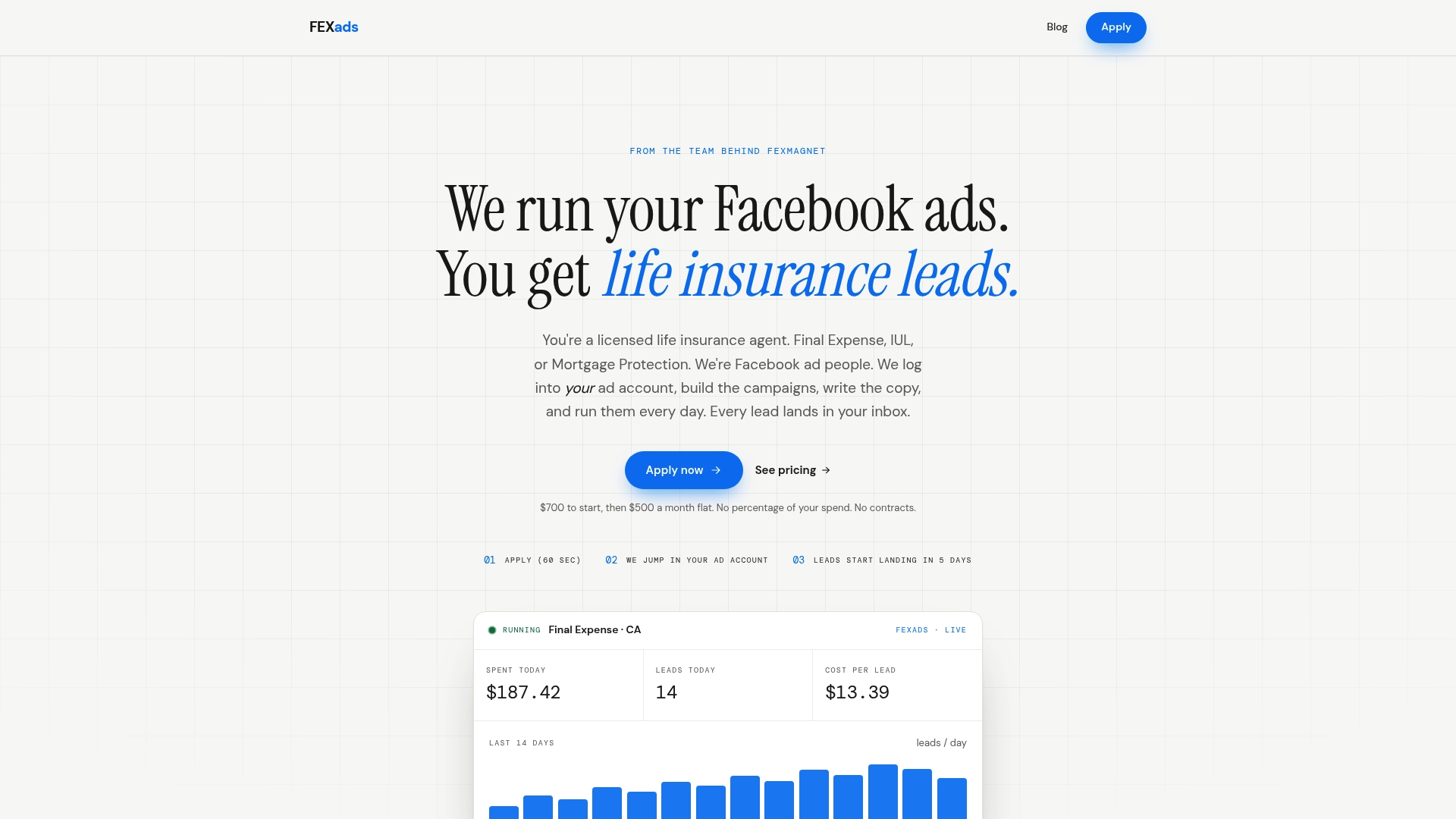
If you would rather not run these tests yourself, that is the work we do. Setup is $700 one-time and covers a custom campaign build, a website, an ad account audit, pixel installation and audience targeting. Ongoing management is $500 per month, billed separately from your ad spend, and includes creative refreshes, compliance checks and daily optimization. There are no contracts, and all leads are generated in your own ad account, so you own the leads and the data.
You can see both prices and apply on the management and setup page, or look at our Facebook ad options by state first. If you are still comparing lead sources, our comparison of eight insurance lead generation channels lays out the trade-offs.
FAQ
Is broad targeting better than interest targeting for life insurance ads?
Usually, yes, as a starting benchmark. Insurance ads in the US already lose age, gender and ZIP filters under the special ad category, so the creative carries most of the targeting. Interests are worth testing against a broad campaign, but they rarely need to be the foundation.
Can I use interest targeting on a new ad account with no pixel data?
Yes, and it is one of the better uses for it. A few relevant interests give delivery a starting direction while the pixel collects conversions. Plan to compare it against a broad ad set once you have data.
How long should I run a broad versus interest test?
Until each side has enough leads and booked appointments to tell a real gap from noise, not a fixed number of days. Set that volume before you launch. Ending the test early because one side had a good weekend is the most common mistake.
Do interests restrict who sees my Facebook ad?
Not always. In many current setups an interest works as a suggestion, and Meta can deliver beyond it if it predicts better results. Only a hard limit, where Meta still offers it, strictly restricts delivery.
Sources
- Broad Vs Narrow Interest Targeting Facebook Ads | Coinis
- Broad vs interest targeting for Meta app campaigns | RocketshipHQ
- Facebook Ad Targeting in 2026 | WordStream
- Broad vs Interest Targeting on Meta in 2026 | Komunikate
- Meta Provides New Insights into the Benefits of General and Narrow Ad Targeting | Social Media Today
- Facebook Special Ad Category Targeting: 2026 Rules | AdAdvisor
- Navigating Meta Ads Restrictions for Insurance Agents | PSM Brokerage
- Can I Really Just “Go Broad” On Facebook? | Triple Whale
- How to Generate Quality Finance Leads Through Facebook | AccuraCast
- Facebook Ad Set Testing | Primer
- Meta Ads Media Buying Strategy for Shopping and Lead Generation | Techourse
- Advertisements of Life Insurance and Annuities Model Regulation | NAIC
- Audience targeting explained | Baby Love Growth
Recommended
Want us to run your FE ads?
Two plans from $200 setup. A flat monthly fee from $500 that starts at your first sale.
Apply now