Strategy
Facebook Ad Budget for Insurance Agents: What to Spend
By Nick Georgalos · 13 min read · Updated 2026-11-20
Facebook Ad Budget for Insurance Agents: What to Spend ! Insurance agent setting an ad budget For a licensed life insurance agent, a workable Facebook ad budget is about $50 a day, or roughly $1,500 a month, paid to Meta, plus whatever you pay someone to run the campaigns.

For a licensed life insurance agent, a workable Facebook ad budget is about $50 a day, or roughly $1,500 a month, paid to Meta, plus whatever you pay someone to run the campaigns. Spend less and you get too few leads to learn anything. Spend more before you know your cost per sale and you just buy mistakes faster. The right number comes from your sales goal, not from a rule of thumb, and this guide shows how to work it out.
We set up and run Facebook ads for final expense, mortgage protection and Medicare agents inside the agent’s own Meta ad account, so the budget questions below are the ones we answer every day.
TL;DR
- Ad spend and management fees are two separate costs. Meta gets the ad spend. Whoever runs the campaigns gets a fee.
- On our setup, ad spend starts at $50 a day, paid to Meta on your own card. Final expense leads typically cost $9 to $28 each.
- Work backward from sales: target sales, leads needed per sale, then cost per lead, then budget.
- Judge spend by cost per sale and profit, not cost per lead alone.
- Scale a winning campaign in small steps, and change one thing at a time.
Table of Contents
- What a Facebook ad budget for insurance actually covers
- How much to spend per day
- Start from your sales goal, not from a daily number
- Cost per lead is a starting metric, not the finish line
- How to test before you raise the budget
- Rented leads versus your own ads: what the budget really buys
- Who this budget suits
- Our view on budgets
- Get your campaign running
- FAQ
- Sources
What a Facebook ad budget for insurance actually covers
There are two bills, and mixing them up is the most common budgeting mistake.
Ad spend is the money Meta charges to show your ads. You set it as a daily or lifetime budget, and it comes off your card as the ads run. None of it goes to a vendor.
Management is what you pay a person or agency to build, monitor and improve the campaigns. It is a separate line, usually a flat monthly fee.
A budget that only counts ad spend will look cheap and then surprise you. A budget that only counts the management fee will make you think you are covered when no ads are running. Plan for both, and add a small cushion for the days Meta overdelivers against your daily number.
On our side, the two are kept apart on purpose. Ad spend is $50 a day minimum, paid straight to Meta on your card. Our fees depend on the plan:
| Standard | Funnel | |
|---|---|---|
| Setup | $200 | $1,000 |
| Monthly management | $500, starting at your first sale | $750, starting at your first sale |
| What you get | Instant-form ads and a simple website | Everything in Standard, plus a quiz funnel site where every lead is verified by a text code and landlines are screened out |
Because the monthly fee does not begin until you make a sale, your early cash goes into ads and setup, not retainers.
How much to spend per day
The honest answer depends on how many leads you can work and how many sales you need.
Meta’s delivery system needs a steady flow of results to find the people most likely to respond. A budget of $5 or $10 a day produces a handful of leads a week, which is too thin to tell a good ad from a bad one. That is why we set $50 a day as the floor.
Here is what that floor buys. At $50 a day over 30 days, you spend $1,500. Final expense clients typically pay $9 to $28 per lead. Divide $1,500 by those two numbers and you get about 54 leads at the high end of cost and about 166 at the low end. That range is wide because cost per lead moves with your state, your age targeting, your creative and how fresh your ads are.

For context, WordStream’s 2026 benchmarks, drawn from 1,892 U.S. social campaigns running April 1, 2025 to June 30, 2026, put the all-industry median cost per lead for Facebook lead campaigns at $27.39. That figure is a cross-industry median from one report period and will shift with each new release. It is not a target for your campaigns, since insurance lead costs depend on the product, the audience and how you qualify leads. Our own 2026 cost per lead data for insurance agents breaks it down by product.
Start from your sales goal, not from a daily number
A daily budget is an output. The input is how many policies you want to write. Use this sequence.
- Set a monthly sales target. Say you want 6 new final expense sales a month.
- Estimate leads per sale. Use your own close rate. If you close 1 in 12 leads you actually reach, you need about 72 leads to write 6 policies. If you have no history, start with a conservative guess and replace it with real numbers after your first month.
- Multiply by cost per lead. At a $20 cost per lead, 72 leads costs $1,440.
- Add management. Your total monthly cost to acquire those 6 sales is the ad spend plus your management fee.
- Compare to commission. Divide the total by 6 to get your cost per sale, then hold it against the average annualized premium and commission you earn per sale.
That example is illustrative, not a promise. Your close rate, your contact speed and your leads’ quality will change every number. The point is the method: you only know whether $1,500 a month is too much or too little after you attach it to a sales target.
Our CPL calculator for life insurance Facebook ads does the arithmetic if you want to plug in your own numbers.
Cost per lead is a starting metric, not the finish line
A $9 lead that never answers costs more than a $28 lead that books an appointment. Three numbers tell you whether your budget is working:
- Cost per qualified lead: the spend divided by leads you could actually reach and who fit your product. Duplicates, fake numbers and landlines inflate lead counts without producing conversations.
- Cost per appointment or per call: the spend divided by conversations that really happened.
- Cost per sale and profit per sale: the only number that tells you if the whole thing pays.
Speed matters here as much as budget. A lead who filled out a form a minute ago is easy to reach. The same lead six hours later often is not. We cover the follow-up routine in Stop Wasting Facebook Leads: Prioritize CPQL and Speed and in the 5 minute callback guide. If you want a deeper look at what each lead type costs, our cost per lead benchmarks for insurance agents go through it.
This is why our Funnel plan verifies every lead with a text code and screens out landlines. You pay Meta for fewer, but more reachable, leads, so the spend goes toward people you can call.
How to test before you raise the budget
Budget increases are where most new campaigns go wrong. A few habits protect your money.
Give ads time to learn. Meta’s system needs a run of results before delivery stabilizes. Editing the budget, audience or ads constantly resets that process. Make one change at a time and let it run for several days before judging it.
Test creative, not just budget. Two or three different ad angles, such as a pointed question about burial costs versus a simple benefit message, tell you more than doubling spend on one ad. Fresh creative also fights ad fatigue, which shows up as rising frequency. Our glossary explains frequency in Meta ad reports and what a rising number means. Tools that help you generate and compare new ad variations, such as AI ad creative tools, can make it easier to keep a steady supply of creative.
Scale in small steps. When a campaign has a stable cost per qualified lead and real sales behind it, raise the daily budget in modest increments rather than doubling overnight. A jump that large tends to push cost per lead up and send the campaign back into learning. Thinking about testing and budget increases as a structured process, as in this look at AI ad targeting, keeps decisions based on data instead of hunches.
Retarget carefully. People who opened your form but did not finish, or who visited your site, are cheaper to win back than cold audiences. See what retargeting means in Meta’s reporting before you give it a share of spend.
Also remember that insurance ads fall under Meta’s financial services advertising rules, so targeting and wording have to stay compliant. A rejected ad or a restricted account wastes budget quickly. We check every ad against Meta’s financial services rules before it runs.

Rented leads versus your own ads: what the budget really buys
With rented or shared leads, you pay per lead and the same person may be sold to several agents. The cost looks predictable, but you do not own the data and you compete with others to reach the same contact.
With your own ads, your budget buys attention in an account you control. The ad account, the pixel, the website and every lead are yours. Nothing is shared or resold. Over months, the pixel gathers data about who responds to you, which makes your own campaigns better, and that history stays with you if you change anything else. We lay out the numbers in buying final expense Facebook leads vs running your own ads.
Who this budget suits
Our plans fit best for agents writing $5K or more a month in annualized premium. At that level, a $1,500 monthly ad budget and a management fee sit comfortably against the commission a steady lead flow produces. New agents can also start this way, and our guide to Facebook ads for new insurance agents explains how to open your own account and begin.
If you want more on how the ad side works before committing money, start with how Facebook ads for insurance agents work or the final expense specifics in Final Expense Facebook Ads: Costs, Leads, and What Works.
Our view on budgets
We see agents lose money on Facebook in two ways. Some start at $5 a day, get nine leads in a month, and conclude Facebook does not work. Others start big on a sloppy campaign and burn a month of cash before anyone looks at the numbers.
Our answer is to set a spend level that produces enough leads to learn from, which is why we set $50 a day as the minimum. Then we put the reporting in front of you. Every client gets the FEXmagnet portal with nightly spend, leads, cost per lead, sales and profit, so you see what the budget is doing without asking.
We also think the fee structure should match the risk you are taking. Our monthly fee only starts at your first sale, so you are not paying a retainer while the first campaign finds its footing. There are no contracts, and nothing to rent: the ad account, pixel, website and every lead stay yours.
If a number looks off, text me directly. A budget conversation is easier when the person who runs your ads is the one answering.
Nick
Get your campaign running
If you want a budget that is set from your sales goal and ads that run in your own account, we can set it up. The Standard plan costs $200 to set up, then $500 a month starting at your first sale. The Funnel plan costs $1,000 to set up, then $750 a month from your first sale. Ad spend is separate, at $50 a day minimum, paid to Meta on your card.
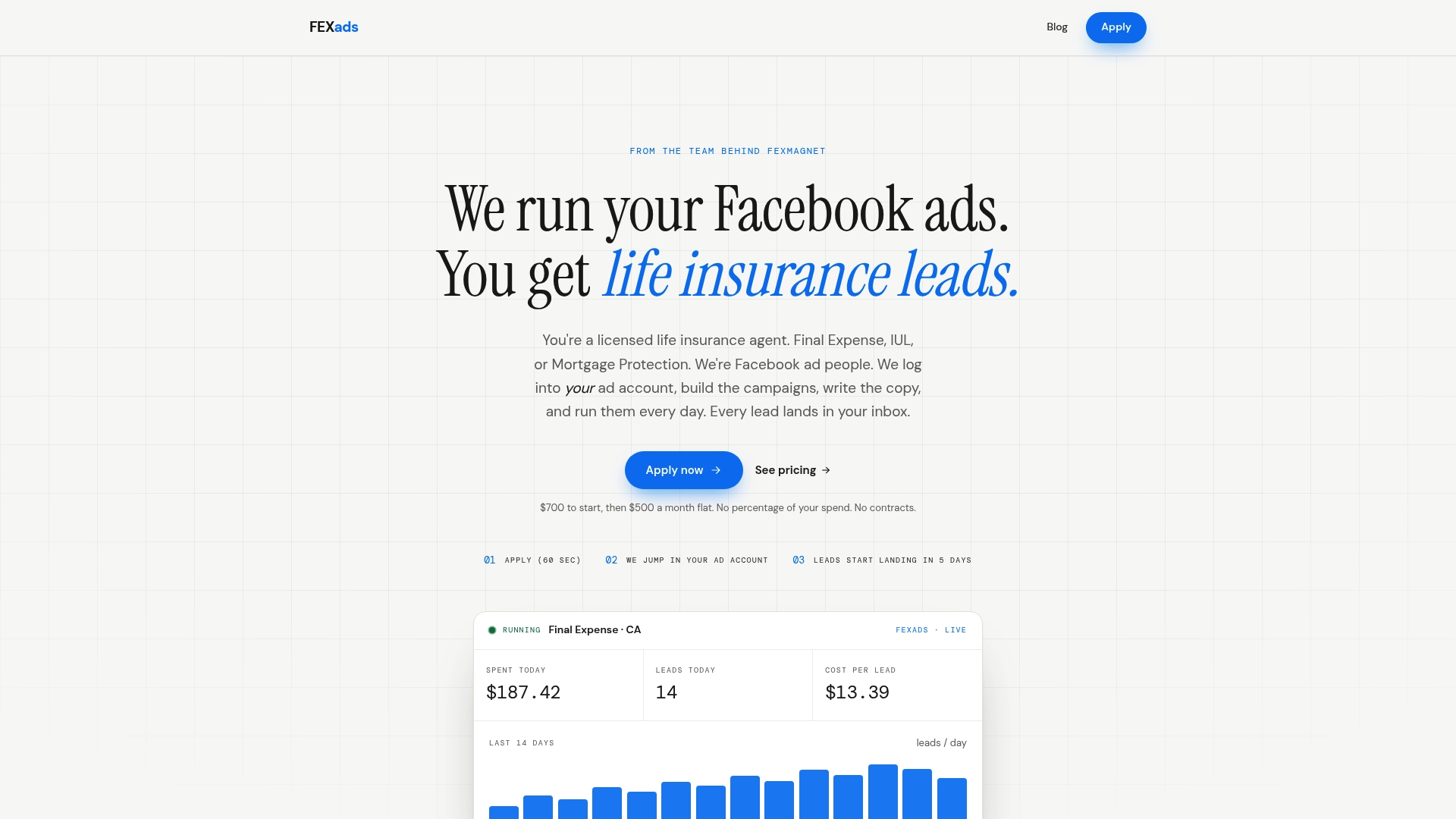
Leads reach you by text, email or CRM within seconds, as instant-form leads, booked calls on your calendar or inbound calls. You can start at fexads.com, or compare options first in our comparison of Facebook ad agencies for insurance agents. For what management typically costs, see Facebook ad management cost for insurance agents.
FAQ
How much should I spend on Facebook ads as a new insurance agent?
Start with enough to generate a meaningful number of leads, which on our setup is $50 a day paid to Meta. At typical final expense lead costs of $9 to $28, that buys roughly 54 to 166 leads in 30 days. Build your budget from your first-month sales target, then adjust once you see real cost per sale.
Is ad spend included in the management fee?
No. Ad spend goes to Meta and the management fee goes to whoever runs the campaigns. With us, ad spend is paid on your own card directly to Meta, and the management fee is separate.
What is a good cost per lead for insurance on Facebook?
Final expense clients typically pay $9 to $28 per lead with us. Other products cost different amounts, and the cross-industry median in WordStream’s 2026 report is a separate benchmark for all industries. Cost per qualified lead and cost per sale matter more than the lead price alone.
When should I increase my Facebook ad budget?
Raise it once you have a stable cost per qualified lead and sales coming from the campaign. Increase in small steps, change one thing at a time, and check your nightly numbers before the next step. Big jumps often raise your cost per lead.
Do I need to pay a monthly fee before I make a sale?
Not with us. Our monthly management fee starts at your first sale on both plans. The setup fee is paid up front: $200 for Standard and $1,000 for Funnel.
Sources
Recommended
Want us to run your FE ads?
Two plans from $300 setup. A flat monthly fee from $700 that starts at your first sale.
Apply now