Strategy
Long-Form vs. Short-Form Content: What Insurance Agents Should Use
By Nick Georgalos · 14 min read · Updated 2026-11-05
Long-Form vs. Short-Form Content: What Insurance Agents Should Use !

Short-form content is anything quick to read or watch, usually under 1,000 words or under about a minute of video. Long-form goes deeper, usually past 1,000 words or several minutes. Neither wins on its own. Short-form earns attention, long-form earns trust, and a licensed agent who sells by phone or appointment needs both, in the right order.
This guide gives you the working definitions, a side-by-side comparison, the spelling question, and a practical way to split your content between the two. We run Facebook ads for final expense, mortgage protection and Medicare agents, so the examples lean toward that world.
TL;DR
- Short-form is roughly under 1,000 words or under 60 seconds to three minutes of video. Long-form is roughly 1,000+ words or longer video. There is no official cutoff.
- Use short-form to get noticed and long-form to explain, build credibility and answer objections.
- For a prospect who has already raised a hand, keep the next step short and specific.
- One long piece can feed many short ones, so build the long asset first when time is tight.
- Write “long-form content” with a hyphen when it modifies a noun, and “short-form” the same way.
Table of Contents
- What counts as short-form and long-form content
- How the two formats compare
- Is it “long-form” or “longform”?
- When short-form is the right call
- When long-form is the right call
- Matching format to the stage of the buyer
- Short and long inside Facebook ads
- Measure what each format is doing
- A simple content plan for a busy agent
- Perspective
- Promo: let us run the ads while you run the calls
- FAQ
- Sources
What counts as short-form and long-form content
The industry has never agreed on one number. Semrush treats written short-form as often under 1,000 words and short videos as typically 60 seconds or less, with long-form running past 1,000 words or a minute of video. Ahrefs uses the same 1,000-word line but notes that definitions vary: some people call anything under 500 words short and anything over 2,000 words long.
Video cutoffs vary more. Search Engine Land puts short video at under three minutes, naming TikToks, YouTube Shorts, and Instagram and Facebook Reels. Shopify counts video as long-form only above 10 minutes and audio above 50 minutes. Cult Media says plainly that there is no official cutoff and treats the numbers as working rules of thumb.

A useful way to hold all this: short-form is built to be understood in seconds, and long-form is built so someone can go deep. If a reader can get the whole point from a glance at a feed, it is short. If they need to sit down with it, it is long.
Quick reference by format
| Format | Usually short-form | Usually long-form |
|---|---|---|
| Written | Social posts, emails, brief blog posts, product copy | Guides, white papers, ebooks, pillar pages, case studies |
| Video | Reels, TikToks, YouTube Shorts, under about three minutes | Webinars, full explainers, interviews, 10+ minutes |
| Audio | Clips of a minute or two | Full podcast episodes |
| Graphic | Single image, carousel, infographic | Multi-page reports |
The written and video examples above follow the lists published by Semrush and Hootsuite.
How the two formats compare
The tradeoffs are consistent across the guides that cover them. Here is the comparison on the points that matter when you are deciding where to spend an hour.
| Short-form | Long-form | |
|---|---|---|
| Main job | Reach, discovery, frequent touches | Depth, credibility, persuasion |
| Effort to make | Quick and cheap per piece | More research and time up front |
| Shelf life | Fades fast | Can keep working for months or years |
| Where it travels | Social feeds, driven by platform algorithms | Search, email, sales conversations |
| Best at | Getting noticed by people who were not looking | Answering complex questions and objections |
The Cult Media comparison frames it the same way: short pieces travel farther per asset on social feeds, while long guides take longer to build but can capture search demand and keep working. Semrush adds that short-form is easier to scale and share, while long-form tends to earn more backlinks and keyword rankings and can position you as a go-to expert.
The cost gap is real on the video side. One agency editing guide puts short-form video editing at $75 to $400 per video and 1 to 4 hours, against $800 to $3,500 and 8 to 25 hours for long-form. Those are agency rates, so treat them as a sense of proportion rather than a quote for your own work.
Is it “long-form” or “longform”?
As a modifier before a noun, hyphenate: “long-form content,” “a short-form video.” Merriam-Webster’s guide to compounds notes that compound adjectives are often written with a hyphen, and this is the pattern most style guides follow for these terms. You will also see “longform” as one word, particularly in publishing and journalism, and both forms circulate. Pick one and use it consistently across your site.
When the phrase stands alone after a verb, many writers drop the hyphen’s job and write it open or keep the hyphen out of habit. Either reads fine. What matters is consistency, not the choice.
When short-form is the right call
Short-form is the tool for getting in front of people who have never heard of you. Search Engine Land notes that Instagram and Facebook are focused on serving short video, so those posts tend to get more views and shares, which makes them a good way to introduce new audience members to a brand before longer content nurtures them.
For an agent, short-form works best when it does one of these:
- Delivers one plain-language idea, such as what a final expense policy is for.
- Shares a real situation that shows the product doing its job, without identifying anyone.
- Gives a clear next step, such as tapping a button to request a quote.
- Tests a message quickly before you invest in a longer piece.
One guide to LinkedIn posts for insurance agents suggests mixing educational, story, opinion and engagement posts across the week rather than running the same type repeatedly, and keeping most posts between 150 and 400 words. That is a handy rhythm for any organic channel you run alongside paid ads.
When long-form is the right call
Long-form matters when the reader needs to be convinced, not just noticed. Semrush points to it as most useful for nurturing leads on expensive offerings and building authority. Content Zen adds that it supports detailed comparisons and works as a foundation you can repurpose into shorter formats.
In insurance, think of these pieces:
- A guide explaining how a mortgage protection policy differs from term life, for a prospect who is comparing.
- A walkthrough of how final expense underwriting works, so the call does not start from zero.
- A longer video where you explain your process and what happens after someone requests a quote.
- A state-by-state resource page that answers local questions.
Long-form also gives your short content something to point to. A Reel that promises an answer works better when a real page sits behind it.
Matching format to the stage of the buyer
The most practical rule is to choose by where the prospect is, not by what you prefer to make. Sagefrog recommends short-form for awareness and long-form for consideration and decision. Inn8ly agrees on the first two stages, then adds a twist: at the decision stage, keep it short, specific and action-oriented. If the goal is trust or understanding, give it the space it needs. If the goal is a conversion, get out of the buyer’s way.
Both views hold up once you separate two kinds of decision. A prospect comparing options wants detail. A prospect who has decided to talk to an agent wants a simple, quick way to do it. For lead generation this gives you a clean map:
- Awareness: a short video or image ad that names one problem and one benefit.
- Consideration: a longer explainer, quiz or article that answers the questions a skeptical buyer asks.
- Action: a short form, a calendar booking or a call button with almost no friction.
- Follow-up: brief, fast messages, then a longer resource if the lead goes quiet.
If you want a wider view on matching content to marketing goals, this walkthrough on using content for lead generation is a good companion to the map above.
Short and long inside Facebook ads
The long-versus-short question shows up in three places when you advertise on Facebook: the ad copy, the creative and the place where the lead lands.
Ad copy
A longer primary text can pre-qualify a prospect before they click, because it explains who the offer is for and what happens next. A short headline and a clear button keep the action simple. Koro’s insurance guide argues that long-form copy or video ads educate the prospect before they submit their information. We cover hooks and lines that work for this audience in our piece on final expense Facebook ad copy, and if you want something to start from, there is ready-to-paste life insurance ad copy.
Creative and placement
Short vertical video fits Reels and Stories, while a still image or a longer video can suit the Feed. Which placement pays for you is a numbers question, and we walk through it in Reels, Feed or Stories for final expense. If you need ideas for what to film, see our list of life insurance ad creatives you can make in two weeks.
The form or page after the click
This is the other meaning of “long vs. short forms” that agents search for. A short Facebook instant form keeps friction low and gets the lead to you in seconds. A longer quiz-style funnel asks more up front and gives you more context on each lead. We compare the two approaches in lead form vs. landing page for final expense. The same principle applies as everywhere else in this guide: the format should match how much the prospect needs to see before they are ready to act.
Measure what each format is doing
Do not judge a short piece by the same yardstick as a long one. A short video may be doing its job when it gets cheap reach, and a long guide may be doing its job when it brings back qualified readers over months. The numbers that matter for paid lead generation are cost per lead, cost per qualified lead and how fast you respond. Our posts on lead quality and speed and the five metrics that matter explain how to read them, and speed to lead covers what to do once the lead arrives.
If you retarget people who watched or clicked, you will also want to watch frequency, since the same short ad shown too often wears out quickly.
A simple content plan for a busy agent
You do not need a content team. A realistic plan looks like this:
- Write or record one long piece a month: a guide, a longer video or a detailed FAQ page.
- Cut it into four to eight short pieces: a clip, a quote graphic, a carousel, a short post.
- Run the short pieces as ads or organic posts that point back to the long piece or to a simple form.
- Keep one short, direct call to action on every piece.
- Review results monthly and make more of whatever brought in real conversations.
This follows the pattern Cult Media describes: one long piece can produce many shorts, while a short clip rarely grows into a long piece without fresh research.
One compliance note for agents: whichever length you choose, insurance ads must follow the rules of the platform and of your state. Every ad we run is checked against Meta’s financial services rules before it goes live, and you should check your own state’s advertising requirements before publishing anything yourself. Our state pages are a place to start.
Perspective
Agents ask us whether they should be making long content or short content. Our answer is that the format matters less than the job it has to do.
What we see in final expense, mortgage protection and Medicare is that the ad earns the click and the follow-up earns the sale. Keep the ad short and clear. Keep the path from the ad to you short too. Save the long explanations for the phone call, the calendar booking or a page that someone chooses to read.
That is why we run ads inside your own Meta account. The leads, the pixel and the data belong to you, so you can see exactly which message produced which result, short or long, and keep what works.
Nick
Promo: let us run the ads while you run the calls
If you would rather spend your time on conversations than on testing ad lengths, that is what we do. We set up and manage Facebook ads for licensed final expense, mortgage protection and Medicare agents inside your own Meta ad account, so you keep the account, the pixel, the website and every lead. Leads reach you by text, email or CRM within seconds, and you can see nightly numbers in the FEXmagnet portal and text Nick directly.
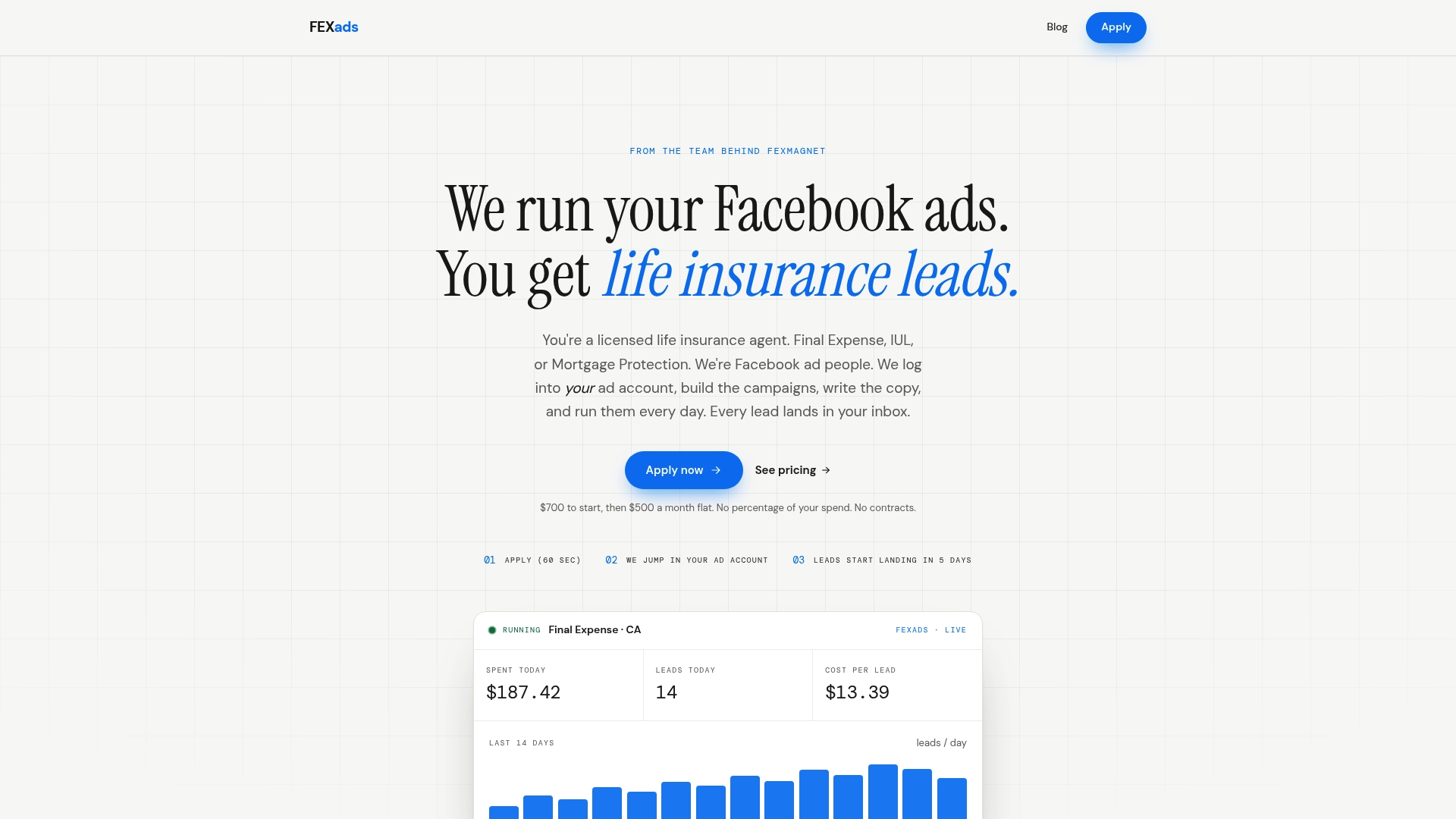
The Standard plan has a $200 setup, then $500 a month starting at your first sale, and includes instant-form ads and a simple website. The Funnel plan has a $1,000 setup, then $750 a month from your first sale, and adds a quiz funnel site where every lead is verified by a text code. Ad spend is separate, with a $50 a day minimum, paid to Meta on your card. See how it works at fexads.com.
FAQ
What is the difference between long-form and short-form content?
Short-form is made to be read or watched quickly, usually under 1,000 words or under about a minute to three minutes of video. Long-form covers a topic in depth and typically runs past 1,000 words or longer in video. The exact line differs by source, so treat the numbers as guidelines.
Is long-form or short-form content better?
Neither is better across the board. Short-form tends to win on reach and speed, and long-form tends to win on search visibility, authority and persuasion. Choose by the goal and by where your prospect is in the buying process.
Is “long-form” one word or hyphenated?
Before a noun it is normally hyphenated, as in “long-form content” and “short-form video.” You will also see “longform” as one word in publishing. Either is understood, so choose one and stay consistent.
What is an example of short-form content for an insurance agent?
A 30-second video explaining one benefit of final expense coverage, a single-image Facebook ad with a clear button, or a short post sharing one plain-language tip are all short-form. Each should carry one idea and one next step.
Should my Facebook lead form be long or short?
A short instant form keeps friction low and speeds up response, while a longer quiz funnel gives you more detail on each lead. The right choice depends on how much qualification you want before the first call. We compare both in our guide on lead forms versus landing pages.
Sources
- Semrush: Short-Form vs. Long-Form Content
- Ahrefs: Short-Form vs. Long-Form Content for SEO
- Search Engine Land: What is short-form content?
- Shopify: Long Form Content
- Cult Media: Short vs Long Form
- Hootsuite: Short form vs long form content
- Increditors: Long-Form vs Short-Form Video Editing
- Merriam-Webster: Forming Compound Words
- PostInstantly: LinkedIn posts for insurance agents
- Content Zen: Long-form guides vs short-form social content
- Sagefrog: B2B content strategy
- Inn8ly: Long-Form vs Short-Form Content
- Koro: Facebook marketing for insurance agents
Recommended
Want us to run your FE ads?
Two plans from $300 setup. A flat monthly fee from $700 that starts at your first sale.
Apply now