Strategy
Lead Nurturing for Life Insurance Agents: A Practical Guide
By Nick Georgalos · 15 min read · Updated 2026-10-29
Lead Nurturing for Life Insurance Agents: A Practical Guide ! Agent discussing family life insurance needs Lead nurturing for life insurance is the work between "a prospect raised a hand" and "a prospect sits down with you.

Lead nurturing for life insurance is the work between “a prospect raised a hand” and “a prospect sits down with you.” It means answering fast, referring to what the person told you, following up on a schedule that fits how ready they are, and tracking what works. Most agents lose sales in this gap, not in the ad or the pitch. Below is a system you can run this week, whether your leads come from Facebook, referrals or anywhere else.
TL;DR
- Contact a new lead within minutes, and open with the details they submitted, not a product pitch.
- Sort leads by readiness (ready now, still deciding, barely engaged) and give each group its own follow-up.
- A workable cadence is 2 to 3 contacts in week one, then lighter touches over 30 to 60 days.
- Get written consent before texting or calling for marketing, and keep proof of it.
- Track contact rate, appointment rate and cost per sale by lead source, not just cost per lead.
Table of Contents
- What lead nurturing means for a life insurance agent
- The first five minutes
- What to say in the first conversation
- Match follow-up to readiness
- Keep it human, with digital help
- Nurturing starts before the lead arrives
- Contact rules you cannot skip
- Perspective: nurturing is mostly about not wasting good leads
- Measure whether nurturing is working
- How our service fits into your nurturing
- FAQ
- Sources
What lead nurturing means for a life insurance agent
In a software company, nurturing means an automated email sequence. In life insurance it is more personal. A person filled out a form because something nudged them: a new baby, a mortgage, a funeral they just paid for. Your job is to keep that moment alive and turn it into a conversation.
The research backs this up. A LIMRA and Bain study found that 90% of prospects say they need to understand life insurance better before buying. Those same prospects are open to useful online content and to being connected with a financial professional. They are not asking to be sold. They are asking to be taught.
The same study found that 39% of prospects recognized a need for individual life insurance because of a life event: a death in the family, a marriage, a home purchase, or having or adopting a baby. That matters for follow-up. A lead who just bought a house and a lead who just lost a parent need different first sentences.
So good nurturing has three parts:
- Speed: you are the first agent they hear from.
- Relevance: you reference what they actually submitted.
- Persistence without pressure: you stay visible long enough to be there when they are ready.
The first five minutes
Nothing you do later makes up for a slow first contact. Advice from a brokerage guide on turning leads into clients is to respond quickly and meaningfully, and to refer to the details the lead submitted. “Meaningfully” is the key word. A generic “Thanks for your interest” text is not a response; it is noise.
A first text that works looks like this:
Hi Maria, this is Dan, a licensed agent. You asked about coverage to help with final expenses for your husband. Do you have two minutes today to talk through options? I can call at 4 or 6, whichever is easier.
It names the person, says who you are, restates their request and offers two simple choices. It does not quote a price or push a product.
To make this possible you need leads to reach you instantly. Instant-form leads, calendar bookings and inbound calls should land on your phone by text or email, or in your CRM, within seconds. If you are setting that up, our guide to delivering leads in under 60 seconds walks through the routing, and the five-minute callback approach covers what to do with Facebook forms specifically.
Missed calls are lost leads
You cannot answer every call while you are in a kitchen-table appointment. If inbound calls go to voicemail, many people simply dial the next agent. Some agents use AI call answering and appointment booking to pick up instantly, book onto their calendar and send a summary by text. Whatever tool you use, the rule is the same: nobody who calls should hit a dead end.
What to say in the first conversation
The first call is not a presentation. A life insurance funnel guide from Rework says the first contact should build rapport, establish credibility and schedule a needs analysis rather than pitch a product. The same guide suggests a 20 to 45 minute needs analysis covering family situation, income, debts, goals and existing coverage before you recommend anything.
This is a vendor’s view rather than a regulatory standard, but it matches how most strong agents work: diagnose first, recommend second. A recommendation lands better when the prospect feels you understood their situation.
A simple qualification checklist for that first call:
- Insurability: age, health, tobacco use, medications. Impaired-risk prospects need to be matched to markets that will actually write them.
- Need: who depends on this person, and what would they face if the income or the person disappeared?
- Budget: what monthly amount feels comfortable, not what the maximum is.
- Timeline: is this a this-week decision or a someday decision?
- Decision-makers: does a spouse or an adult child need to be on the call?
- Existing coverage: work policy, old term policy, a small final expense policy already in place.
The answers also tell you which follow-up track the lead belongs on.
Match follow-up to readiness
Not every lead is in the same place. LIMRA’s Purchase Funnel Series describes channels that drive need recognition, aid serious shopping, provide quotes for evaluation and propel purchases. You can borrow that logic: treat the prospect’s stage as the thing that decides your next message.
| Lead stage | What it looks like | Your move | Cadence |
|---|---|---|---|
| Ready now | Answers quickly, asks about price or coverage | Book the appointment, quote after the needs analysis | Same day, then next day |
| Still deciding | Engaged but “need to think” or talk to a spouse | Send a short explainer, offer a three-way call | Every 2 to 4 days at first |
| Minimally engaged | No reply, or one-word answers | Light, useful touches, no guilt | Sparse, over 30 to 60 days |
A cadence you can copy
The same brokerage source suggests 2 to 3 contacts in the first week, then less frequent contact over a 30 to 60 day cycle if there is no response. Here is one way to use that:
- Minutes 0 to 5: call, and text if there is no answer.
- Day 1: a second call at a different time of day, plus a short text.
- Day 3 to 4: a text with one useful fact tied to their request, such as how a final expense policy pays out.
- Day 7: a final call of the first week, with a clear next step: “Reply 1 for a call, 2 for a text-only quote.”
- Weeks 2 to 8: a touch every 7 to 14 days, alternating between a helpful message and a question.
- After 60 days: move them to a slow list, such as a quarterly check-in or a birthday note.
The point is “without overwhelming them.” Three messages in one hour looks like a bot. Three over a week looks like a professional who cares.
Use life events
Because so many prospects act after a life event, mention it when you have it. If a lead came in after filling in a mortgage protection form, your day-3 message can be about what happens to the house payment if the earner dies, not a generic “just checking in.” That small specificity is the difference between a reply and a swipe-away.

Keep it human, with digital help
Digital tools should carry the routine work so your time goes to conversations. LIMRA and Boston Consulting Group reported in 2020 that 4 in 10 consumers bought life insurance through a hybrid of online research and consultation with a financial professional. Of life insurance owners who worked with a professional, 97% said they were satisfied with the service.
In the 2025 study, 86% of surveyed financial professionals said clients who consult them about life insurance end up buying a policy. Read that as a reminder of what a conversation is worth, not as a promise about your own close rate.
Practically, that means:
- Automate the instant text, the calendar link and the reminder before the appointment.
- Do not automate the needs analysis or the recommendation.
- Send short educational pieces (one-page explainers, a two-minute video) between touches, so a quiet lead still hears from you without a sales ask.
If you want to go deeper on building the funnel logic around those touches, this piece on lead nurturing strategy covers the general marketing model.
Nurturing starts before the lead arrives
You can only nurture what you receive, and the lead source shapes everything. A shared or aged lead has often been called by several agents before you; your nurturing starts behind. An exclusive lead from your own ad is fresher and you are the only one the person expects to hear from.
Two upstream choices matter for follow-up:
- Form design. Short forms get more submissions, but a form that asks nothing gives you nothing to reference. Our comparison of a final expense lead form versus a landing page shows the trade-off, and the three-field form guide shows a lean version that still gives you something to open with.
- Lead quality. If your leads are slow to answer or fake, no cadence saves them. See why final expense Facebook leads stop converting for the usual causes, and what each lead type costs and what closes to benchmark your own numbers. If you work with older, resold data, our glossary entry on aged leads explains why they behave differently.
Contact rules you cannot skip
This is the part that gets agents sued. This is general information, not legal advice; for your own program, talk with a TCPA attorney or your agency’s compliance team.
The FCC’s February 2024 TCPA order states that robocalls and robotexts generally require prior express consent, and telemarketing calls require prior express written consent. A 2025 FCC notice adds that simply providing a phone number generally supports consent only for informational messages closely related to the service requested, unless the person says otherwise. In plain terms: a lead who gave you a number to get a quote has not necessarily agreed to a stream of marketing texts.
The FCC’s 2012 order sets out what written consent looks like: a clear disclosure that prerecorded telemarketing calls will be made by or on behalf of a specific seller, an unambiguous agreement, no requirement that the person consent as a condition of purchase, and records you can document electronically. The FTC has also said that nearly all prerecorded telemarketing calls have been illegal since September 1, 2009 unless the seller first has written permission, and it cites calls to numbers on the National Do Not Call Registry as a violation too.
Privacy matters as well. The NAIC model regulation requires licensees to notify individuals about their privacy policies and describes conditions for disclosing nonpublic personal health information. Health details you collect on a needs analysis fall under that thinking, and your state’s version of the rule applies to you.
A safe working routine:
- Put clear consent language next to the submit button and save a record of each lead’s consent.
- Honor opt-outs immediately and keep your own do-not-contact list.
- Scrub against the Do Not Call Registry before any outbound call campaign.
- Check your state’s calling-hour and telemarketing rules, since many are stricter than the federal baseline.
Our walkthrough of Do Not Call compliance in eight steps and the TCPA glossary entry go through these in more detail.
Perspective: nurturing is mostly about not wasting good leads
We run Facebook ads for final expense, mortgage protection and Medicare agents, so we see the same pattern across accounts. An agent blames the ads for “bad leads” when the real problem is that a lead sat for six hours, or got one call and nothing more. Final expense leads typically cost $9 to $28 each, so every one you fail to reach is real money.
Our view is simple. Speed first, because the person is thinking about this right now. A second and third touch second, because most people do not pick up on the first try. And measure by sale, not by lead, because a cheap lead you cannot reach is the most expensive one you will buy.
That is also why we build leads to reach you in seconds, by text, email or CRM, and why the ads run in your own Meta account. You own every lead and the data behind it, so your nurturing is never competing with another agent who bought the same name. Our CPL calculator lets you work out what a lead needs to cost for the math to work given your own contact and close rates.
— Nick
Measure whether nurturing is working
If you do not measure it, you will not know if a change helped. A CRM with reporting dashboards lets you track pipeline performance and revenue trends in one place. You do not need an expensive setup; a spreadsheet works if you fill it in every week.
Track these, per lead source:
| Metric | What it tells you |
|---|---|
| Speed to first contact | Whether your process or your phone is the bottleneck |
| Contact rate | Share of leads you actually spoke with |
| Appointment rate | Share of contacted leads who booked |
| Show rate | Share of appointments who showed up |
| Close rate | Share of shows who bought |
| Cost per sale | The only number that decides if a source pays |
Work backward from cost per lead. A $20 lead that closes 1 in 10 costs $200 per sale before your time. Lifting your contact rate from 40% to 60% with faster, better follow-up cuts that number with no change to your ads. Review the table monthly and change one thing at a time.
On the ad side, watch frequency in your Meta reports, and consider retargeting people who engaged with your ad but did not complete the form. That is nurturing too, just before the lead is yours.
How our service fits into your nurturing
FexAds sets up and runs Facebook ads for final expense, mortgage protection and Medicare agents inside your own Meta ad account. You keep the ad account, pixel, website and every lead, and nothing is shared or resold. Leads reach you by text, email or CRM within seconds, so you can start the first-five-minutes routine above.
There are two plans. Standard is $200 setup, then $500 per month starting at your first sale, and includes instant-form ads and a simple website. Funnel is $1,000 setup, then $750 per month from your first sale, and adds a quiz funnel site where every lead is verified by a text code and landlines are screened out. Ad spend is separate, $50 per day minimum, paid to Meta on your card. It fits best if you sell $5K or more in AP per month.
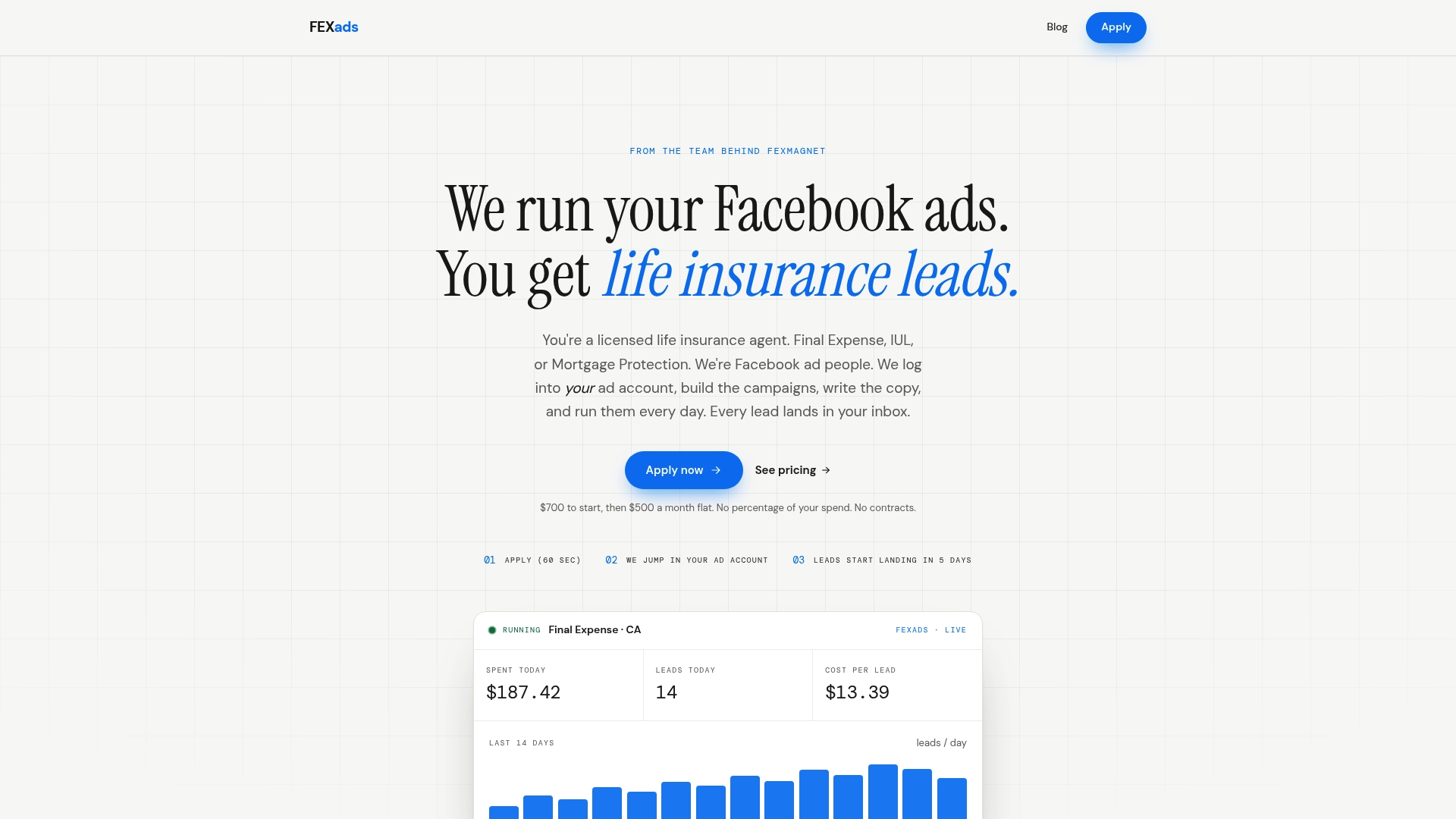
Every client also gets the FEXmagnet portal with nightly spend, leads, cost per lead, sales and profit, and can text Nick directly. See how the Facebook lead engine works or start at fexads.com. If you sell Medicare, read our Medicare leads guide first.
FAQ
How fast should I contact a new life insurance lead?
As fast as you can, ideally within minutes. Guidance for agents is to respond quickly and refer to the details the lead submitted. Set up instant alerts so a lead never waits for you to check email.
How many times should I follow up?
A common recommendation is 2 to 3 contacts in the first week, then lighter contact over 30 to 60 days if you hear nothing. Vary the channel and the time of day, and stop when someone opts out. Respect your state’s rules and the consent the lead gave you.
Can I text life insurance leads?
Only with the right consent. Under the FCC’s rules, telemarketing texts generally need prior express written consent, and a phone number given for a quote may cover only closely related informational messages. Ask your compliance advisor or attorney to review your form language.
What is the difference between lead generation and lead nurturing?
Generation gets a prospect’s contact details. Nurturing is everything you do afterward to earn a conversation and an appointment. You need both, and a weak nurturing process wastes the money spent on generation.
Sources
- LIMRA: How to Convert Intent to Action (2025)
- LIMRA: The Purchase Funnel Series
- LIMRA: Consumers seek hybrid experience when buying life insurance (2020)
- Insurance Advisors Direct: Nurturing Leads into Clients
- Rework: Life Insurance Lead Funnel
- Salesforce: Best CRM for Insurance Agents
- FCC TCPA order, February 2024
- FCC notice, 2025
- FCC TCPA order, 2012
- NAIC privacy model regulation
- FTC: Court halts massive robocall operation
Recommended
Want us to run your FE ads?
Two plans from $200 setup. A flat monthly fee from $500 that starts at your first sale.
Apply now