Strategy
How to Set a Budget for New Facebook Campaigns
By Nick Georgalos · 14 min read · Updated 2026-11-11
How to Set a Budget for New Facebook Campaigns ! Insurance agent setting a Facebook campaign budget Set your budget backward from what a sale is worth to you, then fund it at a level Meta can learn from.

Set your budget backward from what a sale is worth to you, then fund it at a level Meta can learn from. For a final expense agent, that usually means a daily budget of at least $50, one or two ad sets, and about a week of patience before you judge anything. Below is the math, the structure and the rules for raising spend once leads turn into sales.
TL;DR
- Start from your allowable cost per sale, not from a number that feels comfortable. Work back through close rate and cost per lead to a daily budget.
- A new campaign needs enough daily spend to collect real data. We set $50 a day as the minimum for our clients.
- Use few ad sets with real money in each. Spreading a small budget across many ad sets starves all of them.
- Judge results on cost per qualified lead and sales, not raw cost per lead, and change spend in small steps.
- Raise the budget only after the campaign has produced stable, profitable results for several days in a row.
Table of Contents
- Start with what a sale is worth
- How much daily budget a new campaign needs
- Campaign budget or ad set budget
- The first seven days
- Which numbers tell you the budget is working
- When to raise the budget
- What to expect by product
- Perspective
- How we set budgets for agents
- FAQ
- Sources
Start with what a sale is worth
Most agents pick a budget first and hope the numbers work. Reverse it. The budget is the output of three inputs: how many sales you want, how often leads become sales, and what each lead costs.
The chain looks like this:
- Sales target. How many policies you want from this campaign each month.
- Close rate. The share of leads you reach that end up buying. Use your own history. If you have none, run a conservative estimate and replace it with real data after the first month.
- Cost per lead. What Meta charges you for each lead form completed or call generated.
Sales target divided by close rate gives the leads you need. Leads needed times cost per lead gives the media budget. Divide by 30 and you have a daily figure.
Then run the check that matters: does the total cost to get one sale sit comfortably under what that sale pays you? Allowable acquisition cost should reflect your margin and how long the policy stays on the books, not a copied industry average, as this guide to lead-generation budgets puts it. For a deeper look at tracking that return, see our walkthrough on how to track final expense Facebook ad ROI.
A worked example
Say you want 6 final expense sales a month and you close about 1 in 10 of the leads you reach. You need 60 leads. Our final expense clients typically pay $9 to $28 per lead, so use the middle of that range, about $18.
- 60 leads x $18 = $1,080 in ad spend
- $1,080 / 30 days = $36 a day
That figure is lower than our $50 daily minimum, and that is deliberate. Your first month will not land on your best-case cost per lead, and a campaign running at the floor gets Meta more data to work with. At $50 a day, the month’s spend is about $1,500. At the same $18 cost per lead, that is roughly 83 leads. At $28, it is about 54. At $9, about 166. Those are arithmetic, not promises; your own cost per lead will decide where you land.
If you want the cost per lead data behind these ranges, read Facebook cost per lead for insurance agents.
How much daily budget a new campaign needs
A budget that is too small does two things. It produces so few leads that you cannot tell a good ad from a bad one, and it gives Meta little to learn from. One lead a day tells you almost nothing about whether the audience works. Five or six a day starts to.
There is no official dollar threshold, but the principle is simple: the more leads the system sees, the faster it finds who responds. That is why we put the minimum at $50 a day, paid to Meta on your own card in your own ad account.
Some guides suggest starting as low as $5 to $10 a day and raising it for ads that produce quality leads. That can work for a hobby test. For an agent who needs sales this quarter, it stretches the testing phase from days into months.
What a daily budget actually means
Meta describes a daily budget as an average over the week. According to Meta, on days with better opportunities it may spend up to 25% over your daily budget, but over a calendar week you will not be charged more than seven times the daily amount. So a $50 budget can spend $62.50 on a strong day and less on a slow one. Do not panic over a single day’s number. Look at the week.

Daily or lifetime budget
Daily budgets fit an ongoing campaign, which is what a lead generation agent runs. Lifetime budgets suit promotions with a fixed start and end date, such as an enrollment event. For final expense, mortgage protection and Medicare lead flow, choose daily.
Campaign budget or ad set budget
This is the structure question that most of the top results argue about. The short answer: control while you test, consolidation once you know what works.
| Situation | Better choice | Why |
|---|---|---|
| First two weeks, comparing two audiences or offers | Ad set budgets | Each variant is guaranteed spend, so the test is fair |
| Proven ad sets, same goal and similar cost per lead | Campaign-level budget (Advantage+) | Meta shifts money toward the stronger delivery |
| Small total budget | Consolidate into one or two ad sets | A thin budget split many ways teaches nothing |
| Scaling a winner a lot | Duplicate the ad set rather than overhaul it | The original keeps its delivery history |
Independent budgeting guides describe ad set budgets as manual controls for isolated tests and campaign budgets as the better fit for scaling similar ad sets. A guide on controlling Meta spend adds the warning that a campaign-level budget does not create an equal test, because the algorithm is free to feed one ad set and ignore another.
Keep the structure small
At $50 to $100 a day, one campaign with one or two ad sets is plenty. Each ad set should hold two or three ads that make a different angle: a different hook, headline or image. If you split $50 across five ad sets, each gets $10 a day, and none will collect enough results to teach you anything.
The first seven days
The biggest budget mistake with a new campaign is not spending too little. It is touching it too soon. Every time you change targeting, creative or a large chunk of budget, you restart part of what Meta has learned.
A workable first week:
- Days 1 to 2. Confirm the pixel fires, forms submit, and leads reach your phone or CRM within seconds. Do not judge cost per lead yet.
- Days 3 to 5. Watch lead volume and frequency. Call every lead fast. Speed to contact decides a lot of the results you will later blame on the ads.
- Days 6 to 7. Look at cost per lead, then at how many leads you reached, how many booked or quoted, and how many bought.
After a week you have a first read, not a verdict. Sales usually lag leads by days or weeks, so a campaign with a high cost per lead and a strong close rate can beat a cheap-lead campaign that never closes.
Which numbers tell you the budget is working
Cost per lead is the number everyone quotes, and it is the easiest to misread. A lower cost per lead paired with a lower share of qualified leads is not an improvement; Meta lead generation guidance makes the point that the lead-to-qualified rate is the more meaningful business metric.
Track this ladder for every campaign:
| Metric | What it tells you |
|---|---|
| Click-through rate | Whether the ad earns attention |
| Cost per lead | What Meta charges per form or call |
| Cost per qualified lead | What a reachable, eligible prospect costs |
| Cost per appointment | Whether leads turn into conversations |
| Cost per sale | Whether the whole thing pays |
| Profit after ad spend and fees | The only number that decides the next budget |
If you are using lead forms, a verified phone number matters here. In our funnel plan, every lead is verified by a text code and landlines are screened out, so the leads you count are leads you can actually call. Our post on prioritizing cost per qualified lead and speed goes deeper on this, and so does the five minute callback guide.
When to raise the budget
A good day is not a trend. LeadEnforce’s guidance on changing Meta budgets says increases should follow a stable cost for several days, healthy conversion volume and acceptable frequency, and that for lead generation you should review booked calls, qualified leads and sales notes next to cost per lead.
Our rule of thumb for agents:
- Profit first. Raise spend only when the campaign has paid for itself, not when it merely looks promising.
- Small steps. Increase by roughly a fifth at a time rather than doubling. A big jump can push delivery into more expensive audiences.
- Wait between steps. Give each change several days to show up in cost per lead and in booked calls.
- Watch your capacity. Doubling leads is no gain if you cannot call them within minutes.
Increasing spend on weak lead quality just buys more weak leads, so qualified leads, booked calls and sales have to improve as spend does. Deciding when to adjust also depends on what happens after the lead arrives, and lead nurturing strategies are worth reading before you decide a campaign is underperforming when the real gap is follow-up.
When you are ready to go from $1,000 to $5,000 a month in ad spend, our guide to scaling final expense Facebook ads walks through the steps.
When to lower or pause
Cut back when cost per sale climbs above your allowable cost for a full reporting window, or when frequency rises and results fall at the same time. Often the fix is not less money but fresh creative. Rotate new ads in before you cut the budget.
What to expect by product
Budgets look different by line of business, because lead cost and policy value differ.
- Final expense. Lower cost per lead, high volume, smaller average premium. Our clients typically pay $9 to $28 per lead.
- Mortgage protection. Fewer leads and a higher cost per lead, with a larger sale. Plan for a longer sales cycle.
- Medicare. Seasonal. Plan budget around the enrollment windows and expect the cost of leads to move with competition.
The key is that each product has its own break-even. Do not copy someone else’s cost per lead. For the broader picture, see Facebook ads for insurance agents and lead generation channels compared.
Perspective
Most agents who tell us Facebook did not work spent the first month changing things every other day. They split a small budget across four audiences, killed ads after two days and never tracked a single sale back to an ad.
We think about budget as capital you allocate against a return. You decide what a sale is worth, you fund the campaign at a level that produces enough leads to learn from, and you let it run long enough to read. That is why the ads run in your own Meta account, on your own card, with your own pixel. You see every dollar, and every lead stays yours.
It is also why our monthly fee starts at your first sale and not before. We want to be judged on the same thing you are: whether the campaign produces policies. The FEXmagnet portal shows nightly spend, leads, cost per lead, sales and profit, so the budget decision is made on numbers rather than on a feeling. And you can text me directly if something looks off.
Nick
How we set budgets for agents
If you would rather not run this yourself, this is what we do. We set up and manage Facebook ads inside your own Meta ad account. You keep the account, the pixel, the website and every lead. Nothing is shared or resold.
There are two plans:
- Standard: $200 setup, then $500 a month starting at your first sale. Includes instant-form ads and a simple website.
- Funnel: $1,000 setup, then $750 a month from your first sale. Adds a quiz funnel site where every lead is verified by a text code and landlines are screened out.
Ad spend is separate: $50 a day minimum, paid to Meta on your card. We fit best with agents selling $5K or more a month in annual premium. Every ad is checked against Meta’s financial services rules before it runs.
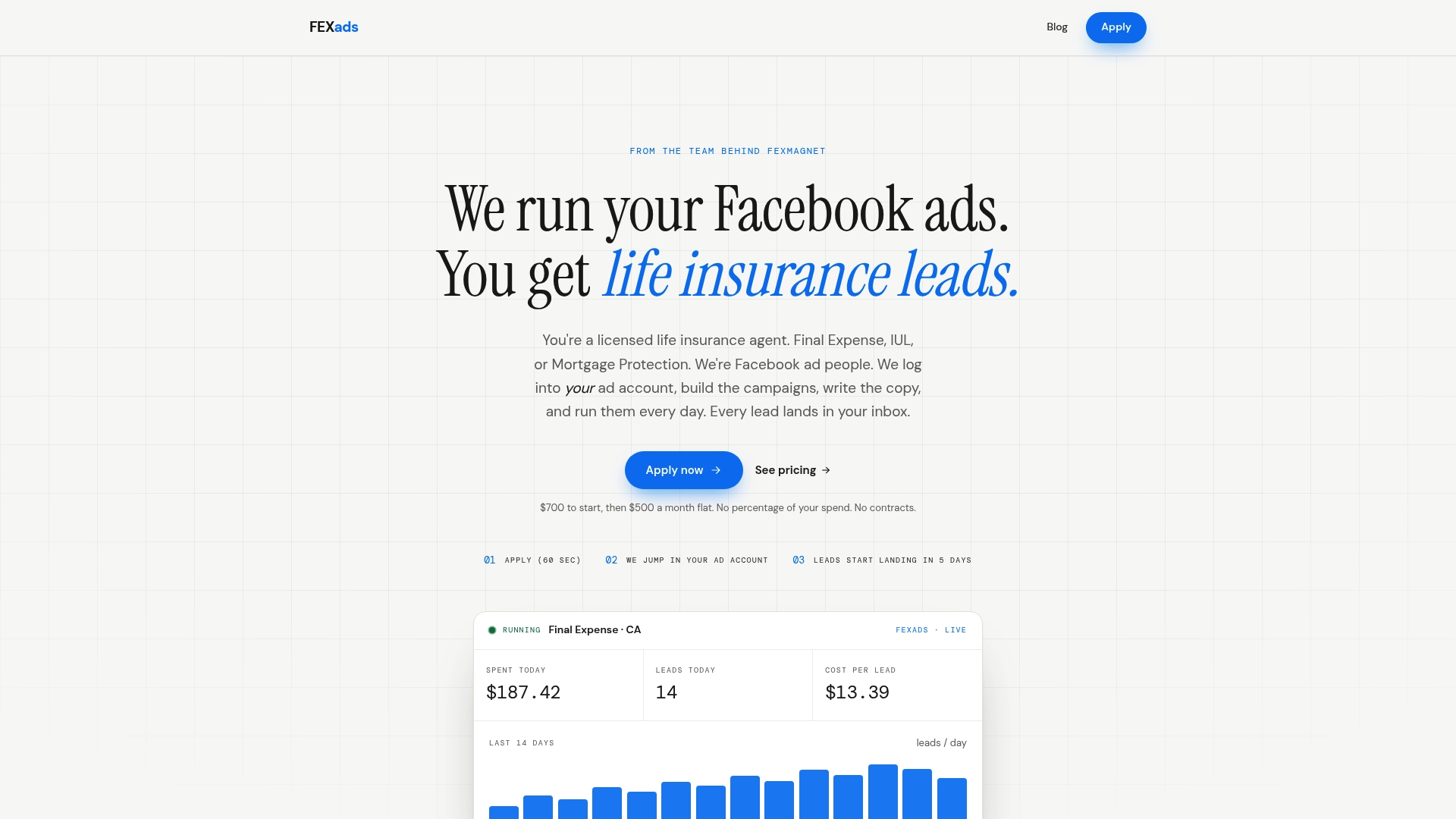
To see how it would work for your numbers, visit FexAds and apply. You can also read how we compare against other options in our comparison of Facebook ad agencies for insurance agents.
FAQ
What is the minimum daily budget for a new Facebook campaign?
Meta lets you set a very low daily budget, but a low budget gives you too little data to learn from. For lead generation by insurance agents, we set $50 a day as our minimum. That keeps enough leads coming in to read results within a week or two.
Should I use a campaign budget or an ad set budget?
Use ad set budgets while you test, so each audience or offer gets a fair share of spend. Move to a campaign-level budget once you have proven ad sets with the same goal. Keep the number of ad sets small either way.
How long should I wait before judging a new campaign?
Give it about seven days without changing targeting or creative before you take a first read. Then look at cost per qualified lead, appointments and sales rather than cost per lead alone. Sales often arrive after the first week, so keep tracking them.
How fast can I increase my budget?
In small steps, roughly a fifth at a time, and only after the campaign has been profitable for several days. Doubling overnight can disrupt delivery and raise your cost per lead. Check frequency and creative freshness before each increase.
Can I spend $50 a day and still be profitable?
Yes, if your cost per sale stays under what a sale pays you. At $50 a day you spend about $1,500 a month, so a handful of final expense sales can cover it. Your own close rate and average premium decide the answer, so run the math from your numbers.
Sources
- About Daily Budgets, Meta Business Help Center
- Meta Ads Budget for Lead Generation: Complete Guide
- Facebook Ad Budget: How Much to Spend
- Meta Campaign Budget vs Ad Set Budget: Control Guide
- Meta advertising for lead generation: playbook
- How to Change Your Meta Ads Budget Without Hurting Performance
Recommended
Want us to run your FE ads?
Two plans from $300 setup. A flat monthly fee from $700 that starts at your first sale.
Apply now