Strategy
Lead Gen vs. Conversions: Which Facebook Objective Fits Agents
By Nick Georgalos · 13 min read · Updated 2026-11-06
Lead Gen vs. Conversions: Which Facebook Objective Fits Agents !

Lead generation and conversions are not rivals. They are two different jobs. Lead generation gets a prospect’s contact details in front of you. A conversion is whatever action you decided counts as success: a form submit, a booked call, or an issued policy. In Facebook ads the two words also name two campaign setups, and the one you pick changes who fills out your form, what each lead costs and how many of them ever buy.
This guide is for licensed life insurance agents running final expense, mortgage protection or Medicare ads. It explains how the two setups work, how to read the numbers, and how to judge results by the only figure that pays the bills: cost per sale. If you are still deciding how to attract and warm up prospects at all, lead nurturing strategies are a good companion read.
TL;DR
- “Lead gen” captures contact info inside Facebook with an instant form. A “conversion” setup sends people to your website and optimizes for an action the pixel tracks.
- Instant forms usually produce more submissions at a lower cost per lead. Website funnels add friction, which tends to filter for intent.
- A form fill is not a sale. Judge every campaign by cost per sale and profit, not by cost per lead.
- Qualifying questions, a verification step and a fast callback matter more than the objective you pick.
- Start with the setup that fits your follow-up speed and budget, then test the other.
Table of Contents
- What lead gen and conversions mean on Facebook
- Lead gen vs. conversions at a glance
- What the data says about forms vs. landing pages
- What is a good Facebook conversion rate?
- The numbers that matter: CPL, lead-to-sale rate, cost per sale
- Where life insurance breaks the simple funnel
- How to improve lead quality on either setup
- Which one should you start with?
- Our perspective
- How Fexads can help
- FAQ
- Sources
What lead gen and conversions mean on Facebook
The words do double duty, which is why the search results are so muddled. Marketers use “conversion” as a general term for any desired action. Inside Meta’s ad tools, it also refers to a specific campaign style.
Lead generation (instant forms). The person taps your ad and a form opens inside Facebook or Instagram. Meta pre-fills the form with profile information, so the prospect does not leave the app or type much. That cuts mobile friction. You can read more in our glossary entry on the Facebook instant form and the lead form ad.
Conversions (website). The person taps your ad and lands on your own page. You tell Facebook which action to optimize for, such as a submitted quote request or a booked call, and the pixel on your site reports back when it happens. The lead enters your systems through your site, not through Meta.
One naming note: Meta has reorganized its objectives. According to WordStream’s objectives guide, the old Lead Generation objective became “Leads,” and the old Conversions objective was split across Engagement, Leads and Sales. In practice, the choice you face today is where the lead gets captured (in Meta or on your site) and what event Facebook is told to chase.
Lead gen vs. conversions at a glance
| Instant form (lead gen) | Website funnel (conversion) | |
|---|---|---|
| Where the lead is captured | Inside Facebook or Instagram | On your own page |
| Effort for the prospect | Very low, often pre-filled | Higher, a few more taps |
| Typical volume | More submissions | Fewer submissions |
| What the pixel tracks | Form submit in Meta | Any action on your site |
| Verification options | Higher-intent review screen, custom questions | Text-code verification, landline screening, quiz steps |
| Best when | You can call within minutes and want volume | You want to filter for intent before a lead reaches you |
The trade-off is quantity versus intent. Madder’s 2026 guide describes instant forms as low effort and capable of more submissions, while websites add friction but can attract people willing to read and complete an outside form.
What the data says about forms vs. landing pages
The most cited head-to-head is older, so treat it as direction, not gospel. WordStream’s 2019 comparison reported that lead ads converted 12.54% of clicks into leads versus 10.47% for landing pages, with a cost per action of $17.98 versus $13.26. So the form got more leads, while the landing page was cheaper per action in that dataset.

The same analysis found something more useful for agents. In WordStream’s own account, conversion campaigns produced a 5.7% higher rate of leads reaching a qualified stage, even though lead ads turned clicks into leads at a higher rate. More raw leads did not mean more good ones.
That matches what we see in final expense. A person who taps a pre-filled form in two seconds is a different prospect from one who answers a few questions on a page. Neither is wrong. They need different handling. We go deeper on the final expense version in our comparison of a final expense lead form vs. landing page on Facebook.
What is a good Facebook conversion rate?
Benchmarks are easy to misread, so check what each one measures first.
- WordStream’s 2026 US benchmarks covered 452 leads-objective campaigns from April 1, 2025 through June 30, 2026. They reported an all-industry conversion rate of 8.54%, with categories ranging from 4.15% to 15.87%. The averages are technically medians.
- The 2024 edition defined the rate as leads divided by clicks and reported 8.25% across industries.
So a “good” rate here means roughly 8% of clicks becoming leads. That is a click-to-lead number. It says nothing about how many leads become customers. Shopify’s 2026 guide makes the same point: the conversion action depends on the campaign objective and may be an email signup, an app install or a purchase.
If a vendor tells you your conversion rate is high, ask which conversion. A 12% form-fill rate with 2% of leads buying is worse than a 6% rate with 10% buying.

The numbers that matter: CPL, lead-to-sale rate, cost per sale
Three formulas cover almost everything.
- Cost per lead (CPL) is ad spend divided by leads. HubSpot defines it the same way and separates it from acquisition cost, which covers turning a prospect into a customer. See also our glossary on cost per lead.
- Lead-to-sale conversion rate is customers divided by leads, times 100. Marketingo’s formula gives an example: 100 leads and 8 new customers is an 8% rate. Define “lead” and “conversion” the same way every month, or the number means nothing.
- Cost per sale is ad spend divided by sales. This is the one that decides whether you profit. Our glossary entry on CPA covers it.
A worked example
Say you spend $1,800 in a month. These figures are illustrative, not client results.
| Setup | Leads | CPL | Sales | Lead-to-sale | Cost per sale |
|---|---|---|---|---|---|
| Instant form | 100 | $18 | 8 | 8% | $225 |
| Website funnel | 60 | $30 | 9 | 15% | $200 |
The funnel looks 67% more expensive per lead and still wins on cost per sale. Flip the sales numbers and the form wins. That is why the right answer depends on your follow-up, not on a rule of thumb. For context, we find final expense agents typically pay $9 to $28 per lead, but the figure that matters is what each lead is worth to you after your close rate.
Where life insurance breaks the simple funnel
For an ecommerce store, a conversion is a checkout. For you, the path is longer: a person shows interest, you reach them, you talk, they apply, underwriting runs, and the policy issues. Each step is a different event with a different meaning. A tap is not a contact, a captured lead is not an eligible one, and a quote is not a bound policy.
This matters in two ways.
- Reporting. If you only watch form fills, you will cheer for the cheapest campaign even when it sends you people who never pick up.
- Timing. Policies often issue days or weeks after the lead came in. Judge results over a month or more, and expect the most recent weeks to look weaker than they will end up.
Track the whole chain: dollars spent, real leads received, conversations held, policies sold, premium written, and what is left after ad spend. Our guide to Facebook life insurance leads walks through how that looks for an agent.
How to improve lead quality on either setup
The objective is only one lever. These matter just as much.
- One product, one message per campaign. A final expense ad should say it is final expense and who it is for. Plain wording attracts people who want what you sell.
- Add qualifying questions. Two or three multiple choice questions, such as age range, who the coverage is for, and timing, screen out people who are not a fit. One agency analysis of insurance campaigns, as relayed by Link+ CRM, reports that this trims volume by roughly 20 to 30 percent while raising quality by 40 to 60 percent. Treat those figures as directional.
- Use the review screen on instant forms. Meta’s higher-intent form type adds a step before submission, which slows the casual tapper.
- Verify the contact. On a website funnel, a text-code check confirms the number is real and mobile. Landlines can be screened out, which saves calls to numbers that cannot text back.
- Use clear consent language. Keep it plain, and keep consent boxes unticked by default.
- Call fast. Speed to lead is the biggest lever you control after the ad itself. A lead called in five minutes is not the same lead as one called the next morning. See our speed to lead playbook and the guide on making Facebook lead forms yours.
For a fuller diagnosis of weak leads, read how to stop wasting Facebook leads, which covers cost per qualified lead.
Which one should you start with?
Use these questions.
- Can you call within five minutes, every day? If yes, instant forms let you use volume well. If not, a funnel that filters first protects your time.
- Is your close rate healthy on cold-ish leads? If you close well, more volume is an advantage. If you burn hours on tire-kickers, add friction.
- Do you sell IUL or another higher-ticket product? Those buyers tend to read more before acting, so a page with a few steps often fits. Our piece on IUL Facebook ads goes into detail.
- How much can you spend? Facebook needs data to optimize. A budget that is too thin makes any setup look bad.
Many advertisers end up using both: forms to capture demand cheaply, and a website funnel for people who need a bit more convincing. Run each long enough to read cost per sale, then shift budget to the winner. Our overview of insurance lead generation channels shows where Facebook sits next to the other options.
Our perspective
Most agents come to us asking which Facebook objective is better. We think that is the second question. The first is: whose account, pixel and leads are these?
When the ads run in your own Meta account, every lead, every data point and every learning belongs to you. You are not renting a list that three other agents also call. That is the foundation, and the objective choice sits on top of it.
On top of that, we build for the two honest situations. Instant forms for agents who can call in minutes and want volume. A quiz funnel, with every lead verified by a text code and landlines screened out, for agents who would rather talk to fewer, better-qualified people.
Then we look at the nightly numbers: spend, leads, cost per lead, sales and profit. If the cheap leads are not buying, we change the setup. That is the whole job.
Nick
How Fexads can help
We set up and run Facebook ads for licensed final expense, mortgage protection and Medicare agents, inside your own Meta ad account. You keep the account, the pixel, the website and every lead. Leads reach you by text, email or CRM within seconds.
There are two plans. Standard is a $200 setup, then $500 a month starting at your first sale, and includes instant-form ads and a simple website. Funnel is a $1,000 setup, then $750 a month from your first sale, and adds a quiz funnel site where every lead is verified by a text code. Ad spend is separate, $50 a day minimum, paid to Meta on your card. It is best suited to agents selling $5K or more a month in AP.
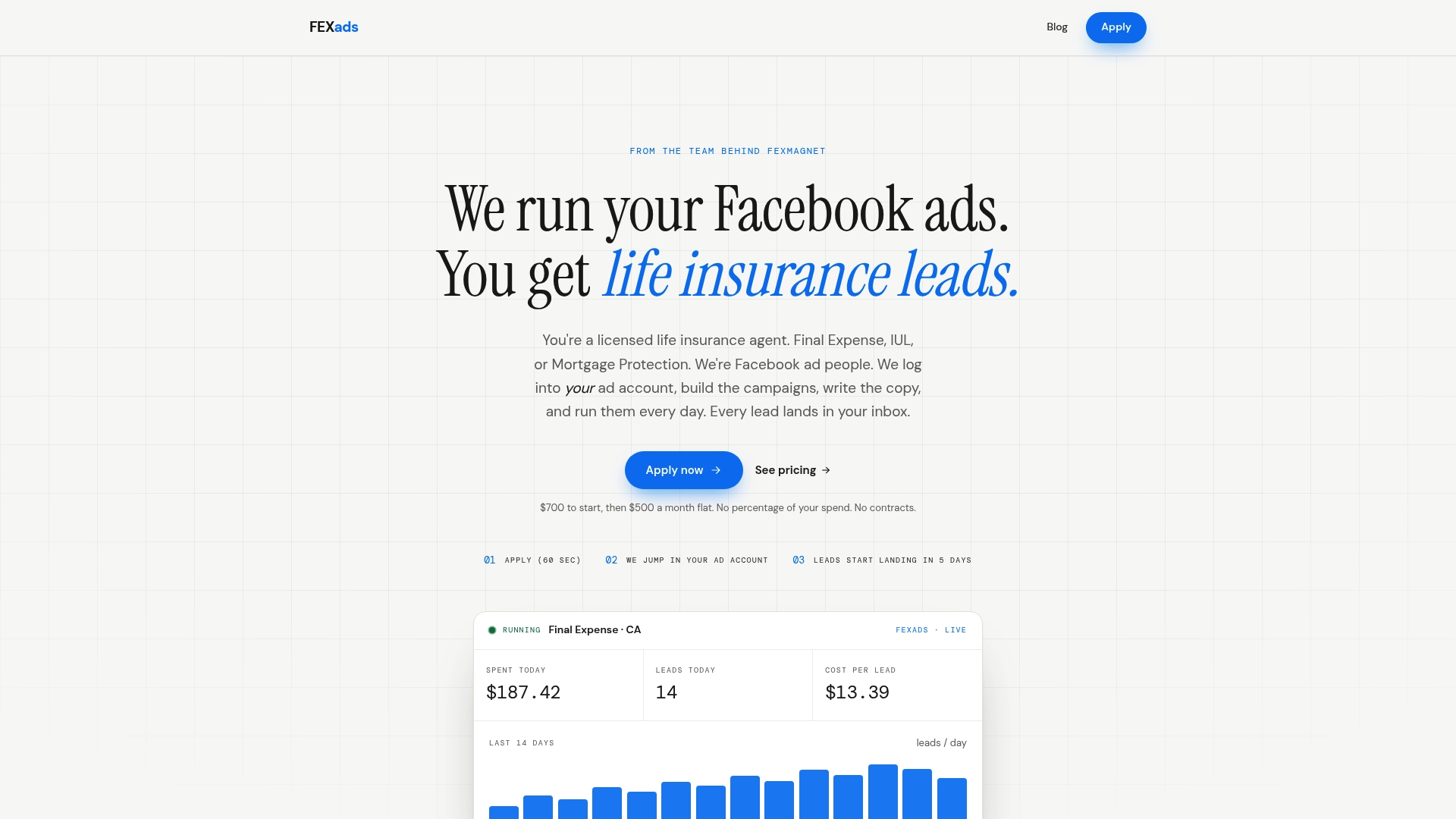
Every client gets the FEXmagnet portal with nightly spend, leads, cost per lead, sales and profit, and can text Nick directly. See how we run final expense Facebook ads or start at Fexads.
FAQ
Is lead gen or conversions better for final expense?
Neither wins on its own. Instant forms usually bring more leads for less per lead, while a website funnel tends to bring fewer, more intentional ones. Compare them on cost per sale over at least a month of data, then put more budget behind the winner.
Is a lead the same as a conversion?
Only if you define the conversion as a lead. A conversion is whichever action you tell Facebook to optimize for, and for an agent the real end goal is an issued policy. Track the stages separately so you can see where prospects drop off.
What is a good conversion rate for Facebook ads?
WordStream’s 2026 US data shows a median of 8.54% across industries for leads campaigns, measured as leads from clicks. That is a click-to-lead rate, not a sales rate. Your lead-to-sale rate and cost per sale are the numbers to hold yourself to.
How do I calculate cost per sale?
Divide your total ad spend by the number of policies sold from those leads. With $1,800 spent and 8 sales, cost per sale is $225. Use leads from the same period and give recent weeks time to mature, since policies can take a while to issue.
Sources
- HubSpot: How Meta Lead Ads work
- WordStream: Every Facebook ad objective in 2026
- Madder: Lead form or website
- WordStream: Facebook lead ads vs. landing pages
- WordStream: Facebook Ads Benchmarks 2026
- WordStream: Facebook Ads Benchmarks for 2024
- Shopify: Facebook ads conversion rate
- HubSpot: Cost per lead
- Marketingo: Lead conversion rate
- Link+ CRM: Facebook lead ads for insurance agents
Recommended
Want us to run your FE ads?
Two plans from $300 setup. A flat monthly fee from $700 that starts at your first sale.
Apply now