Strategy
Life Insurance Ad Seasonality: When to Push and When to Hold
By Nick Georgalos · 15 min read · Updated 2026-11-01
Life Insurance Ad Seasonality: When to Push and When to Hold ! Agent planning life insurance ad timing Life insurance has seasonality, but it is mild.

Life insurance has seasonality, but it is mild. Unlike Medicare, there is no enrollment window that forces a rush. Demand follows life events more than the calendar, so the smart move is to keep your ads running year-round and adjust budget, creative and follow-up around a few predictable bumps and dips.
This guide is for licensed agents running Facebook ads for final expense, mortgage protection or IUL. It covers what the data says about the calendar, where life events beat months, and how to adjust a campaign without resetting it every quarter.
TL;DR
- Life insurance search interest is far steadier than Medicare’s. One analysis put its seasonal range at about 22%, against about 98% for Medicare Advantage.
- Expect small bumps in January and spring, a recurring education moment in September, and softer response around the holidays.
- Life events (a baby, a marriage, a mortgage, a health scare) drive purchases more than any month does. Build your angles around them.
- Do not judge a season by cost per lead alone. Track booked calls, policies issued and premium, then compare like weeks with like weeks.
- Keep a steady daily budget, refresh creative before fatigue sets in, and make small moves rather than stop-and-start swings.
Table of Contents
- Does life insurance have a selling season?
- What the calendar does move
- Life events beat months
- A practical year of budgets, creative and timing
- What lead costs look like
- How to tell if a seasonal change helped
- Where the market is heading
- Perspective
- Let us run the ads through every season
- FAQ
- Sources
Does life insurance have a selling season?
Not in the way Medicare does. Medicare has fixed enrollment periods, so ad demand spikes and collapses on schedule. Life insurance is sold every week of the year. One industry analysis describes it as the least seasonal insurance category, with purchases following life events more than calendar patterns.
That has a practical consequence for how you run Facebook ads. If you treat life insurance like a seasonal product, you will cut budgets in the “slow” months, lose your learning data, and pay more to rebuild momentum later. A better frame is a stable base with a few tilts.
The tilts are real, though. Facebook is an interruption channel: people are scrolling, not searching, so their mood and attention matter. Holidays, tax time, back-to-school and year-end all change what is on their mind and what your ad competes with.
What the calendar does move
January and tax season
New Year resolutions often extend to money. The same analysis notes modest life insurance interest in January as people think about financial planning and protection, with tax preparation prompting some consideration too. The NAIC publishes a New Year checklist that tells consumers to review coverage after a baby, marriage, new home or mortgage, divorce, remarriage or a new job. That is a ready-made message for a January ad: a fresh year, a quick coverage check.
Spring and home buying
Spring brings a mild bump tied to home-buying activity. For mortgage protection agents, this is the natural window. A new mortgage is one of the clearest triggers there is, and your ad can speak to it directly: a family just took on a large debt, and the question is what happens to it if the earner is gone. Keep the creative tied to the move itself, not to generic fear.
September: Life Insurance Awareness Month
September is the one fixed date in the life insurance year. LIMRA and LOMA describe Life Insurance Awareness Month as an education campaign about protecting families’ financial security. Their latest barometer found that 48% of American adults did not own life insurance, and 38%, about 92 million adults, said they needed coverage or more coverage.
You do not need to run a special campaign. But September is a good month to put educational, plain-language ads in front of people who are already hearing the message elsewhere. Lead with a real premium example and make the next step obvious, since the same LIMRA piece notes that people with a gap often overestimate cost or do not know what to buy.
The holidays
The holidays are the softest stretch. One quoting-software company reported that, in its own customer traffic, consumer interest in life insurance was as much as 30% lower around the holidays than in January and February. That is one company’s traffic, not a market benchmark, so treat it as a direction rather than a number to plan around.
What it means for you: expect lower response, slower callbacks from leads who are traveling or busy, and more distraction. It does not mean shutting off ads. It means setting expectations for volume and adjusting your follow-up.
Q4 as deployment, not building
One marketing agency argues that Q4 should be a deployment phase for assets you already built, not a time to start from scratch. For a Facebook advertiser that is sound advice. Test new angles, forms and creative in the quieter months. By October, know what works and put budget behind it.
Life events beat months
The calendar tilts demand. Life events create it. Every major source agrees on this, and it should shape your targeting and your copy more than any month does.
- The NAIC lists marriage, divorce, a new child and caring for an elderly family member as moments to reconsider coverage.
- A U.S. consumer study found that people named having children (43%), buying a home (35%), a changed financial situation (33%) and marriage (28%) as important purchase events.
- McKinsey’s research says trigger events like a new baby or taking financial responsibility for an older relative can raise demand for protection products two- to threefold.
- Bain recommends targeted digital outreach tailored to moments like marriage, a new child or a death in the family.
One financial planning firm calls this ‘behavioral seasons’: the stretch of life when a person is ready to act, whatever month it is. That is a useful way to think about it.
What this means by product
| Product | Natural trigger | Ad angle that fits |
|---|---|---|
| Final expense | Age 50 to 85, a funeral in the family, a parent’s passing, a health scare | Leaving family with no burden, simple approval, price in plain numbers |
| Mortgage protection | New home, refinance, new baby | What happens to the house if the earner is gone |
| IUL | Tax season, new job, retirement planning | Tax-advantaged growth and protection, framed carefully and compliantly |
These triggers do not follow the calendar, which is why a steady budget with rotating creative tends to beat on-off campaigns. For ready-to-use wording, see our tested life insurance ad copy.
A practical year of budgets, creative and timing
There is no single correct plan, but this rhythm fits how life insurance demand behaves. Adjust it to your own results.
| Period | What changes | What to do |
|---|---|---|
| January to February | Resolution and tax-time interest | Run “coverage check” and new-year angles. Good time to test new creative. |
| March to May | Home-buying activity | Lean into mortgage protection creative. Keep final expense steady. |
| June to August | Steady, with summer distraction | Refresh creative, test forms and landing pages, fix follow-up. |
| September | Awareness Month education | Use premium examples and plain-language education ads. |
| October to mid-November | Pre-holiday window | Deploy what has proven to work. Avoid launching untested ideas. |
| Late November to December | Softer response, busy households | Hold a steady budget, shorten your callback time, expect slower booking. |
Keep the base budget steady
Facebook’s delivery system learns from conversions. Large swings in daily budget can disrupt that learning. If you want to tilt toward a season, make moderate changes and give them time. One analysis suggests agents often find lower costs during off-peak troughs, which is a reason to keep spending through them, not to pause. Treat any specific saving as something to confirm in your own account.
Refresh creative before it wears out
Seasonality matters less than fatigue. When the same people see the same ad repeatedly, results fall whatever the month is. Watch frequency in your Meta reports and swap creative when it climbs. Our 12 life insurance ad creatives give you a rotation you can build in about two weeks.
Move from awareness to education
Bain suggests that insurers shift spending from broad awareness toward targeted, mid-funnel education that answers specific barriers, such as the belief that coverage costs too much. That fits Facebook well. An ad that shows a real monthly price for a 68-year-old does more than a slogan about family.
Follow up faster when response is slow
In quiet stretches, every lead matters more. Speed to contact is the cheapest lever you have. Leads that reach you by text or email within seconds can be called while they are still on their phone. Retarget visitors who clicked but did not finish, using retargeting audiences, rather than buying more cold traffic.
What lead costs look like
Costs vary far more with your targeting, offer and form than with the month. One 2026 marketing blog puts life insurance leads from Facebook or Google at $15 to $75 per lead, with close rates averaging 2 to 5%. Another source puts U.S. life insurance CPL at $25 to $125 depending on geography, filters and carrier competition. These are wide ranges across all life insurance, from several sources, so use them as context only.
For final expense on our own campaigns, clients typically pay $9 to $28 per lead. That is a range from our client work, not a promise, and your result depends on your state, offer and follow-up. To model your own numbers, use the CPL calculator and read our Facebook cost per lead data for insurance agents. For a wider look at what closes, see costs by vertical.
If you want to improve what happens after the click, these conversion rate optimization tips cover the on-page basics that lower cost per lead in any month.

How to tell if a seasonal change helped
A cheaper lead in December might be a worse lead. A pricier lead in January might close better. So judge by the full funnel.
Bain recommends tracking sales conversations, policies issued and premium volume, not just top-of-funnel counts. For a Facebook campaign, that means:
- Cost per lead from Meta, as the first signal only.
- Contact rate: how many leads you actually reached.
- Booked appointments or calls per lead.
- Policies issued and annual premium.
- Cost per sale and profit after ad spend.
Two habits keep the comparison honest. First, compare like with like: this January against last January, or one holiday week against the week before, never a quiet week against a launch week. Second, change one thing at a time. If you change the budget, the creative and the form in the same week, you will not know which one moved the numbers.
Research on U.S. life insurers also supports the basic idea that spending pays off: a peer-reviewed study found that advertising intensity was positively related to both policies issued and dollars of coverage issued. Your job is to measure it in your own account, with your own sales.
Where the market is heading
Demand has been healthy. LIMRA reported that in the second quarter of 2025, new annualized premium rose 13% to $4.5 billion and policy count rose 7%. The same release points to whole life policy count growth of 14%, with final expense products a key driver. Growth like that means more advertisers competing for the same attention, which is another reason to rely on a stable account with clean data rather than chasing seasonal dips.

Advertising also builds name recognition: a LIMRA study found that about 46% of consumers cited advertising as a primary factor in brand awareness for life insurers. For an individual agent, steady local ads build the same familiarity over time. And since about half of prospects research coverage online but only 15% engage deeply with a professional, the agent who answers fastest and explains clearly has room to win.
Perspective
We run Facebook ads for final expense, mortgage protection and Medicare agents, and we see the same mistake every year: an agent hears that December is slow, shuts off the ads, and spends the next two months trying to get back to where the account was.
Our view is simple. Life insurance does not have a rigid season, so your ad account should not have one either. The agent who keeps spending steadily, keeps the pixel learning, and keeps fresh creative moving will almost always beat the agent who starts and stops.
That is also why we build everything inside your own Meta ad account. The account, the pixel, the website and every lead belong to you. History and learning stay with you through every slow week and every busy one. Nothing is shared or resold.
We also think the numbers should be visible. Our clients see spend, leads, cost per lead, sales and profit every night in the FEXmagnet portal, so a seasonal dip shows up as a number you can act on, not a surprise at the end of the month. If something looks off, you can text me directly.
Every ad is checked against Meta’s financial services rules before it runs, so a seasonal angle never puts the account at risk.
Nick
Let us run the ads through every season
FEXads sets up and runs Facebook ads for licensed final expense, mortgage protection and Medicare agents, inside your own Meta account. Leads arrive as instant-form leads, booked calls or inbound calls, and reach you by text, email or CRM within seconds.
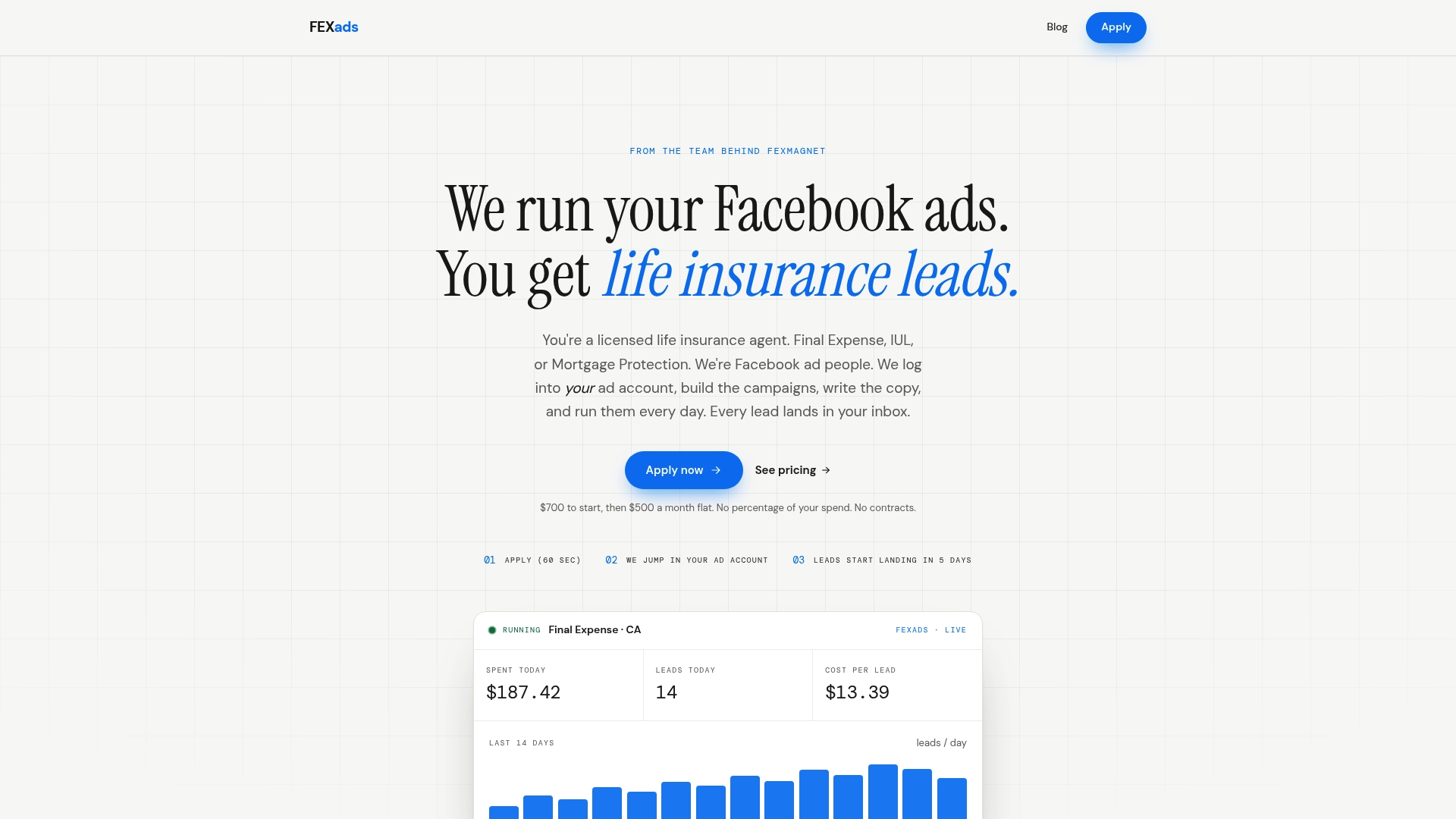
The Standard plan is a $200 setup, then $500 per month starting at your first sale, and includes instant-form ads and a simple website. The Funnel plan is a $1,000 setup, then $750 per month from your first sale, and adds a quiz funnel site where every lead is verified by a text code and landlines are screened out. Ad spend is separate, with a $50 per day minimum paid to Meta on your card. It fits best for agents selling $5K or more a month in AP. See how it works on our done-for-you Facebook ad setup page, or start at FexAds.
FAQ
Is life insurance a seasonal product?
Only mildly. Demand follows life events such as marriage, a new baby, a home purchase or a health scare more than it follows the calendar. You will see small bumps around January and spring and a softer stretch around the holidays, but nothing like Medicare’s enrollment-driven swings.
Should I stop my Facebook ads over the holidays?
Usually not. Response may be lower, but pausing resets your learning and you pay to rebuild it later. Keep a steady budget, expect slower contact and booking, and tighten your follow-up speed instead. If your cash flow forces a cut, reduce moderately rather than switching off.
Does September really matter for life insurance ads?
It is a useful tailwind. Life Insurance Awareness Month is a recurring national education campaign, so people see the message elsewhere before they see your ad. Plain-language ads with real premium examples and a clear next step fit that mood well.
How do I know if a season changed my results?
Look past cost per lead. Track contact rate, booked calls, policies issued, premium and profit, and compare against the same period in a prior year or the weeks just before. Change one variable at a time so you can tell what caused the difference.
What is a good cost per lead for life insurance ads?
Published ranges are wide, from about $15 to $125 depending on the source and the product. On our final expense campaigns, clients typically pay $9 to $28 per lead. Your own number depends on state, offer, form type and how fast you follow up.
Sources
- Insurance Lead Seasonality: Volume Peaks & Valleys
- Seasonal range of search interest, life insurance vs. Medicare Advantage
- Life Insurance Awareness Month (LIMRA and LOMA)
- 92 Million Reasons to Talk About Life Insurance (LIMRA)
- LIMRA: U.S. individual life insurance sales, Q2 2025
- LIMRA: consumer brand awareness of life insurers
- Increasing Life Insurance Sales During the Holidays
- The Life Insurance Calendar Is Predictable
- NAIC: New Year insurance checklist
- NAIC: Time to review your policies
- Life insurance consumer purchase behavior study
- McKinsey: Unlocking the next horizon of growth in life insurance
- Bain: New Life for Life Insurance
- Seasonal Insurance Planning Isn’t About Holidays
- 7 Marketing Strategies for Life Insurance
- Vertical Deep Dives: Insurance, Mortgage, Solar & Legal Leads
- Advertising Effectiveness for Financial Services Firms
- Conversion rate optimization tips
Recommended
Want us to run your FE ads?
Two plans from $300 setup. A flat monthly fee from $700 that starts at your first sale.
Apply now