Strategy
Top vs. Bottom Funnel: How Life Insurance Agents Use Both
By Nick Georgalos · 14 min read · Updated 2026-11-07
Top vs. Bottom Funnel: How Life Insurance Agents Use Both !

The top of the funnel is where strangers first notice you and start to see a need. The bottom is where someone who already wants coverage decides to talk to you, fill out a form or book a call. Top-funnel ads educate and build familiarity. Bottom-funnel ads ask for the lead or the appointment. For a licensed agent running Facebook ads, the practical answer is rarely one or the other. It is knowing which stage each ad belongs to and judging it by the right numbers.
TL;DR
- Top of funnel (TOFU): broad cold audiences, education and awareness, soft calls to action. Judge it on engagement, video views and clicks, not on leads.
- Bottom of funnel (BOFU): people close to buying. Direct offers, a clear next step, and judged on cost per lead, cost per sale and profit.
- Most agents should lean bottom-funnel first. A direct instant-form or quiz offer, then retargeting to catch the people who did not act.
- Track beyond the lead. A cheap lead that never reaches an appointment is a top-funnel-looking number on a bottom-funnel ad.
- Scale in small steps. Increase a winning campaign gradually and refresh creative before it fatigues.
Table of Contents
- What top, middle and bottom funnel mean
- Top vs. bottom funnel at a glance
- How the message and call to action change
- Examples for life insurance agents
- A rule every ad needs: Meta’s financial services policy
- Why bottom funnel usually comes first for agents
- How to measure each stage
- Combining stages and adjusting spend
- Perspective: where we would put your first dollar
- How we set this up for agents
- FAQ
- Sources
What top, middle and bottom funnel mean
The marketing funnel is a simple model of how a stranger becomes a customer. The common three-stage version, as Semrush describes it, runs from awareness of a problem, to considering solutions, to deciding on one and buying.
- Top (TOFU, awareness): the person realizes they have a need or a challenge. Search Engine Land frames this as the stage where the audience first recognizes the need.
- Middle (MOFU, consideration): they are comparing options, including yours.
- Bottom (BOFU, decision): they are ready to act, and your job is to remove last-minute hesitation. HubSpot points to friction removal, demos and pricing pages as what closes the deal at this stage.
Now translate that to your business. A 58-year-old who has never thought about burial costs is top of funnel. A 62-year-old who has been comparing final expense quotes for a week is bottom. A homeowner who just closed on a mortgage and sees an ad about what happens to the loan if they die sits somewhere between.
You will also hear “upper funnel” and “lower funnel.” Same idea, different words.
Top vs. bottom funnel at a glance
| Top of funnel | Bottom of funnel | |
|---|---|---|
| Audience | Broad, cold, little or no knowledge of you | Narrow, already interested or comparing |
| Goal | Awareness, interest, familiarity | Lead, booked call, application, sale |
| Message | Why coverage matters, the risk of doing nothing | The offer, the next step, answers to objections |
| Call to action | Soft: watch, read, learn more | Direct: check my rates, book a call, get my quote |
| Main metrics | Reach, engaged views, clicks, engagement | Cost per lead, cost per sale, close rate, profit |
| Typical Facebook tactics | Cold audiences, video, educational posts | Instant forms, quiz funnels, retargeting, lookalikes |
The differences in audience and measurement match what MNTN says: upper-funnel work reaches people who are new to the category and relies on education and storytelling, while lower-funnel work targets high-intent prospects with direct, benefit-focused messaging and is measured on cost per acquisition and revenue.
How the message and call to action change
The fastest way to waste money is to put a bottom-funnel ask in front of a top-funnel audience, or the reverse.
G2 notes that at the bottom of the funnel you can be more aggressive with calls to action like “book a demo,” while at the top the audience is the biggest and broadest and an aggressive CTA is out of place. For an agent, that means:
- Top-funnel ad: “If you leave a mortgage or debts behind, who pays them?” The ad makes the person feel the gap. The click goes to a short video or an explainer, not a quote form.
- Bottom-funnel ad: “Final expense coverage for ages 50 to 85. See your options in two minutes.” The ad names the product, the person it is for, and the next step.
One life insurance guide from CrankWheel describes the early stage as messaging about why people need a policy, and the interest stage as highlighting the risk of leaving a mortgage or debts to loved ones. Later-stage ads end by pointing straight to a financial professional.
Identity-driven hooks are a top-funnel favorite. LeadCapture.io reports on life insurance Facebook ads built around lines like “Be the dad with life insurance,” written in a native, friend-like style rather than polished corporate creative. The same source observes that lowering friction in the CTA, such as “Check my rates” rather than “Get a quote,” helps conversion, and that the ad, landing page and form should stay aligned.
If you want to see how this plays out in a specific product, our guides on final expense Facebook ads and mortgage protection Facebook ads show the angles we see agents run.
Examples for life insurance agents
Top of funnel
- A 60-second Reel breaking down what a $250K term policy really costs at age 30. Visme lists this kind of educational social content as a TOFU idea for people in discovery mode.
- A short video on what a funeral costs a family that has no plan.
- A webinar or explainer for newcomers, which Visme places between TOFU and MOFU.
Middle of funnel
- Retargeting people who watched most of your video, with a follow-up that compares coverage types.
- A short quiz that helps the person figure out what they need.
Bottom of funnel
- An instant-form ad: “Final expense, ages 50 to 85. Tap to see your options.”
- A calendar-booking ad for people who already know they want coverage.
- A one-on-one policy review, which Visme maps to the decision stage with hot, ready-to-act leads.
For audience ideas at each stage, see our breakdown of final expense Facebook ad targeting and IUL Facebook ads.
A rule every ad needs: Meta’s financial services policy
Whatever the stage, insurance ads sit under Meta’s financial products policy. Meta’s ad standards say ads for insurance must target people 18 or older, and that advertisers may be required to be licensed in the country they target. The same policy prohibits ads that directly request personally identifiable or certain financial information. This matters most for bottom-funnel creative, where the temptation is to ask for too much too fast. Check every ad against these rules before it runs.
Why bottom funnel usually comes first for agents
Big brands can spend heavily on awareness because they have a long horizon and many products. An individual agent has a budget, a territory and a need to write business this month. That points to a clear order:
- Start with a bottom-funnel offer. One product, one audience, one direct next step.
- Add retargeting. People who clicked, watched or opened a form and did not finish are warmer than anyone you can buy. Our glossary entry on retargeting and our post on retargeting window length cover how long to keep them in the pool.
- Layer in top-funnel creative once the direct campaign is profitable and you want to widen the pool.
The IDudes describe a three-stage structure for profitable insurance Facebook ads: cold audiences for awareness, retargeting for warmed clickers, and direct offers and lookalikes at the bottom. They also note the top of that funnel is measured on engagement, video views and landing page clicks rather than leads.
Awareness has a cost, and it pays off slowly. If you cannot yet say what a sale costs you, buying awareness first makes the math harder to read.
How to measure each stage
The most common mistake is grading top-funnel ads on bottom-funnel numbers, or the other way around.
Top-funnel metrics
OM Agency suggests judging upper-funnel work by reach quality and engaged views, mid-funnel by qualified traffic and micro-conversions, and lower-funnel by cost per action and revenue. For an agent that means watching:
- Video view rate and engaged views
- Cost per landing page click
- Size of the retargeting audience you are building
Bottom-funnel metrics
At this stage, Coupler.io points to cost per lead, cost per acquisition and ROI. It adds that many leads with few sales usually signals a quality problem: weak targeting that attracts the wrong people, or ad copy that promised something the product does not deliver.
Track a date stamp at four points for each lead: lead in, appointment set, appointment held, policy placed. Enroll Here recommends this, plus a monthly review of lead counts, close rates, total cost and cost per sale for every lead source.
For reference points, Precision Senior Marketing cites typical cost per acquisition of $60 to $180 for final expense and $80 to $200 for term life, and healthy marketing spend of 3 to 8 percent of revenue. Treat these as ranges to compare against, not promises. Your own numbers matter more.

Does top-funnel advertising actually contribute?
It is hard to see in a last-click report. Mavan explains that attribution gives credit for a sale that already happened, while incrementality asks what would not have happened without the spend. The cleanest test is a holdout: run the campaign for one comparable group and withhold it from another, then compare. A small agent will not run a formal test often, but you can approximate it. Pause a top-funnel campaign for a couple of weeks and watch what happens to retargeting volume and lead cost.
Combining stages and adjusting spend
A workable budget is layered. Precision Senior Marketing suggests $500 to $1,000 a month per testing campaign, $2,000 to $10,000 or more on proven campaigns, and a few hundred dollars a month on always-on retargeting and lookalikes. Their timeline is days 1 to 14 for learning, 15 to 45 for optimization, 45 to 90 for proof, and scale after day 90.

On scaling, The IDudes recommend raising a winning campaign by no more than 20% every two weeks and refreshing creative every two to three weeks before fatigue sets in. Our walkthrough on scaling final expense Facebook ads from $1,000 to $5,000 covers the same discipline in more detail, and the post on lowest cost versus cost cap bidding explains when to change the bid strategy.
Paid social often has to warm people before asking for a purchase or a lead, which is why warming audiences before the ask shows up in so many paid campaigns. In life insurance, retargeting does that job cheaply.
To see how the message should shift from awareness to a ready-to-buy prospect, this breakdown of awareness-stage audiences versus purchase-ready prospects is a useful companion to the table above.
Perspective: where we would put your first dollar
We run Facebook ads for final expense, mortgage protection and Medicare agents, and the pattern is consistent: agents get into trouble when they treat the funnel as a theory instead of a P&L.
Our view is simple. Start at the bottom. Run an instant-form ad or a quiz funnel to people who are already in market, inside your own Meta ad account, so the pixel learns from your leads and nobody else’s. Look at cost per lead, but look harder at what happens after: booked appointments, held appointments, placed policies.
Once that works, the top of the funnel becomes cheap insurance for the future. Warm audiences feed retargeting, retargeting lowers your cost per lead, and fresh creative keeps the whole thing from going stale. That is why our clients see nightly spend, leads, cost per lead, sales and profit in one portal. You cannot manage a funnel you cannot see.
We also check every ad against Meta’s financial services rules before it runs, because a rejected top-funnel video and a restricted account cost the same: time.
Nick
How we set this up for agents
We manage your Facebook ads inside your own Meta ad account. You keep the account, the pixel, the website and every lead. Nothing is shared or resold.
There are two plans:
- Standard: $200 setup, then $500 a month starting at your first sale. It includes instant-form ads and a simple website.
- Funnel: $1,000 setup, then $750 a month from your first sale. It adds a quiz funnel site where every lead is verified by a text code and landlines are screened out.
Ad spend is separate, with a $50 a day minimum paid to Meta on your card. The best fit is an agent selling $5K or more a month in AP. Final expense clients typically pay $9 to $28 per lead.
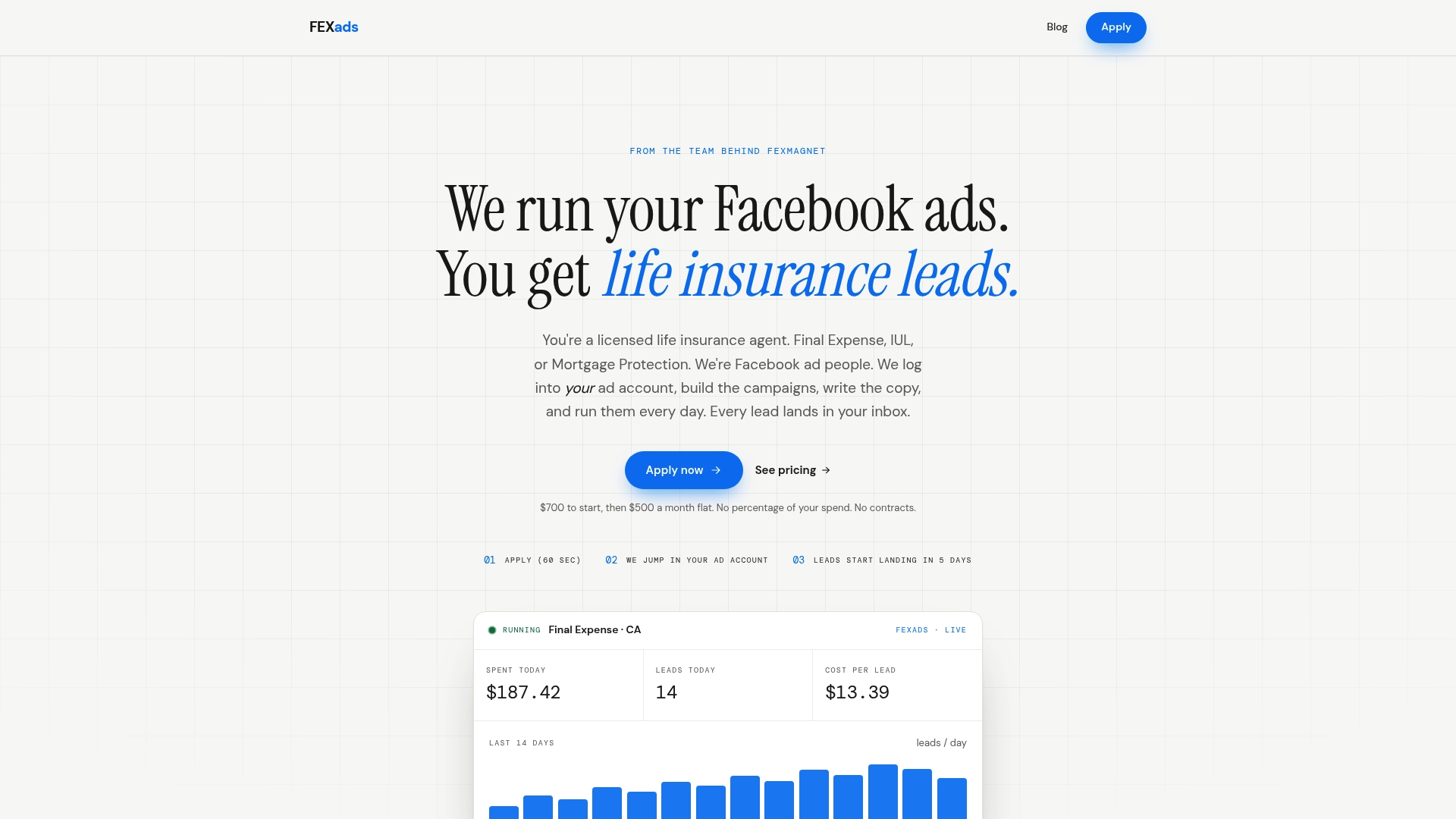
If you want a bottom-funnel campaign running with retargeting behind it, see how FexAds runs your Facebook ads. You can also compare options in our guide to lead generation channels for insurance agents or see what final expense Facebook ads cost and what they deliver.
FAQ
Is top of funnel or bottom of funnel more important?
Neither wins on its own, but bottom funnel pays first. Bottom-funnel ads reach people who are ready to act, so they produce leads and sales you can measure within weeks. Top-funnel ads feed the pipeline over time and make retargeting cheaper.
What is the middle of the funnel?
It is the consideration stage. The person knows they need coverage and is comparing options. On Facebook, it is usually retargeting: people who watched a video or visited your page see a follow-up that explains your offer and answers common questions.
Can an instant-form ad be a top-funnel ad?
Usually it works best at the bottom, because it asks for contact details. If you use a lead form with a cold audience, expect more low-intent leads. Our glossary entries on the lead form and lead form ad explain how they work.
How long before I know if a funnel works?
Expect a learning and optimization period before you judge it. One planning timeline puts the first 14 days as learning and proof closer to day 45 to 90. Judge it on placed policies and profit, not on early lead counts alone.
Sources
- What Is a Marketing Funnel: Stages & Targeting Strategies (Semrush)
- What is a marketing funnel? (Search Engine Land)
- Stages of the marketing funnel (HubSpot)
- Upper-Funnel vs. Lower-Funnel Marketing (MNTN)
- BOFU Content (G2)
- How to Generate Facebook Ads for Life Insurance (CrankWheel)
- Inside a Psychology-Charged Lead Funnel (LeadCapture.io)
- Life Insurance Marketing: Strategies for Agencies & Agents (Visme)
- Financial and Insurance Products and Services (Meta)
- Measure Digital Marketing Agency ROI without Last-Click (OM Agency)
- How to Measure Ad Leads Performance (Coupler.io)
- Insurance Lead Source Attribution Guide (Enroll Here)
- Insurance Ad Budget: Setting Expectations That Work (Precision Senior Marketing)
- How Do I Measure Which Marketing Spend Really Works? (Mavan)
- What $500K in Insurance Facebook Ads Actually Taught Us (The IDudes)
Recommended
Want us to run your FE ads?
Two plans from $300 setup. A flat monthly fee from $700 that starts at your first sale.
Apply now