Strategy
Insurance Video Scripts: 4 Templates Agents Can Film Today
By Nick Georgalos · 15 min read · Updated 2026-11-02
Insurance Video Scripts: 4 Templates Agents Can Film Today ! Insurance agent filming a short video script A good insurance video script does one job: it gets one type of prospect to take one next step.

A good insurance video script does one job: it gets one type of prospect to take one next step. That means one message, one recognizable moment in the first few seconds, plain language, a specific call to action, and a compliance check before anything goes live. Below you will find the structure, the rules to watch, and four scripts you can adapt for final expense and mortgage protection ads.
TL;DR
- Build every script around one message for one audience. Hook, short explanation, specific call to action.
- Open with a moment your prospect recognizes, then bring in the coverage as the answer.
- Replace “call us to learn more” with a concrete step, such as starting a short quote or booking a call.
- Testimonials, endorsements and carrier-approval rules apply to your video, so get the script reviewed before you film.
- Test scripts as paid Facebook ads in your own ad account, and let your cost per lead and show rate decide the winner.
Table of Contents
- What an insurance video script actually needs
- Hooks that stop the scroll
- How long should the video be?
- The call to action: be specific
- Four scripts you can adapt
- Tailor the script to the product and the person
- Compliance: what to check before you film
- Test your scripts like ads, not like speeches
- Common mistakes in insurance video scripts
- Promo: let someone else run the ads
- Perspective
- FAQ
- Sources
What an insurance video script actually needs
Most scripts that flop try to say everything. They explain term versus whole life, list three riders, and mention the agent’s license before the viewer has a reason to care. Guidance on writing life insurance commercials points the other way: one core promise, a relatable scenario, simple language and a short call to action, with the style matched to the audience.
That gives you five parts:
- Audience. Name who the video is for. A 62-year-old homeowner worried about funeral costs and a 38-year-old with a new mortgage need different words.
- Hook. The first line or two, spoken over a scene the viewer recognizes.
- Bridge. One or two sentences that introduce the coverage as the solution to the moment you just showed.
- Proof or detail. One concrete fact about how it works. Not five.
- Call to action. One step, stated plainly.
If a line does not serve one of those five jobs, cut it.
Hooks that stop the scroll
The strongest openings start with a recognizable moment, such as a parent tucking a child into bed or a couple planning for retirement, and only then introduce the product. The product is the answer, never the opening.
For agents running Facebook video, that translates into hooks like these:
- The kitchen-table moment. “My mom sat us down and said she didn’t want us paying for her funeral.”
- The mailbox moment. “If you have a mortgage and a family, there’s a letter in your mailbox you should read.”
- The question. “If something happened to you this year, who covers the mortgage?”
- The direct call-out. “Homeowners in Ohio between 50 and 75: this is for you.”
Keep the hook under about five seconds of speaking. On a phone, the viewer decides almost immediately whether the video is about them. If you want more tested opening lines for written ads, our pages on final expense ad hooks and creative and ready-to-paste life insurance ad copy cover the same ground in text form.
How long should the video be?

There is no single right length, and the sources disagree because they describe different media. Commercial-writing guidance describes 15 to 30 seconds as common for insurance spots. New York Life’s advertising guidance says direct-response television insurance ads commonly run 30 to 120 seconds. One explainer template uses a 90-second example and suggests staying under two minutes.
For a Facebook lead ad, a practical rule of thumb:
| Goal | Length to start with | Script focus |
|---|---|---|
| Cold prospecting video that sends people to an instant form | 20 to 40 seconds | Hook, one benefit, one step |
| Explainer that sends people to a quiz or booking page | 60 to 90 seconds | Hook, how it works, one step |
| Retargeting video to people who already engaged | 30 to 60 seconds | Answer one objection, one step |
These are starting points, not rules. Your own numbers will tell you more than any template, which is why the testing section below matters.
The call to action: be specific
The weakest ending in insurance video is “call us to learn more.” A better CTA names the action and its size. One explainer guide recommends specific steps such as getting a 3-minute quote or clicking the link to start an application over vague invitations.
Good CTAs for an agent running Facebook ads:
- “Tap the button and see what coverage fits your budget. It takes about a minute.”
- “Pick a time on my calendar below and we’ll walk through your options.”
- “Fill out the short form and I’ll text you back today.”
Match the CTA to the lead path behind the ad. If the viewer lands on an instant form, the script should say “tap the button.” If it lands on a booking page, say “pick a time.” A mismatch between what the video asks and what the page offers costs you leads you already paid for.
Four scripts you can adapt
These are original templates written for this article. Replace the bracketed parts with your state, carrier details and real facts. None of them name a price, a guaranteed approval or a benefit amount, because those claims need your carrier’s approved language.
Script 1: Final expense, 30 seconds
Audience: homeowners roughly 55 to 80.
[On camera, kitchen table] "When my grandmother passed, the family had to pass a hat around to cover the funeral. Nobody should leave that to their kids.
I’m [Name], a licensed agent in [State]. I help people your age set up final expense coverage so your family isn’t stuck with the bill.
Tap the button below, answer a few quick questions, and I’ll text you back with options that fit your budget."
Why it works: a real-feeling scene, one promise, one step. The story must be true if you present it as yours. If it is not, use a question hook instead.
Script 2: Mortgage protection, 30 to 45 seconds
Audience: homeowners 28 to 55 with a recent mortgage.
[On camera, front porch or home office] "If something happened to you this year, who pays the mortgage?
Most families I talk to have never worked that out. Mortgage protection is coverage designed so your family can keep the house.
I’m [Name], licensed in [State]. Pick a time on my calendar below and we’ll go through what fits your situation. It takes about fifteen minutes."
Why it works: the question puts the viewer in the scenario immediately, and the bridge defines the product in one sentence. For deeper creative angles on this product, see our mortgage protection Facebook ads playbook.
Script 3: 60-second explainer
Audience: prospects who have clicked before but have not booked.
Hook (0 to 5 s): “Confused about the difference between final expense and regular life insurance? You’re not alone.”
Explanation (5 to 40 s): “Final expense is a smaller whole life policy built to cover things like funeral costs and final bills. It’s usually easier to qualify for than a large policy, and the amount is meant to be manageable. [Confirm this wording with your carrier.]”
Detail (40 to 52 s): “The right amount depends on your state, your age, and your health answers. That’s why I ask a few quick questions first.”
CTA (52 to 60 s): “Tap below and pick a time. I’ll walk you through it, no pressure.”
The structure is the hook, explanation and CTA sequence that explainer guidance recommends, with plain language instead of jargon.
Script 4: Agent introduction, 20 seconds
This works as a pinned video or a retargeting spot.
“Hi, I’m [Name]. I’m a licensed agent in [State], and I help families with final expense and mortgage protection. If you filled out a form, I’m the person who’ll reach out, and I’ll text first so you know it’s me. Here’s what to expect…”
It sets expectations, which reduces ghosted calls. Pair it with fast follow-up: speed to lead is what turns a warm form fill into a conversation.
Tailor the script to the product and the person
The same words should not sell final expense, mortgage protection and Medicare. Sales-script guidance suggests starting from the customer’s needs and the product’s fit, then shaping the message around personas, demographics, pain points and the sales journey.
In practice:
- Final expense: family burden, dignity, not leaving a bill behind. Slower pace, larger on-screen text, a warm tone.
- Mortgage protection: the house, the kids, the what-if. A younger, more direct delivery.
- Medicare: federal marketing rules are strict and differ from life insurance, so have your carrier or compliance contact approve any Medicare script before it runs.
Tone matters as much as the words. Teams that write for general audiences end up with copy that reads like a brochure. Teams that write for one person end up with a script that sounds like a neighbor.
Compliance: what to check before you film
Insurance advertising is regulated at the state level, and carriers have their own approval processes. This section is not legal advice; your carrier’s compliance department and your state’s rules have the final word. Here is what to know going in.
Carrier approval. The NAIC model regulation on life insurance advertising says insurers must control their advertisements and notify agents of prior-approval procedures for ads not furnished by the insurer. If your carrier has not given you the ad, ask how to get yours approved.
Required disclosures. New York Life’s guidance for direct-response ads lists items such as the company name, a brief product description, and an end tag with the company name and address, limitations disclosure, state availability language and form number. Those are one carrier’s requirements, so use them as a prompt to ask yours what it needs, and write the end tag into the script instead of bolting it on later.
Testimonials. Under the same NAIC model, testimonials must be genuine, reflect the speaker’s current opinion, apply to the policy and be accurately reproduced, and a financial interest or benefit must be disclosed. If a client says something on camera, get it in writing and keep it exact.
Endorsements and typical results. The FTC says that endorsements must reflect typical consumer experience unless the ad clearly says otherwise, and unexpected connections must be disclosed. Do not build a script around your single best case.
The platform. Facebook has its own financial services ad rules on top of all of this. Every ad we run is checked against Meta’s financial services rules before it goes live.
A short checklist before filming:
- Does every claim have approved carrier language behind it?
- Are there no guarantees of approval, price or benefit that you cannot document?
- Is the end tag or disclosure written into the script, with time on screen to read it?
- Is every testimonial real, current and written down?
- Has someone other than you read the script for state-specific issues?
Test your scripts like ads, not like speeches
A script is a hypothesis. The market scores it. Agents who film one video and wait for it to work usually conclude video does not work.
A simple testing routine:
- Film two or three hooks over the same body and CTA. Changing the hook alone shows you what stops the scroll.
- Run them as ads with enough budget to get a readable result. For context, final expense clients of ours typically pay $9 to $28 per lead, and you can estimate your own range with the cost per lead calculator.
- Judge by cost per lead first, then by what happens after: contact rate, appointments held, sales. A cheap lead that never picks up is not a win.
- Watch frequency. When it climbs and results slide, the audience has seen the script too many times. Swap the hook before you rewrite everything.
- Use retargeting for the follow-up video that answers the objection people raised.
Search visibility is a separate project. If you also post your videos on your own site or a channel, optimizing videos for search is a topic worth reading separately from ad performance. And if you manage materials across many agents or locations, insurance marketing tools that support regional execution and approvals show how larger organizations handle the same compliance problem.
For more variety once your first scripts are running, see 12 life insurance ad creatives agents can use in two weeks and our playbook for getting 50 conversions from life insurance Facebook ads.
Common mistakes in insurance video scripts
- Opening with credentials. “I’m a licensed agent with 15 years of experience” is a fine second sentence. It is a poor first one.
- Explaining the product before showing the problem. People do not care how a policy works until they care why they need it.
- Insurance vocabulary. Words like rider, underwriting and face value lose most viewers. Say what it does for the family.
- Too many calls to action. “Call, visit my site, follow my page, and fill out the form” gives a viewer four ways to do nothing.
- Scripted delivery. A script is a guide. Read it aloud five times and cut every sentence you would never say to a neighbor.
Promo: let someone else run the ads
Writing the script is half the job. The other half is the account, the audience, the tracking and the daily optimization. We set up and run Facebook ads for licensed final expense, mortgage protection and Medicare agents, inside your own Meta ad account. You keep the ad account, pixel, website and every lead.
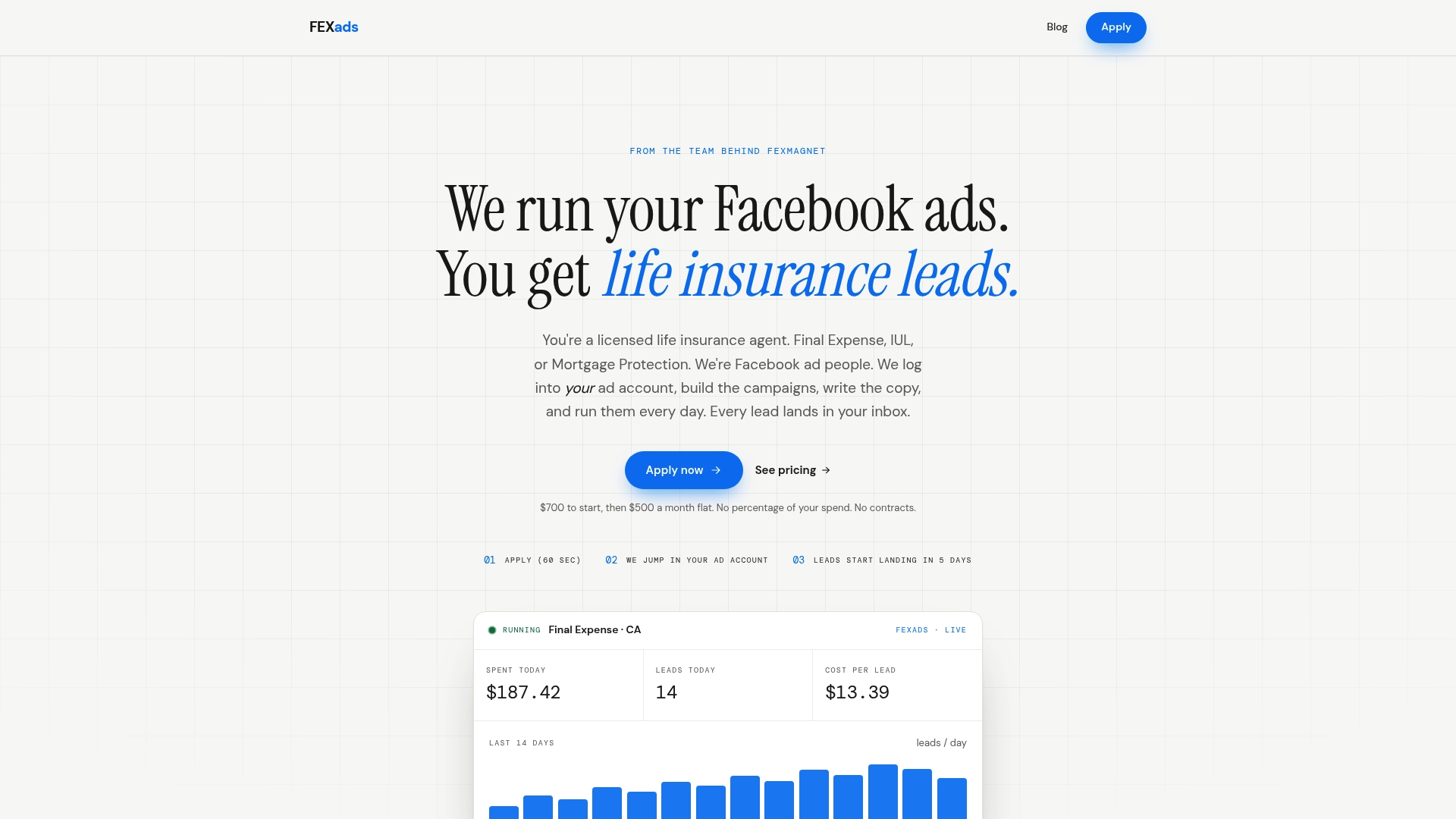
There are two plans. Standard is a $200 setup, then $500 a month starting at your first sale, and includes instant-form ads and a simple website. Funnel is a $1,000 setup, then $750 a month from your first sale, and adds a quiz funnel site where every lead is verified by a text code and landlines are screened out. Ad spend is separate, with a $50 a day minimum paid to Meta on your card. Our best fit is agents selling $5K or more a month in AP. See how it works at FexAds or read how Facebook ads work for insurance agents.
Perspective
Most agents come to us after buying rented leads that were sold to four other people. The same lesson applies to video: if everyone is reading the same generic script, you sound like everyone else.
What works is a script that sounds like you, aimed at one kind of person, running in an ad account that you own. When the ad is yours and the lead is yours, you can learn from every view and every form fill, and you can keep what you learn.
That is why we build everything inside the agent’s own Meta account, check each ad against Meta’s financial services rules before it runs, and show nightly spend, leads, cost per lead, sales and profit in the FEXmagnet portal. If a script is not working, you will see it in the numbers, and you can text me about it.
Nick
FAQ
How long should an insurance video script be?
For a Facebook ad, start with 20 to 40 seconds for a lead-form video and 60 to 90 seconds for an explainer. At about 140 to 160 spoken words per minute, that is roughly 50 to 100 words for the short version. Test lengths against each other and keep the one with the best cost per lead and contact rate.
Do I need my carrier to approve my video script?
Often, yes. The NAIC model regulation says insurers control their ads and must tell agents about prior-approval procedures for ads they did not supply. Rules vary by state and carrier, so ask your carrier’s compliance team before you film, not after.
What call to action works best for a life insurance video ad?
One that names a specific, small step: tap the button and answer a few questions, or pick a time on the calendar below. Vague endings such as “call us to learn more” give the viewer no reason to act now. Make the CTA match the form or booking page the ad leads to.
Can I use a client testimonial in my script?
Only if it is genuine, current, accurately reproduced and applies to the policy, and any financial interest or benefit is disclosed. Get the statement in writing and have your carrier or compliance contact review it. Avoid presenting one exceptional result as typical.
Sources
- Quick Read: How to Make a Life Insurance Commercial
- New York Life advertising style guidance (PDF)
- Insurance Explainer Video Script Template
- NAIC Advertisements of Life Insurance and Annuities Model Regulation
- FTC: Advertising and Marketing on the Internet
- How to Optimize Videos for SEO
- Insurance Marketing Tools That Support Regional Execution and Compliance
Recommended
Want us to run your FE ads?
Two plans from $300 setup. A flat monthly fee from $700 that starts at your first sale.
Apply now