Strategy
Life Insurance Ad Offers That Get Agents Real Leads
By Nick Georgalos · 15 min read · Updated 2026-11-18
Life Insurance Ad Offers That Get Agents Real Leads ! Agent comparing two life insurance ad offers The offer is the part of a life insurance ad that decides whether a stranger on Facebook taps the button.

The offer is the part of a life insurance ad that decides whether a stranger on Facebook taps the button. It is the specific thing you promise in return for a name and a phone number: a quote, a rate check, a coverage estimate, a callback. The best offers are small, concrete and tied to one product and one type of buyer. They also run in an ad account you own, so the leads they produce belong to you and nobody else.
This guide covers the offers agents actually run for final expense, mortgage protection and IUL, how to match each offer to an ad format, what Meta and the TCPA mean for your wording, and how to tell within a few weeks whether an offer is paying for itself.
TL;DR
- A strong offer is specific, low-commitment and matched to one product: “see what $10,000 of final expense coverage costs at your age” beats “get life insurance.”
- Pick the format after the offer: instant forms for speed, a quiz or landing page when you want verified, higher-intent leads.
- Keep health, income and policy questions out of the lead form itself. Meta restricts sensitive questions in lead ads, so qualify on the call.
- Judge an offer by cost per sale and profit, not cost per lead alone. Final expense leads on our accounts typically cost $9 to $28 each.
- Run offers in your own ad account so the pixel data, the site and every lead stay with you.
Table of Contents
- What counts as an offer in a life insurance ad
- Offers that work for each product
- Make the offer small, and say what happens next
- Pick the format after you pick the offer
- Wording rules that keep offers running
- How to tell whether an offer is working
- Why the account matters as much as the offer
- What it costs to have us run your offers
- FAQ
- Sources
What counts as an offer in a life insurance ad
Most agents treat the ad as the creative: the photo, the headline, the video. The offer sits underneath all of it. Two ads can look identical and perform very differently because one asks the prospect to “learn more” and the other asks them to “find out in 60 seconds what $15,000 of burial coverage costs for a 68-year-old.”
An offer has four parts:
- The deliverable. What the person gets: a rate, a quote, a comparison, a review of what they already have.
- The audience. Who it is for: adults 50 to 80 thinking about funeral costs, new homeowners, parents with a mortgage.
- The effort. How little it takes: a short form, a one-tap booking, a call within minutes.
- The next step. What happens right after: a text from you, a call, a calendar slot.
If any of the four is vague, the prospect fills the gap with suspicion. People scrolling Facebook have seen a lot of “free quote” ads, and a quote with no detail reads like a lead-selling funnel.
Offers that work for each product
What follows are patterns, not guarantees. Which one wins depends on your state, your audience and your follow-up speed, which is why you test them.
Final expense
Final expense buyers are usually older, price-sensitive and wary of being sold. The offers that fit them reduce pressure and talk about the specific cost they are worried about.
- Coverage-amount price check. “See what $10,000 of burial coverage costs at your age.” The number does the work.
- No-exam or simplified-issue eligibility. “Find out if you qualify without a medical exam.” Say this only for products you actually write, and state the age range and health condition in plain terms.
- Guaranteed-issue option. For prospects with health problems, an offer built around coverage with no health questions gives them a reason to respond. Our final expense and life insurance ad copy templates show how agents word it.
- Cover-your-family’s-costs guide. A short checklist of what a funeral can cost and what families wish they had arranged. It works as a softer first step for people who are not ready to talk to an agent.
Mortgage protection
Mortgage protection prospects are recent or current homeowners, so the trigger is the house, not their own death.
- “What happens to the house?” review. A short check of what the family would owe if the main earner were gone.
- Rate check by loan size. “See what it costs to protect a $250,000 mortgage.” Tie the number to a loan amount people recognize.
- Coverage gap review. Many homeowners assume the policy through work covers the mortgage. An offer to compare the two gives them a reason to book a call.
For costs and sourcing on this vertical, see our page on mortgage protection leads.
IUL and living-benefits products
IUL buyers tend to be younger, working and more financially literate. They respond to education before a quote.
- A plain-language explainer or calculator. “See how much tax-free retirement income a policy could target.” Keep the wording within what the illustration actually shows.
- A policy review. “Check whether your current policy still fits your goals.”
- A short video from you. Two minutes on how the product works builds trust before the call.
A quick comparison
| Offer type | Best for | Prospect effort | Typical next step |
|---|---|---|---|
| Coverage-amount price check | Final expense | Very low | Text, then call |
| No-exam eligibility check | Final expense, health-conscious buyers | Low | Call |
| Mortgage coverage gap review | Mortgage protection | Low to medium | Booked call |
| Calculator or quiz | IUL, mortgage protection | Medium | Verified lead, then call |
| Agent explainer video | IUL, any vertical | Low (watch) | Retargeting, then form |
Make the offer small, and say what happens next
The consistent pattern in agent-facing guidance is to lower perceived commitment. A free quote, a check that takes a minute, a callback at a time the person picks: each asks for less than “talk to an agent.” One widely shared video framework suggests opening with a real cost or a sudden life event, naming the problem in plain language, and closing with a low-friction action such as checking a rate in sixty seconds, rather than asking viewers to buy (as summarized here).
Two habits make these offers hold up:
- Put the exact conditions next to any number. If you quote a monthly price, state the age and health status it assumes. A number without conditions invites a bad call and a complaint.
- Say what happens after the tap. “You’ll get a text from me within a few minutes” sets the expectation, and it only works if you actually follow up that fast. Speed matters more than most agents admit, and our note on landing page speed shows what slow pages cost you before the prospect even sees the offer.
Fear-heavy angles deserve caution too. They tend to get rejected or limited by ad platforms, and they also attract people who are anxious rather than ready to buy.
Pick the format after you pick the offer
The same offer behaves differently depending on where the prospect lands.
Instant forms. Facebook’s lead ads open a form inside the app, pre-filled with the person’s profile details, so there is almost no friction. Ethos’s agent guide describes Meta lead ads and instant forms alongside static and video creative, and separates awareness campaigns, which educate and widen reach, from direct-response campaigns, which aim to generate leads from more educated users. Instant forms fit offers with a simple promise, like a price check. For a deeper look, see our glossary entry on the lead form and the lead form ad.
Quiz or landing page. A short quiz asks the prospect a few easy questions (age range, coverage goal, tobacco use is the sort of thing agents ask on the call, not in a Meta form) and ends with a phone verification. The extra step filters out casual taps and bad numbers. It suits offers where the prospect needs to feel the result is personal, like a mortgage gap review or an IUL calculator.
Booked calls and inbound calls. For higher-ticket products, an offer that ends in a calendar slot or a call button skips the callback chase altogether.
Retargeting. Most people do not convert the first time. Showing a follow-up ad to people who watched your video or opened a form but did not finish keeps the offer in front of them. Our glossary explains retargeting in plain terms, and the video scripts we publish give you something to film for that audience.
For a wider view of what each ad type produces, read Facebook life insurance leads: a 2026 agent guide and the ad creatives you can build in two weeks.
Wording rules that keep offers running
An offer that gets your ad rejected, or your account restricted, costs more than a weak offer.
Platform rules
Meta treats insurance as a sensitive financial category, and its lead-form rules limit what you can ask. Ethos’s guide warns that lead-ad questions cannot request certain sensitive information without written permission, including financial, health and insurance details. In practice, that means a form that asks about medical conditions or current coverage is a risk. Ask for a name, a phone number and a best time to call, and cover the rest on the phone.
Avoid wording that implies you know something personal about the viewer, such as their health or finances. “Are you over 50?” is a risky headline. “Burial coverage for adults 50 to 85” describes the product without pointing at the person.

Calling and texting rules
A lead is permission to contact, but only for what the person agreed to. If your offer promises a text, text. If it promises a call, make sure your follow-up respects the federal Do Not Call and TCPA rules. Our Do Not Call compliance steps walk through what to put in place before you dial. Rules around consent and AI-generated voices have changed in recent years, so check current guidance with your compliance contact or attorney before you build automated calling around any offer.
Your state and carrier
Your state’s insurance department and your carrier’s marketing guidelines may require disclosures or pre-approval of ad copy. Run the final wording past your carrier’s compliance team before it goes live. Every ad we run for clients is checked against Meta’s financial services rules before it launches.
How to tell whether an offer is working
An offer is not good because it is cheap per lead. It is good because it produces sales at a cost you can live with.
Track these in order:
- Cost per lead. Online life insurance leads can range widely. Ethos’s guide puts them at $10 to $150 depending on quality and source. On final expense, our clients typically pay $9 to $28 per lead.
- Contact rate. How many leads pick up. Bad phone numbers and landlines drag this down.
- Appointments and applications. Where the offer starts to prove itself.
- Cost per sale and profit. The only numbers that settle a debate between two offers.
Return on ad spend is simple: divide the revenue from a channel by what you spent on it, as the same guide notes. Use annual premium (AP) as your revenue figure and your own commission as the real return.
A worked example. Say you spend $1,500 in a month and get 75 leads at $20 each. If 30 answer, 10 book, and 4 write a policy averaging $900 in annual premium, your AP is $3,600. Compare that against the $1,500 spend, then against the second offer you ran next to it. If the “no-exam eligibility check” gave 60 leads at $25 and 6 sales, it costs more per lead and still wins. That is why cost per lead alone misleads.
Test one change at a time: the offer, then the creative, then the format. Broader audiences can lower lead cost but may lower lead quality, so compare offers on the same audience. Our cost per lead benchmarks and the costs by vertical give you ranges to check against. If you want to build the habit of reading results beyond the ad platform, this piece on using content for lead generation is a good companion for thinking about what to measure.
Why the account matters as much as the offer
Two agents can run the same offer and end up in very different places. If the offer runs in a vendor’s account, your leads may be shared or resold, and the pixel data that teaches Facebook who your buyers are stays with the vendor. An exclusive lead goes to one buyer; a shared lead is often sold to several, and the first caller tends to win. When the ad runs in your own Meta account, the data from every offer you test accumulates in an asset you keep. Each test makes the next one cheaper to run, because the pixel learns from your results.
Our view on offers
Agents ask us which offer is best, and the honest answer is the one you can follow up on in minutes. A great offer with a slow callback loses to an average offer with a text that lands in seconds.
We build every campaign around one product, one audience and one clear promise, and we run it in your Meta account so the account, the pixel, the website and every lead are yours. Nothing is shared or resold. We check each ad against Meta’s financial services rules before it runs, and you see spend, leads, cost per lead, sales and profit every night in the FEXmagnet portal.
We also think the fee should follow your results. That is why our monthly fee starts only after your first sale, and why you can text me directly when a number looks off.
Nick
What it costs to have us run your offers
We set up and run Facebook ads for licensed final expense, mortgage protection and Medicare agents. There are two plans:
- Standard: a $200 setup, then $500 a month starting at your first sale. It includes instant-form ads and a simple website.
- Funnel: a $1,000 setup, then $750 a month from your first sale. It adds a quiz funnel site where every lead is verified by a text code and landlines are screened out.
Ad spend is separate: $50 a day minimum, paid to Meta on your card. The best fit is an agent selling $5K or more a month in AP. Leads reach you by text, email or CRM within seconds, as instant-form leads, booked calls or inbound calls.
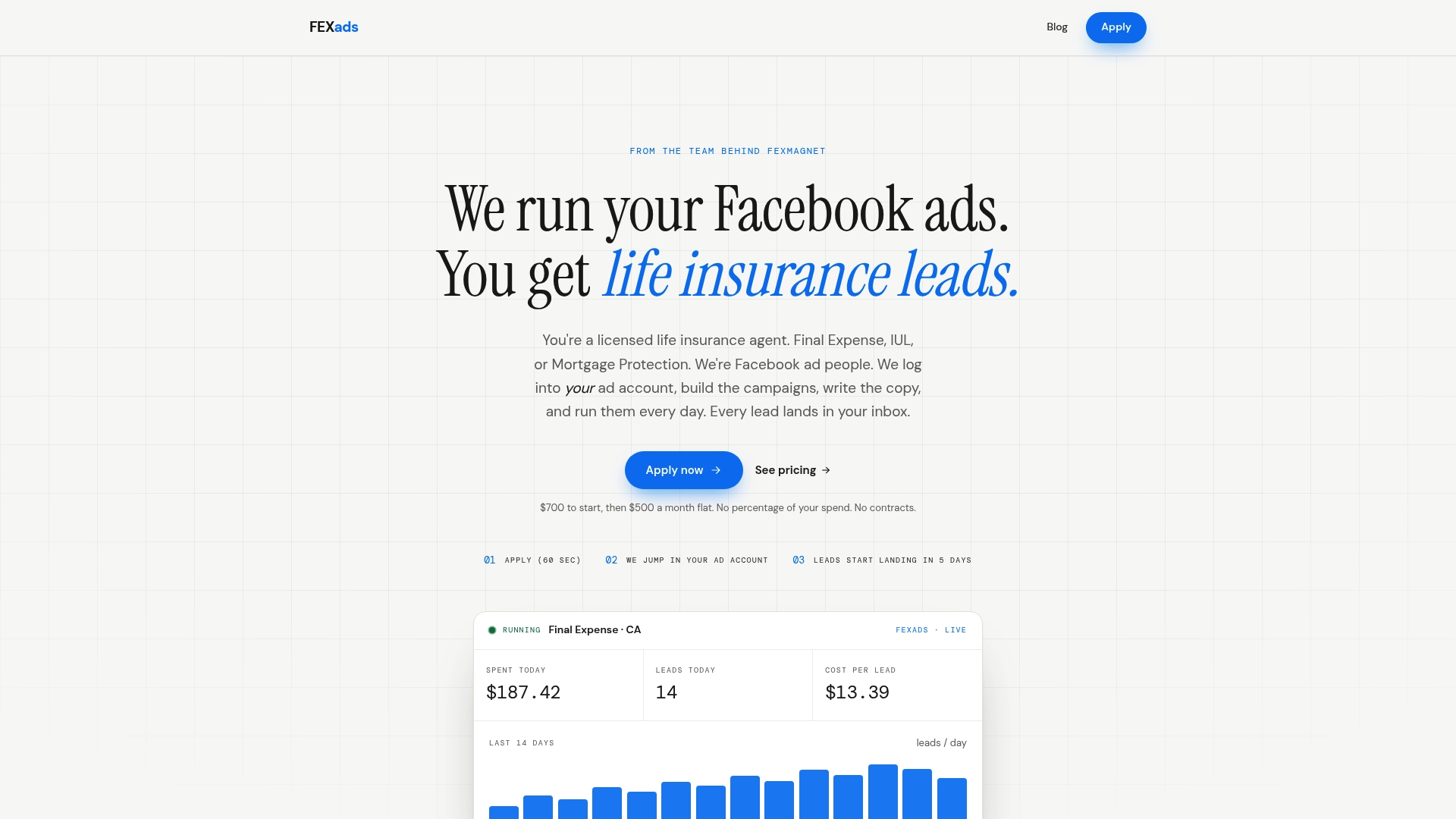
If you want your next offer tested in your own account, see how FexAds works or compare the approach in our guide to Facebook ads for insurance agents.
FAQ
What is the best offer for a final expense ad?
A coverage-amount price check works well because it answers the question the buyer already has: what will this cost me. Pair it with the age range and a clear statement of what happens next. Test it against a no-exam eligibility check, since the better offer depends on your audience and follow-up speed.
Should I offer a free quote or something else?
“Free quote” is common enough that it blends in. A specific deliverable, such as a rate for a named coverage amount or a review of a mortgage gap, gives the prospect a reason to respond that a generic quote does not. Keep the promise small so the form stays short.
Can I ask about health conditions in a Facebook lead form?
It is risky. Meta limits sensitive questions in lead ads, including health and insurance details, unless you have permission. Keep the form to contact details and a time to call, and ask the health questions on the phone, where you also need them for underwriting.
How many offers should I run at once?
Start with two on the same audience so the comparison is fair, and give each enough budget to produce a useful number of leads. Judge them on cost per sale after a few weeks, then replace the loser with a new challenger.
How do I keep leads exclusive?
Run your ads in your own Meta ad account, send leads to your own form, site or calendar, and keep the pixel in your account. When no vendor sits between the ad and your phone, nobody else receives the lead.
Sources
- Building a Facebook Lead Generation Campaign (Ethos agent guide)
- Life Insurance Ad Copywriting: Video Scripts and Hooks
Recommended
Want us to run your FE ads?
Two plans from $300 setup. A flat monthly fee from $700 that starts at your first sale.
Apply now